
Once upon a time there was a sickly child who, for long periods, was unable, or forbidden. to leave the house, confined instead to his bed. From his window he looked out, with a touch of melancholy, at a city that would later be romanticized but at the time offered mostly gray skies, dampness, and cold: Edinburgh, Scotland.
Let us briefly jump to the end of the story, and please forgive the spoiler: That child never recovered. He died of a stroke more than 15,000 kilometers from his birthplace, among the local inhabitants of one of the Samoan islands, at the relatively young age of forty-four.
Does that mean he lived a tragic life? Not necessarily.

Robert Louis Stevenson was born to Margaret Balfour and Thomas Stevenson, a respected and prosperous lighthouse engineer. Both were devout Christians who raised their children in a strict but loving household. Stevenson’s fragile health and long stretches spent indoors did nothing to suppress his vivid imagination or his deep curiosity about the world and the people around him.
From a very early age, he invented stories and told them to anyone willing to listen. He only learned to read independently at the age of seven, due, by his own admission, to sheer laziness. Until then, he filled his days drawing images shaped far more by his inner world than by external reality.
“Mamma,” he is supposed to have once said, “I have drawn a man. Shall I draw his soul now?”
Even as a child, Stevenson understood something many people never fully grasp: that the most precious thing in life is human connection — the people that surround us and our relationships with them. In his memoirs, he recalled that while he lay ill, the greatest gift he ever received, one that moved him to tears and remained dear to him for his entire life, was the long, thoughtful letters his cousin wrote to him.

His father dreamed not only of restoring his health but also of setting him on a solid professional path. He hoped his son would study engineering and follow in his footsteps. But Stevenson, even on his best days, was ill-suited to the discipline of engineering. After an unsuccessful attempt, father and son reached a compromise: he would study law instead. Although Stevenson completed his legal studies, he never practiced. His first appearance in a courtroom, likely as part of his training, was also his last.
What he did do, whether lying in bed, sitting on a tree stump in the yard, or hunched over a desk, was write: poems, essays, and, above all, stories, which gradually began to appear in the newspapers of the day. As he grew older, he embraced the one piece of medical advice that truly improved his life and brought him joy: to seek climates more favorable to his fragile lungs.

And so he began to travel, first through Europe, then to America. One journey through France, undertaken with a stubborn donkey named Modestine, produced two lasting results. The first was Travels with a Donkey in the Cévennes, one of Stevenson’s earliest books, revealing him as a gentle, humorous, and deeply humane narrator. The second was a meeting, in a friend’s home, with an American woman named Fanny Osbourne.
Their love story was woven from the fabric of a great novel. Socially, they were mismatched in every way: he was a sensitive, sickly Scottish bachelor still financially dependent on his father; she was a married American artist escaping an unhappy marriage, outspoken by the standards of the time, eleven years his senior, and a mother.
Despite everything, they fell deeply in love. When she returned to America in an attempt to repair her marriage, Stevenson followed her.
They married after her divorce in 1880, and from then on Fanny and her children accompanied him on his travels around the world. Officially, they were searching for better air for his lungs, but in truth, Stevenson was simply hungry to see life in all its fullness.
After the marriage, Stevenson formed a close bond with Fanny’s son, Lloyd Osbourne. He became a father figure to the boy, who called him “Papa,” and Lloyd returned his affection with devoted admiration. From this relationship emerged one of the most widely read adventure novels ever written: Treasure Island. Family memoirs recount an evening when Stevenson found young Lloyd coloring a map of an imaginary island he had drawn. Stevenson leaned over his shoulder, picked up a pencil, and began adding names: “Skeleton Island”, “Spyglass Hill” and “Cape of the Woods”. Then he drew three red crosses and declared, “Here is where the pirates buried their treasure.” The map was titled Treasure Island, and became the seed of a story Stevenson initially wrote for his own family.

One rainy evening, a friend who had heard Stevenson reading a chapter of the story aloud in his living room suggested submitting it to the London children’s magazine Young Folks. The ending had not yet been written, yet the editor agreed to publish the story in serialized form.
It appeared under the title The Sea-Cook, A Story for Boys by Captain George North, an attempt to create the impression that this was a true account written by a real sailor. The gambit failed. Whether because the installments were buried near the back pages, printed in small type and without illustrations, or because young readers simply were not ready for the story, is hard to say. In any case, the editor later complained that it failed to increase magazine sales and one young reader even wrote to complain that he “did not like the new story.”
Stevenson was unfazed. He believed in the story and insisted on publishing it as a book. The publishing house Cassell and Company agreed, offering him an author’s fee of £500. This time the story appeared under the title taken from the map itself: Treasure Island. Along with the manuscript, Stevenson sent Lloyd Osbourne’s original hand-colored map, covered with his own annotations, so that it could be reproduced at the beginning of the book. When a proof copy was returned to Stevenson for review, however, Lloyd’s map was missing. It had been lost in transit. Furious, Stevenson was forced to redraw the map himself and then adjust parts of the text to match it. This hastily reconstructed map, created in anger at the publisher’s carelessness, is the one most familiar to readers today and appears in many editions of the book.

Published in 1883, the book was an immediate and overwhelming success. The English edition included a dedication acknowledging Lloyd’s role in its creation:
“To Lloyd Osbourne, an American gentleman, in accordance with whose classic taste this narrative has been designed. It is now affectionately inscribed by his friend, the author.”
This time, Treasure Island was embraced enthusiastically by children, adolescents, and adults alike, first in Britain, then across the globe. Nearly 150 years later, it is still considered one of the finest adventure novels ever written. Hundreds of adaptations have followed, and countless fictional pirates in literature, theater, and film trace their lineage back to the characters and imagery Stevenson created.
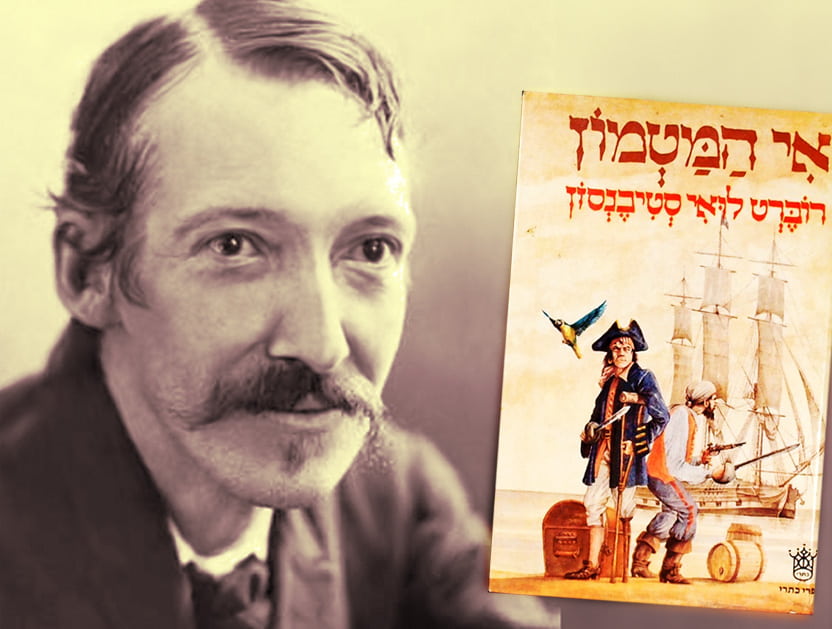
In Israel, a Hebrew translation by Israel Fishman appeared in the 1920s, published by Kefet HaSefer, a press known for producing small booklet editions of world classics. Digital copies of this edition are available on the National Library of Israel website. A more substantial print run followed in the 1940s, published by Yehoshua Tchatchik. The Library’s copy of this later edition, now somewhat fragile, bears a dedication from the publisher himself to the “National Library”.
Since then, the book has been retranslated many times and reprinted repeatedly, with edition after edition selling quickly throughout the past century.
Following the publication of Treasure Island, Stevenson, by then extending his travels deep into the Pacific, became a literary legend.
He continued to write prolifically, publishing additional works, many of them travel narratives. Fanny remained the first reader of most of his manuscripts and was never hesitant to offer strong opinions. After hearing her criticism, Stevenson burned the first draft of his next book, The Strange Case of Dr. Jekyll and Mr. Hyde, and rewrote it entirely at remarkable speed. Accounts differ as to whether this took a matter of days or several weeks, but either way, it was an extraordinarily short time in which to produce a novel.
In the book, Stevenson explored, long before Freud’s theories gained acceptance, the idea of the “other self”, or alter-ego: the constant inner struggle between the wild, almost animal impulses present in every human being and the internal effort to repress them and present a single, morally acceptable identity. Drawing inspiration in part from contemporary horror fiction, the novel relocated terror from the external world to the inner psyche. It became a timeless classic and is widely regarded as one of the foundational works of the psychological thriller.

In 1889, the Stevenson–Osbourne family settled in Samoa, in the South Pacific. Stevenson, by then famous worldwide, became deeply admired by the local population, who called him Tusitala, the teller of tales. Despite vast cultural differences, the islanders respected the pale, chronically ill writer who treated them with none of the condescension common among other Europeans.
One local legend recounts how a young island girl once complained to Stevenson that her birthday fell on Christmas Day, when no one remembered to celebrate her. Stevenson pulled a scrap of paper from his pocket and drafted a formal “bill of sale,” declaring that he had sold her his own birthday, November 13.
In the end, however, his body gave out before his spirit. In 1894, at just 44 years old, Robert Louis Stevenson died in his home on the small tropical island.
On his grave in Samoa, set in a green clearing overlooking the sea, a long poem is engraved. One line reads:
“Glad did I live, and gladly die.”


