
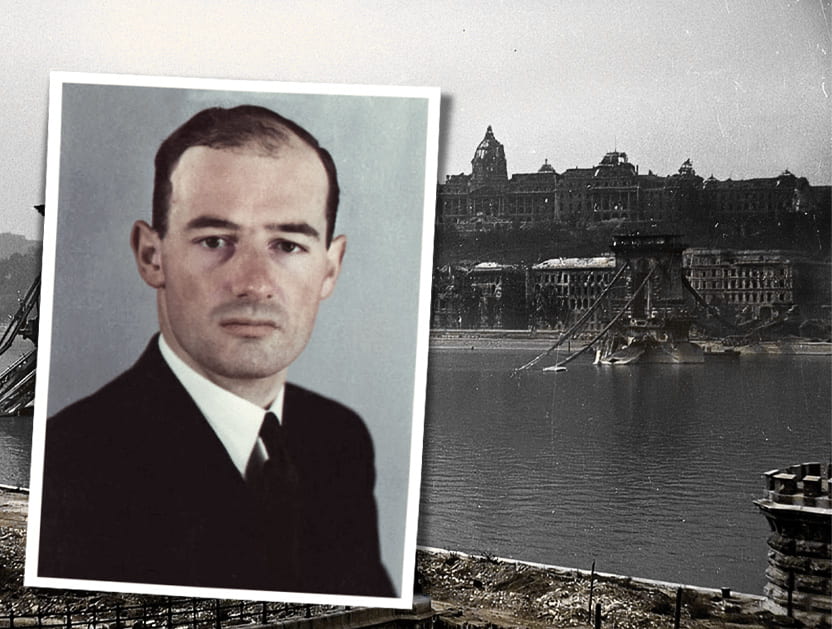
Ari Kaplan, a mathematician, and Marvin Makinen, a scientist, visited Vilnius this past November. The two Americans have been collaborating on a project for about three decades and, at the request of a Lithuanian think tank, traveled from their homes in Chicago to share their research.
Their work concerns the fate of Raoul Wallenberg, a legendary rescuer of Jews during World War II.
Wallenberg, a Swedish diplomat based in Budapest, entered a Soviet military vehicle in the Hungarian capital on January 17, 1945, following the Red Army’s ejection of German troops. He didn’t know whether he was being driven to a meeting with a Soviet official or placed under arrest.
He was never seen in public or heard from again.
The passage of 81 years has not dimmed Wallenberg’s star or people’s interest in his fate.

Kaplan and Makinen visited a Russian prison on eight occasions to examine incarceration records. They’ve since compiled prisoners’ documented sightings of Wallenberg there in the decades following his 1945 arrest and plotted those sightings on a computer diagram of the prison cells. The men hope eventually to determine when and where Wallenberg died and the location of his remains.
A side benefit is that their research includes others imprisoned with Wallenberg and might enable the Lithuanian experts to learn “what happened to some of their national heroes,” information “they didn’t have before,” Kaplan said in a phone interview.
Wallenberg was a businessman from a prominent family who was sent to the United States to study and graduated the University of Michigan in 1935 with a degree in architecture. When the Roosevelt administration formed the War Refugee Board in 1944, Wallenberg, a Christian, was appointed to the task of rescuing Jews from German-occupied Hungary. Based at the Swedish embassy in Budapest as a first secretary, Wallenberg devised a plan: He’d issue each Jewish applicant an official document, known as a schutzpass, attesting to the person’s being a Swedish citizen who was en route to Sweden.
Wallenberg issued nearly 8,000 such documents. Thousands more Hungarian Jews received diplomatic protection in the 32 buildings the Swedish embassy bought or rented in the city. He is credited with also preventing the Germans from massacring tens of thousands of Jews in a Budapest ghetto. Fluent in German, Hungarian and English, Wallenberg negotiated with and bribed key Nazi officials, including Adolf Eichmann, who was responsible for deporting Hungary’s Jews to Auschwitz.
And then, just six months after arriving in Budapest, Wallenberg was gone.

The U.S. Congress in October 1981 bestowed honorary citizenship upon Wallenberg, who it said exhibited “extraordinary courage and with total disregard for the constant danger to himself, saved the lives of almost one hundred thousand innocent men, women and children” during the Holocaust.
The legislation also called on the U.S. president — at the time, Ronald Reagan — to pressure the Soviet Union for information on his disappearance and to secure his freedom.
The move was initiated by Tom Lantos, a Jewish congressman in the House of Representatives and a native of Hungary whose wife Annette as a teenager in Budapest was rescued by Wallenberg.
Canada in 1985 also made Wallenberg an honorary citizen, as did Israel in 1987.
But in hiding or destroying Wallenberg’s records and providing misleading if not deceptive information, the Soviet Union and later the Russian government have consistently stonewalled politicians’ and researchers’ efforts to determine what became of Wallenberg.
“His unsolved disappearance,” University of Nebraska history professor Michael Dick wrote in one chapter of a 2019 book, Unlikely Heroes: The Place of Holocaust Rescuers in Research and Teaching, “makes a martyr of Wallenberg at the hands of the Soviet Union.”


Wallenberg’s mother and stepfather — his father died before Wallenberg was born —committed suicide in 1979, having despaired over not learning his fate.
But Wallenberg is hardly forgotten.

Twin statues of him stand in Budapest and on Wallenberg Street in Tel Aviv’s Ramat Hachayal neighborhood. A plaque on the façade of a building in Haifa notes that Wallenberg worked there for the Holland Bank in 1936. In Washington, D.C., the street in front of the U.S. Holocaust Memorial Museum is named for him. Approximately two kilometers away, a bust of Wallenberg resides in the U.S. Capitol for all to see.
Memorials worldwide to Wallenberg mean that he “has become one of the most widely known representatives of rescuers of Jews during the Holocaust,” reads a page on the Web site of Yad Vashem, which in 1963 bestowed upon him the honorific of Righteous Among the Nations. (As of December 2025, 28,707 rescuers have been so honored.)
And a documentary on him, Raoul Wallenberg: Missing Inaction, is being released this month.
“Sadly, few of today’s generation know of Wallenberg. We very much want our film to inspire a diverse audience of all ages across the globe with [his] life, heroism and sacrifice,” said Alex Ruthizer, the Los Angeles-based producer of the documentary.

In Vilnius, the American researchers’ sharing of their findings — covering 900 photocopied records and nearly 8,050 prisoners’ digital database entries from Moscow’s Vladimir Prison over a 26-year period — has “significantly increased public awareness” of Wallenberg, while shedding light on Soviet repression of Lithuanian political figures, said Arūnas Bubnys, director general of the Genocide and Resistance Research Centre of Lithuania, the recipient organization.
“The preservation and sharing of unique datasets is not merely an academic act, but a form of safeguarding historical truth itself,” he said.
Irwin Cotler, who chairs the Montreal-based Raoul Wallenberg Centre for Human Rights, plans to publish a Wallenberg-themed op-ed on the January 17th anniversary, as he does most years.
Wallenberg “demonstrated how one person with the compassion to care and the courage to act can prevail over evil,” said Cotler, a scholar of international law who in the early 2000s served as Canada’s minister of justice and attorney general.
Cotler mentioned the previous week’s massacre of 15 Jewish Australians at a Chanukah celebration in Sydney, tying Wallenberg’s legacy to it.
“The question of combating antisemitism is not an option. It’s a domestic and international legal responsibility and imperative,” Cotler said.
Wallenberg, he added, remains “a lodestar for combating evil in our time.”
Writer-editor Hillel Kuttler can be reached at hk@HillelTheScribeCommunications.com.


