
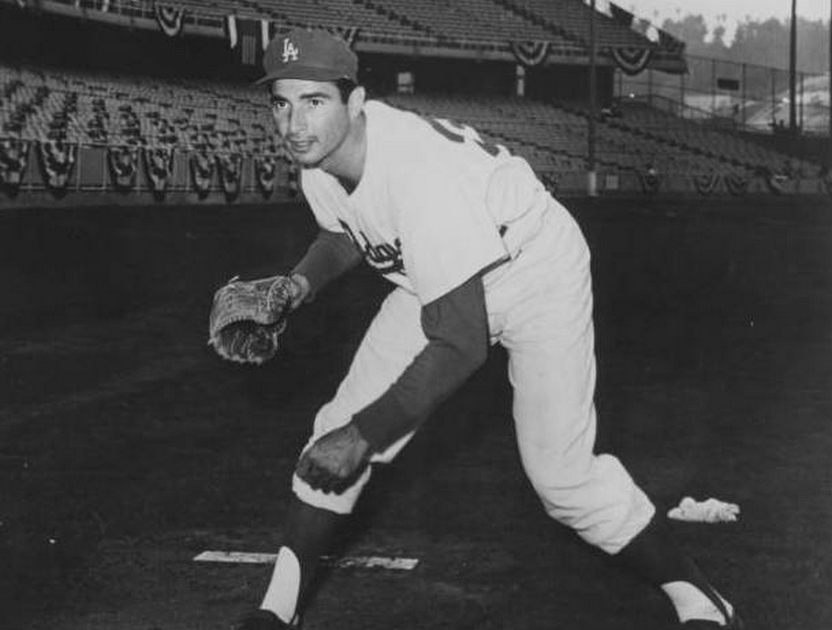
One play on the Sunday afternoon of August 21, 1966, at Dodger Stadium in Los Angeles, California, is imprinted in Wes Parker’s mind.
The St. Louis Cardinals had scored a run in the top of the first inning and loaded the bases with two outs. Although early, the Cardinals had the Dodgers’ Sandy Koufax, the best pitcher in Major League Baseball, on the ropes.
“Tim McCarver hit a rocket — I mean, a rocket — down the first-base line. I dove and wasn’t even sure I caught it. I flipped it to Sandy, and he caught it six inches before McCarver reached the bag,” Parker, the Dodgers’ first baseman that day, recalled in a phone interview in late November.
Koufax “came over to me and said, ‘Nice play,’” Parker said. “You didn’t get many compliments from Sandy.”
The incident was memorable, as were the season and postseason — but nothing like the bombshell that soon followed.

The Dodgers beat the Cardinals 4-1 that day for Koufax’s 20th victory of the season. He would lead the majors in 1966 with 27 wins, 317 strikeouts and a 1.73 earned run average, earning the Cy Young Award as baseball’s best pitcher and finishing second in the balloting for the National League’s Most Valuable Player. The Dodgers reached the World Series for the third time in four seasons, losing to the Baltimore Orioles.

Six weeks later, Koufax retired — at just 30 years old. His decision shocked the baseball world but was sensible to Koufax. The chronic arthritis afflicting his elbow — in the left arm that earned him a living, thrilled Dodgers fans and made him a legend — threatened his quality of life.
“If there were a man who did not have use of one of his arms and you told him it would cost a lot of money and he could buy back that use, he’d give him every dime he had,” Koufax said at a press conference announcing his retirement. “In a sense, maybe this is what I’m doing; I don’t know. I’ve got a lot of years to live after baseball, and I would like to live them with complete use of my body.”

Indeed, nearly six decades have elapsed since Koufax’s retirement and December 30 marks his 90th birthday. He’s the dean of the living Hall of Famers, with only two others’ playing careers dating to the 1950s. Just four players from the Dodgers’ tenure in Brooklyn, Koufax’s hometown, remain — and the great lefty is the sole survivor of the Brooklyn Dodgers’ only World Series championship, in 1955. In fact, he threw the last pitch by a Brooklyn Dodgers player, striking out the batter, the Philadelphia Phillies’ Willie “Puddin’ Head” Jones, in September 1957. The franchise then relocated to California.
The elder Koufax looks healthy and vibrant, judging by his appearance this autumn at two World Series games in Los Angeles, where he sat near the Dodgers dugout and cheered on his former team to its second consecutive championship.

Koufax’s brief, meteoric career included monumental moments in what is known as the Fall Classic.

Most famous was the decision by the Jewish hero, on the eve of the 1965 World Series, to not pitch in the opening game because it fell on Yom Kippur. He would win two games in that series, including the championship clincher in Game 7, when, on just two days’ rest (three or four days off between starts is the norm), he pitched a complete-game three-hitter to defeat the Minnesota Twins, 2-0. In 1963, he established a World Series record by striking out 15 New York Yankees batters.

His legend is such that Marc Brettler, who was just eight years old when Koufax retired, considers it a career highlight to have written the text on the back of a baseball card of the Dodgers great that was part of a set issued in 2003 to honor 140 Jewish MLB players going back to 1871.
Koufax signed the card for Brettler, who framed it and displays it in his house.
“Koufax is an important symbol for being visibly Jewish even when it is difficult,” said Brettler, a retired Biblical scholar who said he often conducts research at the National Library of Israel.
Martin Abramowitz, who launched the card series, said that Jewish fans frequently request that new Koufax cards be issued in updated sets. (Koufax’s agreement with Abramowitz, the latter explained, was for his card to be issued only in the initial set.)

“Some people want [Koufax’s card] for the high value,” Abramowitz said of its draw. “Also, Koufax does have this heroic stature among American Jewish fans that relates to the Yom Kippur [decision] and that one of the best all-time happened to be one of ours.”
For resting that game and for holding out with fellow Dodgers star pitcher Don Drysdale for better contracts before the 1966 season, Koufax stands as “the conscience of the game,” said Jane Leavy, author of the 2002 biography Sandy Koufax: A Lefty’s Legacy. A discussion with Koufax and fellow Hall of Famer Joe Torre about the sport’s problems today led to her new book, Make Me Commissioner: I Know What’s Wrong with Baseball and How to Fix It.

Koufax was known for a jaw-dropping curveball and a blazing fastball that he struggled to master, such that he walked an average of nearly 100 batters per season for a four-year stretch.
His turning point occurred after a Dodgers catcher, Norm Sherry, went to the pitching mound during a jam and advised Koufax not to seek to throw each fastball through a brick wall, but to let up a bit to better control it.
“I went back behind the plate. Good God! He tried to ease up, and he was throwing harder than when he tried to. We came off the field, and I said, ‘Sandy, I don’t know if you realize it, but you just now threw harder than when you were trying to.’ … He struck out the side,” Sherry told me in a 2016 interview. (Sherry, his brother Larry and Koufax were three Jewish players on the Dodgers at the time of the incident.)
From that point on, Sherry said, Koufax “got really good.”
Talk about an understatement. Koufax’s last six seasons are the stuff of legend: three Cy Youngs, four no-hitters (including a perfect game, which, through 2025, has occurred only 24 times in MLB history), an MVP and an average of 21 wins and 285 strikeouts per year.

Koufax, who lives with his wife in Pennsylvania, keeps a low profile and rarely grants interviews, but stays connected to baseball by tutoring Dodgers pitchers at spring training and attending games and alumni gatherings in Los Angeles. He became a close mentor of the most recent Dodgers pitching star and fellow lefthander, the recently retired Clayton Kershaw.
“If there’s an aura about him, it’s because he’s one guy who didn’t capitalize on the fame that came to him because of his accomplishments on the field and his religion. He simply didn’t want to be someone who auctioned himself off for sound bites,” Leavy said of Koufax.
The team’s official historian, Mark Langill, chuckled at a telling example of Koufax’s under-the-radar-in-almost-full-view presence.
Wearing face masks during the period of the COVID-19 epidemic, the two men walked along a Dodger Stadium concourse. Plenty of fans wearing facsimile Koufax jerseys went by, oblivious to the legend’s proximity.
“I thought: If you only knew who you just passed!” Langill said. “He had no entourage. I never saw him recognized with the mask. He’s just low-key, very down to earth, just a gentleman.”
Writer-editor Hillel Kuttler can be reached at hk@HillelTheScribeCommunications.com.


