
The unique fate of the Heilbronner/Havron family, impacted by the horrors of both the Holocaust and the October 7, is a tale of modern Jewish history. It speaks of those, who even amidst the very worst, display resilience and strength.
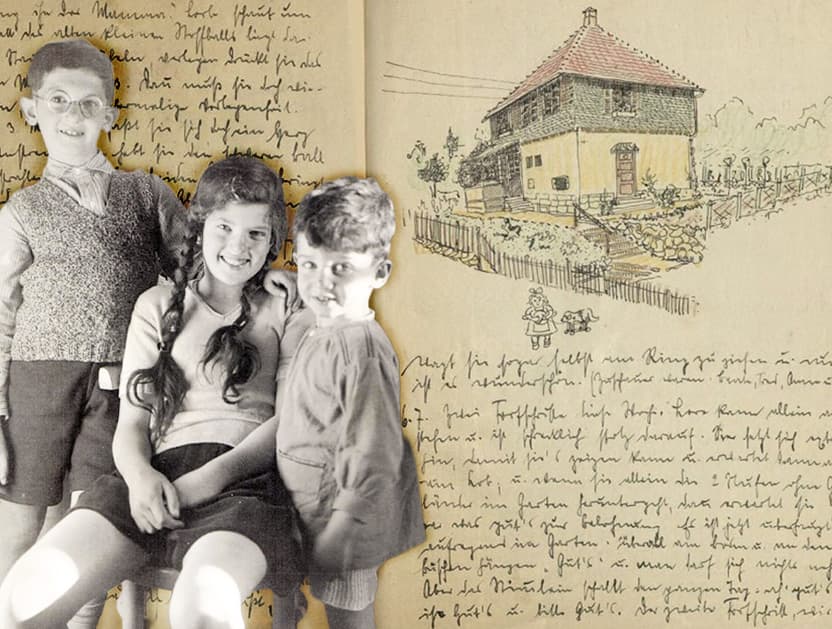
Two Stuttgart-based doctors, Edgar and Anna, were living with their three children in a two-story home with a telephone and car in the early 1930s when the Nazis came to power in Germany. Anna’s diary, illustrated by Edgar and started on Jan 1, 1923, reflects their lives at the time with drawings of their home and their three children, starting with the birth of their first child, Lore (Shoshanna).

Edgar’s drawings depict the family’s two-story house with Lore (Shoshana) pulling a toy dog behind her, standing naked next to the garden tun with garden tools, playing with a train and sitting on a motorcycle with her father. They show Gerhard (Abraham), her second child, riding a wooden horse, climbing on a chair and watering with a watering can. There is little documentation in the diary of the family’s youngest, Hans (Hanan).


Other documents in the family archive include Anna’s notebook recording concerts and theatrical performances she attended between the ages of five and twenty-six, and a photo album from her time as a nurse on the front in the Ukraine during World War I.


Edgar also served in the medical corps in WWI, even receiving the Charlottenkreuz, the “Charlotte Cross”, awarded to individuals who distinguished themselves either in the field or at home in the care of the wounded. Still, the Nazis fired him from his job at a public hospital in 1933, on the grounds that he had not served on the front lines. When Anna asked if she, having served on the front, could take his place, her request was denied. The family got the message loud and clear – Jews no longer had a place in Germany.
An entry from the diary reads:
Dann kam das Frühjahr 1933 und mit einem Schlag, war die herrliche Idylle, die unser Leben am Kräherwald gewesen war, zu Ende. Lore sah und hörte schon was vorging. (…) Dass viele der Freunde und Freundinnen nun zur Hitlerjugend gingen. Da erst schlug ies ich noch enger an ihre jüdischen Freundinnen, Lotte und Grete Hirsch und ausserdem hielten noch einige der anderen fest zu ihnen [CAHJP P484-41, page 2].
Then came the spring of 1933, and in an instant, the wonderful idyll that our life in Kräherwald [a district in Stuttgart] had been, was over. Lore saw and heard what was happening. (…) That many of the friends were now joining the Hitlerjugend. Only then did she cling even more tightly to her Jewish friends, Lotte and Grete Hirsch, and some of the others also remained loyal to them [CAHJP P484-41, page 2].
Although Edgar could continue with his private practice from his home, he traveled later that year to Mandatory Palestine to look for work, and, after a few weeks, found a job as a partner of a Jerusalem physician. The family received their entry permit to Israel in December 1933, and Anna made the long trip with her children to join her husband. At that time, they probably had no idea of the importance of that difficult decision in saving their lives and those of their children, ensuring the family would not experience the horrors of the Holocaust.
About 38,000 Jews joined the Heilbronners in fleeing to Palestine from Germany that year, and, by the end of the decade, the number rose to 60,000.

Just getting permits to leave Germany and enter the Land of Israel was costly. To be allowed to leave Germany, the family first had to pay the Nazi regime 20,000 marks. Then they had had to prove to the British immigration office that they had sufficient funds to cover the cost of their trip
Still, the family managed to bring most of their belongings to Palestine, including their Opel automobile. The archive includes a detailed list of all the furniture and clothing they transferred in in three separate shipments, reflecting the good life they had enjoyed in Germany.
Once in Jerusalem, the family rented an apartment on Mamilla Road (now Agron) from a Christian Arab family. The children began attending a school which used similar teaching methods to their former school in Stuttgart. The institution’s modern pedagogical principles combined cooking and painting with math studies and languages.
Lore, the Heilbronner’s eldest daughter who took the Hebrew name Shoshana, became seriously ill in the family’s third year in their new home, increasing the difficulties of adapting to a new country and life. Yet the family’s/daughter’s love for their new land was made clear in the diary:
Das Schicksal Palestinas lag ihr sehr am Herzen und trotz ihrer eigenen Nöte vergass sie nie in ihrem Gebeten auch für Ruhe in Palestina und Frieden zwischen den Völkern zu bitten und sie fragte auch mich oft, ob ich das nich vergässe (CAHJP P484-41, page 5).
The fate of Palestine was very dear to her [to Lore], and despite her own troubles, she never forgot to pray for peace in Palestine and for peace between nations, and she often asked me that I not forget that either (CAHJP P484-41, page 5).
Lore later died at the early age of 14. When Gerhard and Hans came of age, they both changed their last names to Havron.
Over the years, Edgar became head physician of the founding medical team of ALYN, the hospital for disabled children, and became its director in 1944. His wife, Anna, later joined him as a doctor there.

Meanwhile, his son, Gerhard, who took the name Abraham, joined the Scouts and, while working with them over the summer at Kibbutz Ein Horesh turned away from the academic future his parents had been grooming him for and set his sights instead on joining or building a kibbutz. His parents agreed he attend an agricultural school whose students also did matriculation exams.
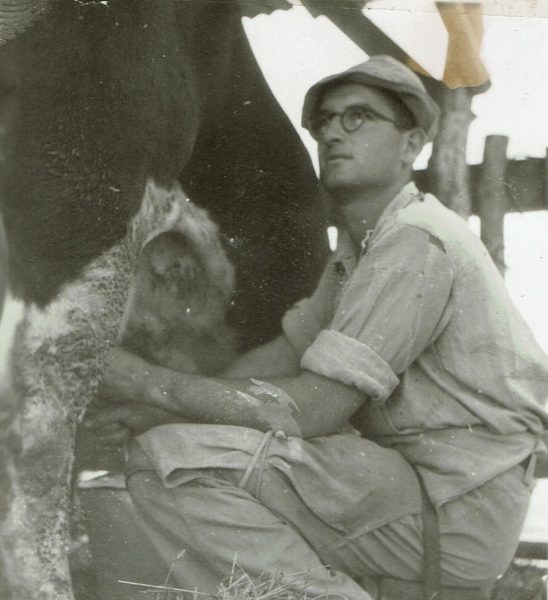
When his classmates were drafted to the Palmach (the Haganah’s elite fighting force) in 1942, Abraham continued his agricultural training with the Scouts, as he was still too young for combat, having skipped two grades. He soon became an expert in raising cattle. Later, in 1946, he was a founding member of Kibbutz Be’eri, which was formed as one of 11 points settled in the southern Negev region. At the end of the War of Independence, in which he fought, the kibbutz moved two kilometers east.
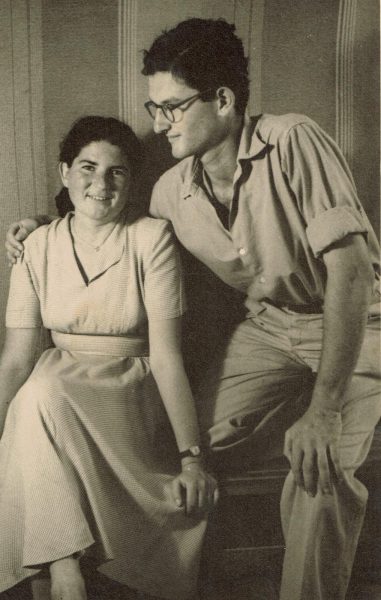
At Be’eri, he built and managed the kibbutz dairy and had four children – Aviv, Shoshan, Lilach and Dudu – with his wife Rina. Abraham was later invited to fly to the US to for a seven-month dairy farm training program and it seemed the family’s brush with tragedy was behind them.
Until October 7.
On that day, atrocities that Edgar and Anna had managed to avoid in the 1930s, came upon their descendants with such a suddenness that there was no time to run. Rina and Abraham had already passed away in 2021 and 2022, respectively, but four family members were murdered and nine taken hostage during the Hamas attack. One of them was held for 515 days.
Two family homes were almost completely destroyed but much of the family history – carefully documented by both Anna and Edgar in diaries and photo albums – was saved only because their grandchildren Lilach and Aviv had by chance brought it to the to the Central Archives for the History of the Jewish People at the National Library just weeks before the Hamas assault. Lilach herself was killed in the October 7 attack.
Still, despite the tragedy, the family looks ahead to the future, an example of resilience and strength. Shoshan’s daughter, Adi, who spent weeks with her mother and two children as a hostage in Gaza, told Channel 12 how her mother’s inner strength kept them sane. Today, Shoshan, (70) says that after losing her husband and sister, her closest friends, the hardest thing is being alone.
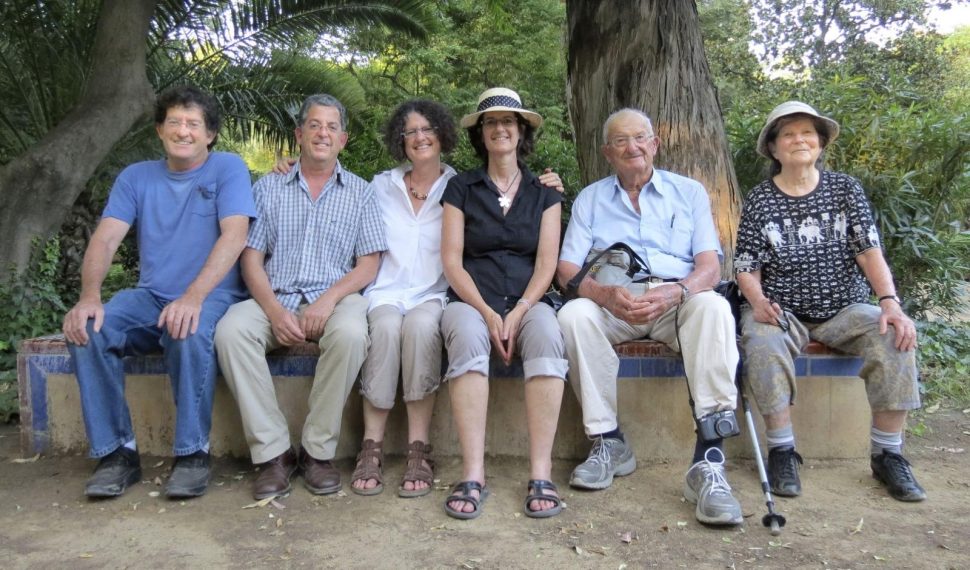
Yet Shoshan’s strength and hope continue to shine, keeping the family moving forward, despite everything. Her daughter Adi said the following on Channel 12:
“I want to tell you, Mother, that despite all the pain we have endured – the cruel events forced upon us against our will, and the loss of Dad – there has also been profound strength. In the midst of it all, you have stood at the head of our family with courage and clarity. You have woven threads into the future, making wise and generous decisions for all of us, and for yourself. You see beyond the present sorrow – to possibility, to hope – and you continue to move forward with remarkable strength.”
The Edgar (Yaakov) & Anna (Chana) Heilbronner Collection is now preserved at the Central Archives for the History of the Jewish People (CAHJP), part of the National Library of Israel. The CAHJP preserves many archives of families and institutions, while making them accessible to the public.
-With assistance from Miriam Rafai


