
By Amir ben-Amram
Excitement ran high at the Gnazim Institute when we discovered some rare letters by Albert Einstein. A closer reading revealed new details about two scientists who served as his personal assistants, including the forgotten figure of a Jewish mathematician who died young of a rare illness in 1933. Through some good, old-fashioned archival detective work, we traced the outlines of these obscure figures and learned new facts about Einstein himself. Two men who had slipped into the margins of scientific history now emerge from the archive: Jakob Grommer and Juda (Jan) Leman, young scientists who briefly accompanied Einstein on his path.
What surfaced were yellowing pages, fading ink, and words that restored long-silent voices. Letters and correspondence linked Einstein to these two Jewish men, born in Eastern Europe, who had come to study mathematics and physics in Germany, where major strides forward were being made in these fields. They were not academic luminaries: they never secured prestigious chairs, nor were their names etched on university buildings. Yet they worked, calculated, translated, and circulated ideas. From these documents a complex portrait appears: Einstein as a brilliant scientist, but also as a perceptive and compassionate observer of people; and two life paths marked by flashes of great promise and long stretches of shadow.

Jakob Grommer
The Gnazim Archive of the Hebrew Writers Association preserves the papers of Nahum Chinitz (1895–1984).
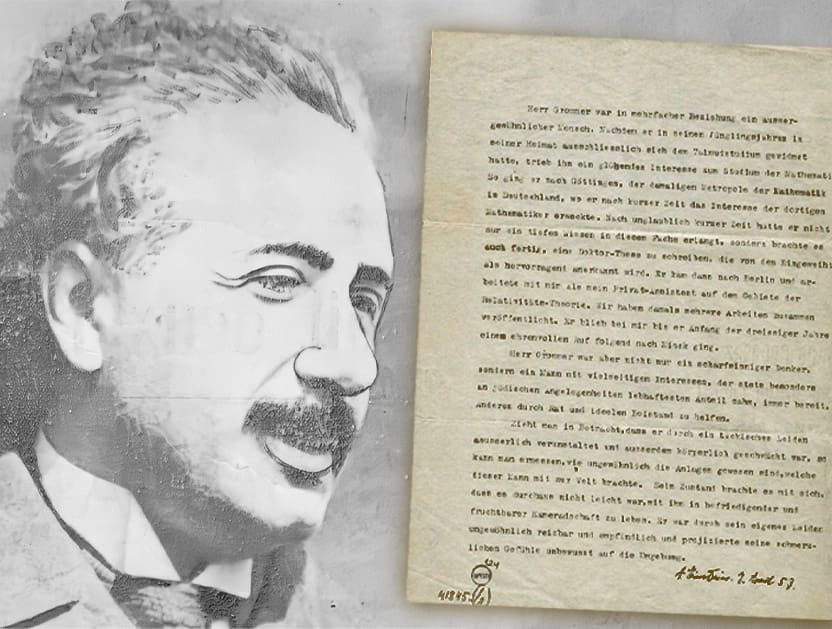
Chinitz was a writer and journalist who immigrated to Mandatory Palestine in 1937 from the United States, where he had settled in 1921 after leaving Brisk in Lithuania (today Brest, Belarus). Among other things, he edited memorial books devoted to Jewish communities, including Brisk. It was in this context that he approached Einstein, hoping to learn more about Dr. Jakob Grommer, a native of Brisk who had been Einstein’s assistant in Germany. Einstein replied readily and wrote the following:
“Mr. Grommer was in many respects an exceptional person. After devoting his youth in his homeland exclusively to Talmudic study, his passionate interest in mathematics compelled him to pursue formal study in the field. He went to Göttingen, then the center of mathematics in Germany, and soon attracted the attention of the local mathematicians. In a very short time, he not only acquired broad knowledge, but also succeeded in writing a doctoral dissertation that experts considered excellent [his supervisor was the great mathematician David Hilbert – A.B.]. He later came to Berlin and worked with me, as a private assistant, on the theory of relativity. We published several works together. He remained with me until the early 1930s, when he moved to Minsk after receiving a respectable proposal [a job offer].
A. Einstein. April 7, 1953.
Mr. Grommer was not only a sharp thinker, but also a man of wide interests, especially in matters concerning Judaism, and was always ready to advise and help others.
Given that he suffered from a serious illness that deformed his face and weakened his body [acromegaly – A.B.], one can appreciate how extraordinary his qualities and abilities were. Yet his condition also made it difficult to get along with him and maintain a fruitful friendship. His suffering made him irritable and highly sensitive, and he unconsciously projected his pain onto those around him.”

Einstein’s warm assessment of Grommer is particularly noteworthy in light of the condescension often shown toward Eastern European Jews, the Ostjuden, by their more “Western” German colleagues.
Chinitz did not stop at the correspondence. He continued to investigate Grommer’s life and located an elderly man from Brisk, David Yosef Vinograd, who remembered him. These recollections appear in Chinitz’s book, In the Company of Great Figures [Hebrew]. Vinograd recalled that as a youth Grommer was a prodigy and a diligent Torah student who spent days and nights at the shtender – the study lectern in theyeshiva. But, as Einstein noted, he made a sharp turn and chose the path of mathematics. Even during his years in Germany, he often attended Jewish lectures and gatherings. Because of his illness, he died young, in 1933.
The website of the municipal library in Brest offers yet another and more detailed account of Jakob Grommer, the most complete we have. According to this source, Grommer was born on August 10, 1879, in Brisk, into a deeply religious family. As a child he was considered exceptionally gifted: he possessed a phenomenal memory, an analytical mind, extraordinary work capacity, perseverance, determination, natural intuition, unimpeachable moral integrity, and a penchant for humanism. From early childhood until 1905 he studied Talmud and was destined to become a rabbi. As the star pupil of the rabbi of Brisk, he was expected to succeed him and, as per tradition, to marry the rabbi’s daughter. But the marriage never took place – the bride fled, frightened by his appearance.
Grommer suffered from acromegaly, an endocrine disorder that causes disproportionate growth of the hands, feet, and skull (it was said that his chin nearly reached his stomach). Wounded by the bride’s rejection, he left the city and went to Germany. There he quickly learned German, began to read voraciously, and developed a deep interest in physics and mathematics. In 1905, despite lacking a high-school diploma, he found work, first at the University of Bern, then at the University of Marburg.
From 1907 to 1913 he studied mathematics, physics, and philosophy at the University of Göttingen. His meeting with David Hilbert proved decisive. Their relationship was that of teacher and student, culminating in 1914 in a brilliant defense of his dissertation under Hilbert’s supervision – a study that made a significant contribution to problems in the theory of entire and transcendental functions. Hilbert personally supported him in obtaining the doctorate and told the university board:
“If I manage to secure a doctorate for this fellow, who does not even have a high-school certificate, then one may truly say I have accomplished something. Most dissertations contain half an idea. Good dissertations contain one idea. Grommer’s contains two good ideas!”
Hilbert’s words convinced the committee, and Grommer was unanimously awarded a Doctor of Science degree by the University of Göttingen.
In the Berlin phase of his scientific life, his partnership with Albert Einstein became central. Eight years later, Einstein wrote that Grommer “assisted me in all the calculations in the field of the theory of relativity,” acknowledging the significant contribution of his colleague. Grommer’s work, published as a separate volume by the Prussian Academy of Sciences, modified Einstein’s gravitational equations so that they would be valid in a spatially closed universe and demonstrated the conservation of its total energy.
Grommer continued to work with Einstein on the development of general relativity, on the attempt to unify gravitational and electromagnetic fields, and on studies of matter and early extensions of quantum theory. Their collaboration produced achievements on two fronts. In 1927, Einstein and Grommer were the first to show that field theory could include within it the mechanical motion of material particles. They published several joint papers. For thirteen years Grommer worked alongside Einstein, served as his assistant, and played an active role in the advancement of relativity and in the efforts to unify the gravitational and electromagnetic fields.
Grommer also earned recognition outside Einstein’s circle. He independently formulated the necessary and sufficient conditions for the validity of the Riemann Hypothesis within analytic number theory, known as “Grommer’s inequalities.” He helped prepare mathematics and physics textbooks for schools in Mandatory Palestine. His scientific work was extremely wide-ranging and included algebra, the theory of transcendental functions, and relativistic mechanics. He headed the Chair of Mathematics at the University of Berlin.
In 1928, following Einstein’s recommendation, he was appointed professor in the Pedagogical Faculty of the State University of Belarus. Beginning in 1931, he also served as a senior researcher at the Physical-Technical Institute of the National Academy of Sciences in Belarus.
For four and a half years, the native of Brest-Litovsk worked with great energy and helped shape research in physics and mathematics in Soviet Belarus. His colleagues saw him as an exemplar. They admired his ability to formulate scientific questions and to propose optimal solutions. Working with him was a genuine learning experience for young scientists. His arrival in Minsk can be considered a formative event in the development of Belarusian mathematics and physics.
On April 11, 1933 Grommer passed away. The Belarusian Academy allocated 1,520 rubles for the solitary scholar’s funeral. All his belongings and papers were given to his housekeeper. According to his wishes, his body was delivered to a medical institute for study, and his brain and other organs were examined for scientific purposes. The Belarusian website also preserved the only known photograph of Jakob Grommer.

Juda Leman
There was more. Traces of Grommer also appeared in a second Gnazim archive, the papers of Zalman Shazar, the former Israeli president. After Grommer’s death, Shazar published an obituary in Davar on May 12, 1933. He described Grommer as one of “the giants of the land,” referring both to his intellectual stature and to the illness that caused the excessive growth of his bones. Shazar was struck by how the brilliant yeshiva student moved into the mathematics faculty “without any pangs of transition; he simply leapt in.” From university life into Einstein’s circle, Shazar wrote, he advanced “in a single stride, like a giant from legend.” The draft of this article is preserved at Gnazim.

In his letter to Chinitz, Einstein apologized for having no photograph of Grommer and referred him instead to Juda Leman. Leman, also one of Einstein’s Jewish assistants, replied with regret that he too had no picture, but wrote that Grommer “lives in our memory as one of the dearest and finest people we have ever met.” In the end, Chinitz obtained a group photograph of Grommer from a Dr. Rabinowitz of Tel Aviv. He documented the story behind it:
“In 1921, when Grommer was in Berlin, a splendid celebration was held in honor of our great poet H. N. Bialik. Moments before the event began, Dr. Jakob Grommer suddenly appeared. He was welcomed with loud applause and invited to join the dais. He refused and sat quietly in the back row. As the photograph was taken, the hand of one of the guests accidentally obscured part of Grommer’s face. A master photographer managed to remove the blemish, and thus Grommer appeared in the picture without flaw.”
(From “In the Company of Great Figures”, N. Chinitz)
Leman himself was also an Ostjude who had emigrated to Berlin from Warsaw. Einstein “adopted” him into his circle. Leman had a special interest in making physics accessible to Jews, and he wrote a short introduction to relativity in Yiddish. Einstein endorsed the project. The booklet was successful enough that it was translated into Russian, Spanish, and English. Einstein ensured that Leman was admitted to the University of Berlin, where he completed his doctorate.
But unlike Grommer, Leman eventually disappointed his mentor. Rather than advancing in science, he changed professions, becoming a screenwriter and film director in Hollywood. IMDb lists one of his films, “The Promised Land,” a 1935 documentary about Mandatory Palestine. It was not a great success. Producer Margot Klausner wrote that “he did not know the country and had no professional knowledge of filmmaking, not before, not during, and not after the film.”
The story of the film is notable in its own right. After failing to distribute it in the United States, the producers submitted it in Germany, where the Nazi government approved its screening, pleased – at that stage in history – to encourage Jewish emigration. The film was shown at the 1935 Venice Film Festival and received an honorable mention.
Leman abandoned physics and attempted to build a film career in America under his Polish name, Jan Leman. He relied on Einstein’s goodwill. Einstein wrote letters of recommendation on his behalf to key Hollywood figures like Harry Warner and David O. Selznick. But the new career did not treat him kindly. In 1953, in a letter to Einstein, Leman’s friend Mary Montrose described his desperate condition: living on charity and loans until he was removed from aid lists, evicted from his home, and contemplating suicide. Einstein replied:
“Juda Leman’s case is well known to me. I know him and his wife personally. The true cause of his troubles is his fixed idea: ‘I was born to be a screenwriter, and I have the right to plan my life accordingly.’ […] Juda Leman could have been a talented teacher, but he ignored all advice.”

Einstein was mistaken in assuming that Leman’s choice doomed him to failure. Within a few years he recovered and successfully wrote for television (two of his television works from 1958 appear on IMDb).
Special thanks to Rachel Popper, who discovered the letters in the Chinitz archive; to David Schneidman, who located and translated material in Russian; and to Yitzhak Bar-Yosef and Adiva Geffen for their assistance in preparing this article.
Further Reading
Nahum Chinitz, In the Company of Great figures, [Hebrew] Tel Aviv: Chen, 1971
Chad, Jordan A.: Albert Einstein and “The Case of Juda Leman”: From Yiddish Physics to Hollywood. In Shofar: An interdisciplinary Journal of Jewish Studies, Purdue University Press, Vol. 40, No. 1, 2022


