
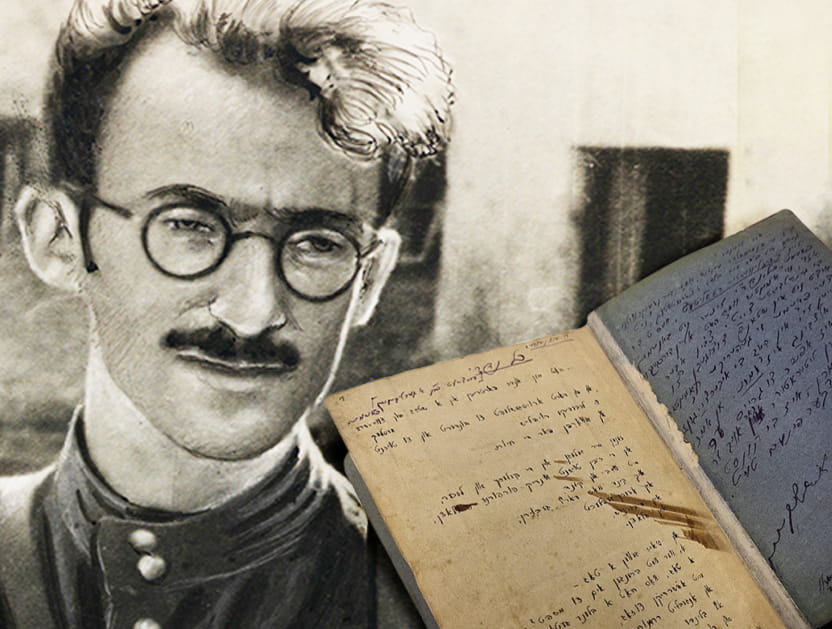
As an archivist, I hold and catalogue historical documents consistently. To some extent this requires that I distance myself from the material so that I can get on with my work and not be distracted by the significance or research potential of the material. At times such a distance is impossible. One such case is the handwritten poem that saved Avrom Sutzkever’s life.
File Arc 4* 1565 2 397, titled Kol Nidre, is stored among a collection of handwritten poetry drafts, mostly from the 1980s. But the pages of this booklet are weighed down heavily with history and are the key to two people’s escape from the Nazis. All of this history is carefully preserved and made accessible by the National Library of Israel as part of the Sutzkever Archive.

Avrom Sutzkever (1913-2010), best known as a partisan poet, was born in Smorgon, which at the time was part of Tsarist Russia, and died in Tel Aviv. He began publishing his poetry in the early 1930s in Vilna as part of the Yiddish literary group, Yung-Vilne (Young Vilna), having moved to the city with his family in 1920. He married his wife, Freydka, who was also active in the Yiddish cultural scene, in 1939 just as World War II broke out.

Sutzkever and Freydke managed to escape deportation and death during the early period of Nazi occupation and were ultimately forced to move into the Vilna Ghetto in September 1941. Throughout the Nazi occupation, Sutzkever continued to compose poetry, and in the ghetto he was involved in organizing cultural events and activities for youth and adults. Simultaneously, he and others were forced into slave labor as part of the Nazi effort to steal and collect Jewish cultural property. Along with a few other intellectuals, including Shmerke Kaczerginski, Rokhl Krinski, Herman Kruk, and Naomi Markeles, Sutzkever’s work detail was to sort through Jewish manuscripts and other documents. They were to report which material the Nazis should preserve for their planned museum and which should be destroyed, with most of the material being destroyed.
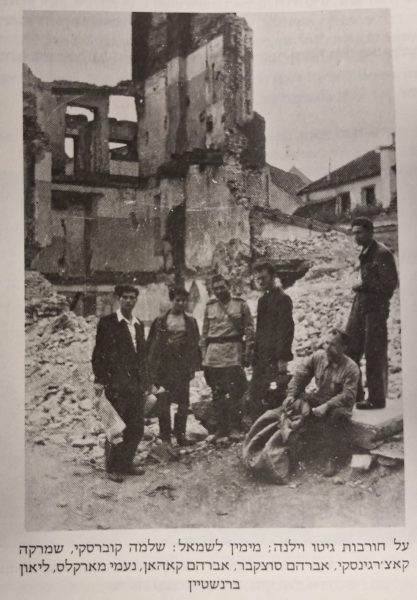
Sutzkever and the others resisted the Nazis by hiding whatever material they could or smuggling it into the ghetto and burying it, with the hope that it would be found after the war, thus preserving Jewish history and culture from the Nazis. They also smuggled scrap paper into the ghetto to be used by the partisans and for cultural activities. They earned the nickname, “The Paper Brigade,” from their fellow resistance fighters. Once the resistance became more active and the United Partisan Organization [Fareynikte Partizaner Organizatsye, FPO] was founded in January 1942, Sutzkever and his fellows used their experience smuggling documents to smuggle weapons into the ghetto, as well.

Another act of resistance, which was more particular to Sutzkever, was poetry.He recalls writing poetry at a high rate, and the years in the ghetto as some of his most productive. While being forced to work with the Nazis, Sutzkever would surreptitiously compose his poems when there were no Germans around. Kol Nidre is one of Sutzkever’s poems from this period, dated at the bottom, “Vilna Ghetto, completed on February 6, 1943.” Although Sutzkever is known for his lyric poetry, Kol Nidre stands out among his writings as an epic poem. It is based on the Yom Kippur Aktion, which took place on October 1, 1941, in which the Nazis rounded up approximately 3,900 Jews in the ghetto, and murdered them in the Ponar forest, a short distance away. Sutzkever gave his poem the name of the opening prayer of Yom Kippur, Kol Nidre. He presented this poem to the literary circle, the Ghetto Writers’ Union, from which he previously received an award for his poem Dos keyver kind [“The Grave Child”].
The poem, 20 pages in the published version, begins with a description of the aktion and Jewish defiance:
Kol Nidre
Told by a survivor
A.
…We were herded in a cage from two-three lanes
And from there hundreds and thousands were dragged out,
Like feverish raw meat,
And thrown to the beasts.
[…]
Parchment Jews assembled
From web covered attics
And well-like cellars –
In the shining study of the Vilna Gaon, —
Gathering for Kol Nidre
As if for an uprising.
[…]

The copy of Kol Nidre held in the National Library of Israel archives is written on repurposed paper. At the end of the booklet, one can see some of the writing from its’ previous life, in Hebrew and Latin script at odd orientations to how the paper was recut to create the booklet. This would have been paper that Sutzkever smuggled out of the Nazi manuscript collection and into the ghetto at the risk of his life. The poem itself is carefully written in clear handwriting, other than a few corrections, copied out by Naomi Markeles.

On September 12, 1943, Sutzkever and Freydke escaped with other partisans to the Narotsh Forest and joined with a Soviet partisan group under the command of Colonel Fyodor Markov. Less than a week after their escape, between September 16-23, the Vilna Ghetto was liquidated. Of the ten or eleven thousand Jews who remained there, some were murdered in Ponar while others were sent to death camps and labor camps. While in the forest, where he spent six months, Sutzkever decided to try and smuggle this poem to the Yiddish poet Peretz Markish in Moscow, in the hopes that if he did not survive at least his poem and record of the Ghetto would. On the inside cover at the front of the booklet, in Sutzkever’s own hand, is a letter to the reader dated December 15, 1943:
“Dear reader!
You, as a normal person, for whom the name: Vilna Ghetto is only a concept, not a crystallized reality, the poem “Kol Nidre” will definitely not impact you as it would a person who themselves had suffered through the period that is portrayed. But I am not now in a state to provide the poem with the proper commentary. Read it with the conviction that everything is true. A truth which is too big to become literature, but if this did happen – literature is stronger than death.
A. Sutzkever
Markov Brigade
15/XII/1943″
-Translated by V. Lightstone

After completing this letter, Sutzkever handed it to the partisan smuggler Shike Gertman with instructions to make sure it reached Markish. By some miracle it did, and Markish, who was also a member of the executive committee of the Jewish Anti-Fascist Committee (JAFC), in turn presented it at a JAFC meeting in Moscow. At the meeting, Sutzkever’s name was not mentioned in order not to draw German attention to him. After its presentation, Shloyme Mikhoels, chair of the JAFC and a Yiddish actor and director, along with Justas Paleckis, the Lithuanian president in exile who happened to also be a poet and had met Sutzkever previously, used this poem to convince the Soviet government to rescue Sutzkever as an important witness to the atrocities committed by the Nazis.
On March 12, 1944, the Markov brigade received a radio transmission that a Soviet plane was being sent to extract Avrom and Freydke Sutzkever and bring them to Moscow. They were sent the coordinates of a secret location at which to meet the plane. By April 2, 1944 Sutzkever was in Moscow and addressing a crowded meeting of the JAFC. Ultimately, he did indeed become an important witness against the Nazis as an expert witness submitted by the Soviet delegation to the Nuremberg trials. Sutzkever was one of the few people to give oral testimony at the Nuremberg trials and the only Jew. On February 27, 1946 he presented his testimony while standing, as a personal form of saying kaddish, the prayer for the dead.

The booklet that made his survival possible, now held in the Library archives, is made of materials that Sutzkever smuggled into the ghetto at the risk of his own life — his words and thoughts as well as the paper. It was copied in beautiful handwriting by a fellow partisan, Naomi Markeles, as an act of resistance to the Nazis. It was smuggled out of the ghetto and then through a war zone by Shike Gertman, and possibly others in the partisan network. It finally reached the Jewish Anti-Fascist Committee in Moscow where it was vetted and then presented to the Soviet government. All of that history, struggle and resistance, is contained in this one booklet which is now the responsibility of the National Library of Israel.
The Kol Nidre booklet was donated to the archive among thousands of other items from Sutzkever’s personal archive. Here it was cataloged, using the card system, and stored safely. In 1983, the National Library of Israel hosted an exhibit to celebrate Sutzkever’s 70th birthday, and this booklet of course was part of the exhibit. The exhibit book, which was published in dual-language, Hebrew and Yiddish, contains a description of the booklet including a transcription and Hebrew translation of Sutzkever’s letter to the reader. In 2013 the information from the card catalog was put into the computer system. My current role, and the reason for my contact with booklet, is to update the storage and cataloging information of the Sutzkever Archive, making it easier to find in a digital search, ready for digitization, and to ensure that it is stored properly. All of the digital updates to this collection have been supported by the Conference on Jewish Material Claims Against Germany, the Foundation Remembrance, Responsibility and Future, and by the German Federal Ministry of Finance.
After I completed my work on the Kol Nidre booklet, I sent it to the National Library’s conservation team which reinforced it in places where the handmade binding was beginning to loosen. In all honesty, the fact that a booklet which was handmade covertly in the Vilna Ghetto held together for eighty years is extremely impressive. From conservation, Kol Nidre was sent to the digitization team, where it was carefully scanned in high resolution. A complete scan of the file is now available to visitors of the Library. Sutzkever’s poem booklet, which quite literally showed that literature overcomes death, is now available and preserved in two forms, physical and digital.
Sutzkever’ story does not end with Kol Nidre. After the Holocaust, he continued to lead an active and full life. He never stopped writing poetry, and later in life began writing prose (beyond his Holocaust memoir). Sutzkever returned to Vilna once the Soviets liberated it from the Nazis and, with the help of his co-conspirator Shmerke Kozerginski, rescued the cultural materials which the Paper Brigade hid. He, Freydke, and their infant daughter Reyna, then briefly lived in Poland and France before moving to Israel in 1947. In 1948 Sutzkever requested the help of the “Histadrut”, the Hebrew Trade Union Federation, in founding Di Goldene Keyt,a long-lived Yiddish literary journal (1948-1995). Throughout his life, he was an active cultural figure, writing poetry and short stories, travelling internationally, and maintaining correspondence with other writers all over the world, including France, Poland, Canada, U.S., Mexico, South Africa, and more. The Sutzkever Archive contains correspondence and literary drafts from such people as Isaac Bashevis-Singer, Elie Wiesel, Ruth Wisse, Ahron Glantz-Leyalis, Ida Maze, and Marc Chagall. His writings have been translated into many languages including English, Hebrew, French, Russian, German, and Polish. The power of Sutzkever’s cultural conviction and literary genius is visible in his legacy.

Recommended Reading:
- From the Vilna Ghetto to Nuremberg : Memoir and Testimony, Abraham Sutzkever, & Justin D. Cammy, (2021), Montreal, Quebec: McGill-Queen’s University Press, 2021
- The Book Smugglers: Partisans, Poets, and the Race to Save Jewish Treasures From the Nazis. David Fishman, Lebanon, NH: ForeEdge, an imprint of University Press of New England, 2017
- Sutzkever: Essential Prose, Avrom Sutzkever translated by Zackary Sholem Berger introduction by Heather Valencia, Amherst, Massachusetts: White Goat Press, a Yiddish Book Center translation, 2020
- Selected Poetry and Prose, A. Sutzkever, translated from the Yiddish by Barbara and Benjamin Harshav with an introduction by Benjamin Harshav, Berkeley, California: University of California Press, 1991
- The Full Pomegranate: Poems of Avrom Sutzkever, selected and translated by Richard J. Fein introduction by Justin Cammy, preparation of the Yiddish text by Harry Bochner and David Braun, Albany, NY: Excelsior Editions, An Imprint of State University of New York Press, 2019
- Abraham Sutzkever on His Seventieth Birthday, Jerusalem: the National Library of Israel, (Hebrew and Yiddish), 1983


