A few years ago, we told the story of the publication of The Wonders of the Maharal, a book that appeared 110 years ago. It was supposedly copied from an unknown manuscript discovered in the royal library of the city of Metz. The book related numerous stories of the Golem of Prague and its supposed creator, the famous rabbi and mystic Judah Loew ben Bezalel, more commonly known as “The Maharal,” which took place sometime in the 16th century. It became a sensation in the Jewish world, was translated into multiple languages, and inspired numerous adaptations.
There was just one problem: any connection between the book and reality was purely coincidental.
As it turns out, this was not the only questionable work authored by Rabbi Yehuda Yudel Rosenberg (1860–1935).
Another manuscript allegedly discovered in that same royal library was a book by Rabbi Manoah Handel titled Vessels of the Temple. Rabbi Manoah, born in what is today northern Ukraine, served as a rabbi in Ukraine, Bohemia and Austria in the 16th century. He was described as a prolific scholar across the entire spectrum of Jewish learning and as a student of Rabbi Moshe Isserles (the Rema) and Rabbi Shlomo Luria (the Maharshal). The manuscript was copied and printed in Piotrków by Rabbi Rosenberg in 1913 under the title The High Priest’s Breastplate of Judgment (Sefer Choshen Mishpat shel HaCohen HaGadol).

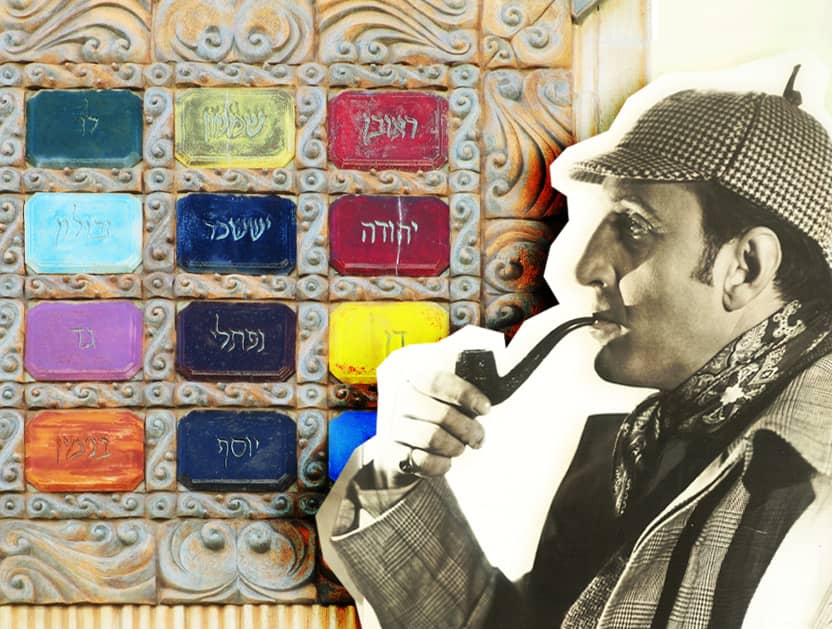
In the manuscript, Rabbi Manoah describes the Temple vessels and the alleged present-day whereabouts of some of them. Among other things, he discusses the High Priest’s wonderous breastplate (the Choshen) and recounts a story he claims to have heard directly from the famous Jewish mystic, the Maharal of Prague
According to the tale, the Maharal learned in a dream that the breastplate was housed in the Belmore Street Museum in London, after British archaeologists had discovered it in Carthage, where it had been brought from Rome.
In his dream, the Maharal saw that the twelve precious stones embedded in the breastplate (each one said to represent one of the twelve ancient tribes of Israel) had recently been stolen. He immediately set out for London. There he identified the thief: an officer named Wilson. Wilson was willing to sell the stones to the Maharal for a large sum of money, and the Maharal promised to obtain the funds within a few weeks.
It turned out that the thief came from a Jewish family but had long since abandoned his faith. Wilson explained that through deception he had won the trust of the museum’s director, Professor Andreas, befriended his daughter, and ultimately gained access to the museum in order to replace the original stones with fakes.

The Maharal placed a curse upon Wilson: whenever he put on his shoes, in which he had hidden the stones, his skin would change color. In the end, Wilson repented and sought the Maharal’s help. At the Maharal’s advice, he returned the stones to the museum director, who forgave him for the theft. The story concludes with Wilson marrying Professor Andreas’s daughter, after the Maharal reveals that the director’s family are in fact Jews descended from Spanish conversos. All’s well that ends well.
But.
The story of the theft of the breastplate’s stones, allegedly discovered in an ancient manuscript in the royal library of Metz, is, to put it mildly, highly unreliable.
The writing style does not fit the Maharal’s era at all; it is unmistakably modern. The story mentions cameras, telephones, newspapers, and other items that certainly did not exist in the Maharal’s time. There was no Belmore Street Museum, nor was there a royal library in Metz, facts that cast serious doubt on the authenticity of Rosenberg’s other works supposedly discovered there.
It appears that the entire story was fabricated and written by Rabbi Rosenberg himself in the early 20th century. It should also be noted that in 1590, when the story is said to have taken place, there were no Jews in England at all, having been expelled in 1290. No one ever saw the original manuscript of Rabbi Manoah, neither before nor after publication. It never existed.
The final nail in the coffin of this fictional tale is the fact that the names Captain Wilson, Professor Andreas, and even the museum itself all appear in The Story of the Jew’s Breastplate, published by the famous British author Arthur Conan Doyle in The Strand Magazine in 1899.

Researchers argue that this amounts to literary theft: Rabbi Rosenberg was familiar with Conan Doyle’s original story, which had been translated into Russian, among other languages. He effectively “converted” the story, ignoring the chronological inconsistencies. Like The Wonders of the Maharal, which was also supposedly discovered in that same royal library, The High Priest’s Breastplate of Judgment appears to be a literary invention, a forgery crafted by Rabbi Rosenberg.
How can we explain that a respected rabbi, who served in prominent communities across the globe and authored numerous works on a wide range of Jewish subjects, would squander his time and risk public trust by publishing what seems to be a derivative literary work?
If we wish to judge him favorably, one might suggest that the deception was actually the work of Yitzhak Sharpman, mentioned in the previous article, who provided the manuscripts of The Wonders of the Maharal and invented the story of their discovery in the nonexistent library. Rabbi Rosenberg, in his naivety, may have published them as historical fact.

But perhaps a more intriguing explanation can be offered. Rabbi Rosenberg was a gifted storyteller who sought, by every means available, to captivate his readers with a convincing and well-grounded narrative. The reference to an ancient manuscript is not so different from modern thrillers that begin with an archaeological discovery or the unveiling of a secret document that never truly existed. It is part of the storytelling apparatus.
The charge of plagiarism may not be entirely fair. Rosenberg’s story can be seen as a prequel to Conan Doyle’s. True, it features the same characters (aside from the Maharal himself), but Rosenberg’s version explains the events leading up to the British author’s tale, adding depth and narrative texture. Without claiming literary expertise, one might even argue that Rosenberg’s story is more compelling than Conan Doyle’s.
In recent decades, numerous authors have written stories imagining the youth of Conan Doyle’s famous literary figure, Sherlock Holmes. This is not considered plagiarism but rather an expansion of a beloved character, an effort to deepen and enrich him. Rabbi Rosenberg did something similar, and he did it rather skillfully. In The High Priest’s Breastplate of Judgment, he even appended Conan Doyle’s story, implying that it was not fiction at all but a historical event that had taken place in the 16th century rather than a late-19th-century invention.

Rabbi Rosenberg had a clear, if somewhat concealed, motive in writing his book. As a rabbi and educator, he sought to draw the new, educated generation of European Jews closer to Judaism. One way to begin was by offering them captivating reading material infused with Jewish spirit. Wilson’s repentance and his search for his Jewish roots, along with Andreas’s eventual return to Judaism and the story’s happy ending, were clearly aimed at the Jews of Rosenberg’s own time.
Questions still remain about Rosenberg’s writing and his other works. But analyzing his hidden intentions is a task for historians and scholars, or perhaps for Sherlock Holmes himself.