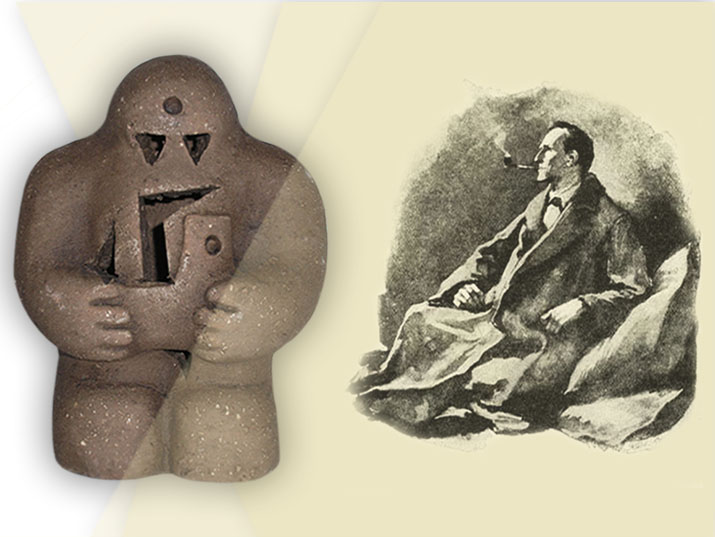
Jews have been familiar with the story of the Golem of Prague, in different variations, since the early nineteenth century.
But on an ordinary day in the year 1908, a new book about the famous Golem suddenly appeared: The Wonders of the Maharal (Sefer Niflaot Maharal). Unlike earlier works that retold the legend of the miraculous creature fashioned from clay and earth by its rabbinic master, this volume marked a genuine innovation in Hebrew literature.
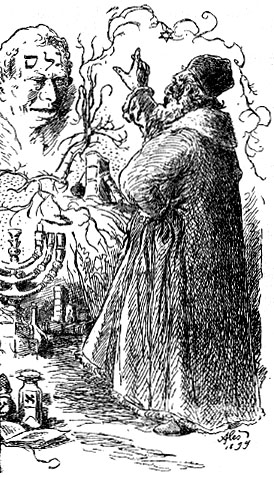
“For three hundred years,” claimed the book’s publisher, Yehuda Yudel Rosenberg, in his introduction, “a precious and delightful treasure lay hidden… in the royal library of the city of Metz.” That treasure, Rosenberg asserted, had been written by none other than Rabbi Isaac ben Samson Katz, the Maharal’s son-in-law, and a central figure in the book itself. It contained a collection of stories which presented somewhat different versions of the fantastical exploits of the Maharal and the human-shaped mass of clay and earth into which he breathed life: the Golem.
The sensation the book caused, the many editions it went through, and its translations into multiple languages (Yiddish, German, English, Judeo-Arabic, and Persian) reveal something about the Hebrew reader’s appetite for this new genre: detective fiction in Hebrew. From the moment of its creation, the Golem functions as a loyal sidekick of its master. In one of the collection’s best-known episodes, the Maharal — Judah Loew ben Bezalel, the rabbi-detective of Prague — solves the mystery of a missing corpse and dispatches the Golem to summon the police to the correct cemetery. Together, they prevent yet another blood libel from taking shape, not for the first time in the book.
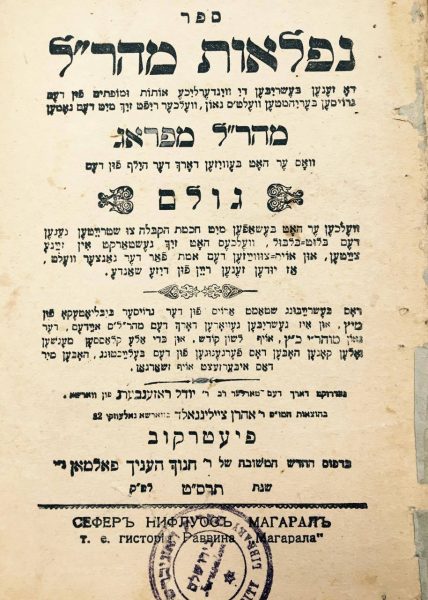
If these stories bring to mind another, far more famous literary detective, that is hardly accidental.
The Wonders of Pseudepigrapha
About six months after the publication of The Wonders of the Maharal, a man named Emanuel (Menachem Mendel) Eckstein published a short booklet in his hometown of Máramarossziget. In the 16-page Sefer Yetzirah he produced, Eckstein advanced a claim that must have sounded scandalous to anyone familiar with Rosenberg’s vast rabbinic scholarship. Having identified numerous errors and historical inaccuracies in The Wonders of the Maharal, Eckstein concluded that the book’s publisher, Yehuda Yudel Rosenberg, not the Maharal’s son-in-law, was its true author.
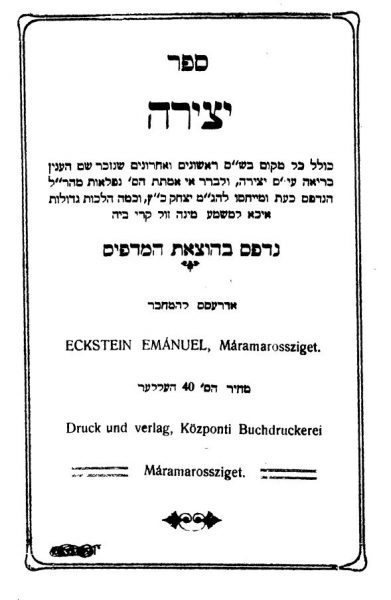
Title page of the booklet Sefer Yetzirah, published by Emanuel Eckstein. The booklet may be downloaded from the Hebrew Books website
Eckstein’s compelling arguments were later reinforced by additional scholars, among them the renowned researcher of Kabbalah and Jewish mysticism, Gershom Scholem. Their studies demonstrated that many of the details in the book contradict the historical reality in which the Maharal lived, from inaccuracies regarding the rabbi’s year of birth to the identity of the story’s arch-villain, the priest Johann Sylvester, a Czech cleric who never existed. Researchers further discovered that Rabbi Rosenberg himself was an enthusiastic reader of detective fiction and an avid consumer of the works of Arthur Conan Doyle and his brilliant, if somewhat snobbish, detective, Sherlock Holmes.
It seems that Rabbi Rosenberg anticipated that some readers might question the authenticity of his account. In the very first edition of the book, he appended to his introduction a bill of sale for the manuscript supposedly discovered in Prague. Rosenberg explained that he had purchased the document from a Jew named Chaim Sharpstein. To this day, no researcher has succeeded in locating either the original bill of sale or the man who allegedly sold it to Rosenberg.
A mystery worthy of Holmes himself.