
In 1911, the chemist George de Hevesy faced an unusual problem. He suspected that the landlady of the building where he lived was saving money by serving him — and the other tenants — the same food repeatedly. When he confronted her, she denied it outright. The meals, she insisted, were freshly prepared every day.
De Hevesy decided to test his suspicion using a chemical technique he was developing at the time: radioactive labeling, often known simply as “radiolabeling.” One day, he “marked” the leftovers on his plate and waited. A few days later, when the landlady served him another meal, he examined it carefully and discovered the same radioactive tracer he had placed on the leftovers earlier. He now had definitive proof: The food was being reused. De Hevesy confronted the landlady, evidence in hand.
This episode was possibly the only time in history that radioactive food labeling was deemed a good idea. But it would not be the last time de Hevesy used chemistry to solve a problem.
Turning Failure into Breakthrough
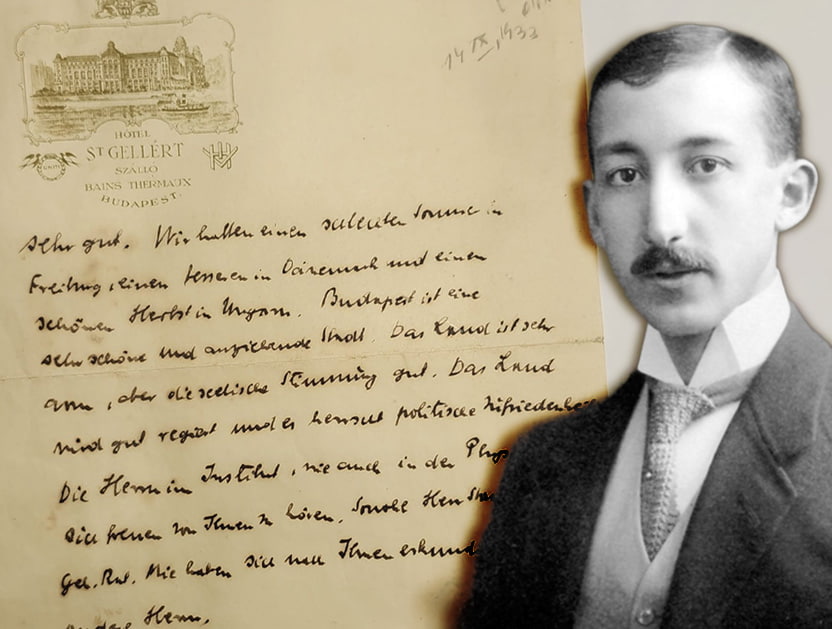
George Charles de Hevesy was born in Budapest in 1885 to a wealthy and prominent family of Jewish origin. His parents converted to Christianity to ease their integration into society, and he received a Catholic education.
After completing his studies, de Hevesy joined the laboratory of Ernest Rutherford, a pioneering researcher of nuclear physics, at the University of Manchester. Rutherford tasked him with an assignment that seemed simple: separate radioactive Radium D from ordinary lead. In practice, it proved impossible. Day after day, month after month, every experiment failed.
His promising career seemed to be unraveling. On the verge of giving up, de Hevesy had a breakthrough insight: the failure itself was the key.
The problem was not his method — it was that separation was fundamentally impossible. De Hevesy demonstrated that Radium D (now known as lead-210) and ordinary lead are chemically identical and therefore inseparable.
From this realization emerged a revolutionary idea. If radioactive and non-radioactive substances behave identically, the radioactive element can be used as a tracer—allowing scientists to follow chemical processes without disturbing them. Thus was born the radioactive tracer method.
This method not only exposed a dishonest landlady, but also transformed chemistry and medicine. It laid the foundations for modern imaging techniques such as PET and SPECT scans (technologies that allow us to map blood flow and examine metabolic processes and organ functionality, among other things) and is considered one of the most important scientific advances of the twentieth century.
What began as apparent failure became a defining breakthrough.
How Do You Stop Nazis from Seizing Nobel Gold? You Dissolve It.
De Hevesy’s work quickly marked him as one of Europe’s most promising young scientists and caught the attention of physicist Niels Bohr. He joined Bohr’s institute in Copenhagen, then among the world’s leading research centers.
In addition to Bohr himself, who won the 1922 Nobel Prize in Physics, a long line of leading scientists passed through the Niels Bohr Institute, among them Linus Pauling (the only person besides Marie Curie to have won two different Nobel Prizes, one in Chemistry in 1954 and the other the Nobel Peace Prize in 1962) and Werner Heisenberg (recipient of the 1932 Nobel Prize in Physics).

In 1935, the Nobel Peace Prize was awarded to German pacifist Carl von Ossietzky, an outspoken critic of the Nazi regime who had been imprisoned in a concentration camp. Enraged, the Nazis declared that all Germans were banned from accepting Nobel Prizes. Since the medals were made of gold, they were to be confiscated for the Reich.
Two German Nobel laureates, Max von Laue and the Jewish physicist James Franck, sent their medals to Bohr’s institute for safekeeping.
The situation became perilous in 1940, when Nazi Germany occupied Denmark. De Hevesy and his colleagues knew it was only a matter of time before German soldiers searched the institute for valuables. De Hevesy himself was in grave danger as a man of Jewish origin, and he prepared to flee. Before doing so, he acted.
Using his chemical expertise, de Hevesy created a batch of aqua regia (“royal water”), the only substance capable of dissolving gold, by mixing nitric and hydrochloric acids. He placed the Nobel medals into glass bottles filled with the solution. Slowly, the gold disappeared into a murky orange liquid. He then placed the bottles openly on a laboratory shelf.
To anyone else, they looked like ordinary chemical solutions. Only a handful of insiders knew that Nobel medals were hidden in plain sight.
Shortly afterward, de Hevesy fled to Sweden. When Nazi forces searched Bohr’s institute, they confiscated equipment and valuables, but left the bottles untouched.
After the war, de Hevesy returned to Copenhagen. The bottles were exactly where he had left them. He precipitated the gold from the solution and sent it to the Nobel Foundation, which agreed, as an exceptional measure, to recast the medals.
The gold had been saved.
De Hevesy did more than protect the Nobel medals of others. In 1944, while living as a refugee in Sweden and as European Jewry was being annihilated, he was awarded the Nobel Prize in Chemistry for his work on radioactive tracers.
That year, the Nobel Committee, perhaps pointedly, awarded several prizes to Jewish scientists forced into exile, including Otto Stern, Isidor Isaac Rabi, and Joseph Erlanger. One notable exception was the Chemistry Prize awarded to Otto Hahn without acknowledging his Jewish research partner Lise Meitner.
De Hevesy’s story is a reminder that even when circumstances seem hopeless, creativity and courage can open new paths forward, and that even in the darkest of times, great treasures can be hidden in the most surprising places, waiting to shine again.


