
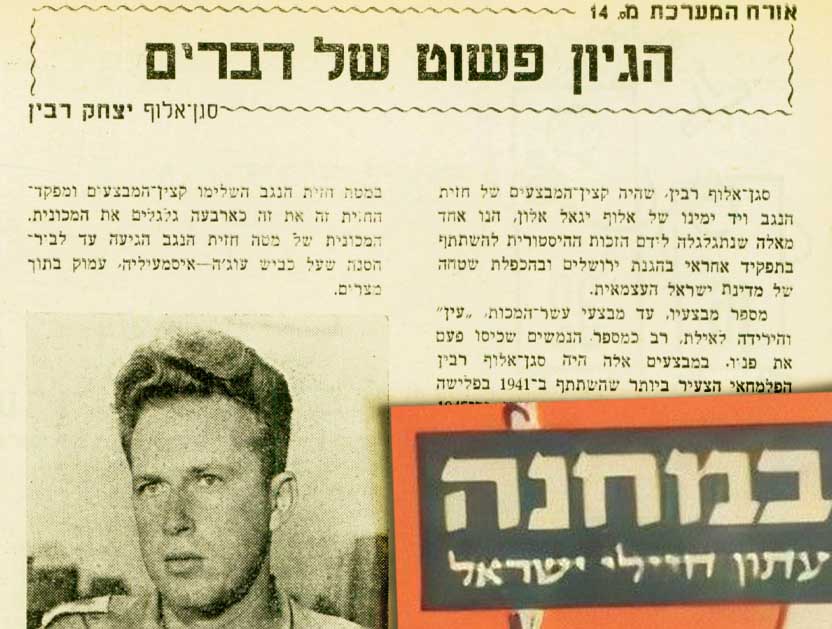
To mark the digitization of all issues of Bamahane, the IDF’s official weekly magazine, on the National Library of Israel’s Historical Jewish Press website, as well as thirty years since the assassination of Prime Minister Yitzhak Rabin, we return to what is (to the best of our knowledge) the first interview ever given by the man who was then a young IDF commander, aged 27. It is the most personal article we were able to find about Rabin, certainly about the young man he was, before he became a politician and public figure.
The interview appeared in issue no. 13 of Bamahane (Hebrew for “At Camp”) in November 1949, just a few months after the end of Israel’s War of Independence. The interviewer and author of the article, Shabtai Teveth, was only a few years younger than Rabin. His piece contains vivid and admiring descriptions of the promising young officer, already a battle-tested commander: “The number of his operations is as great as the number of freckles that once covered his face,” he wrote. At just 26, Rabin had been appointed commander of the Harel Brigade, responsible for breaking through to Jerusalem during the war and leading the fighting there. Later he commanded forces in the south, and by the end of the war was serving as operations officer for the Negev Front. As Teveth noted, Rabin was “always young for his rank.”

Bamahane magazine, where this interview appeared, is older than the State of Israel itself. It was founded in 1934 as an underground, mimeographed weekly of the Haganah organization. Some of the country’s leading writers contributed to it, including Leah Goldberg and Nathan Alterman. In early 1948 it began to appear in printed form, and by the end of that year, after the establishment of the Israel Defense Forces, it became the official publication of the Israeli army.

“As a child, he consumed the books of Jules Verne, and at home he was taught to think independently and to remain loyal to that way of thought,” wrote Teveth of Rabin’s upbringing. Readers learned that Rabin, a Tel Aviv native, had attended the Kadoorie Agricultural High School in the Jezreel Valley because he wished to become a farmer. He studied there as part of the school’s fourth class and befriended Yigal Allon, a member of Kadoorie’s first graduating class.
“Rabin, level-headed, moderate, coolly analytical, with the lowest bass voice ever heard over the IDF’s combat radio,” Teveth continued, attempting to get inside the young commander’s mind as Rabin explained Israel’s success in the War of Independence: “Once one approaches war as one would any profession or science that develops through stages, and attempts to examine the basic factors and the influence of each factor under different conditions, one concludes that what is required of anyone engaged in this field is logical, flexible, and clear thinking.”

As a member of the generation of Israelis who grew up in the pre-state Haganah and Palmach organizations before transitioning to the Israel Defense Forces, Rabin was asked by Teveth what had made that change possible: “How did people bridge the psychological and social gap between the Haganah and the IDF, between the Jewish Yishuv and the State of Israel?” Rabin’s answer still resonates with many of the changes the country has undergone: “We found people with simple, straightforward logic.”
At one point, Teveth suggested that Israel’s victory in the War of Independence had been a matter of luck. “The definition of the word ‘luck,’ insofar as it concerns the outcome of the war, is not clear to me. And why? Because the outcome of any war, or any other struggle, is the result of a balance of forces, and it cannot be otherwise,” Rabin replied. “The balance of forces cannot be measured only in numbers of men and weapons, it is also the quality of each person, from the non-combatant in the rear, through the fighting private, and up the entire chain of command. The level of fighting is the sum of intellectual, cognitive, and professional capacity. Any weapon used in this war could be anywhere from 0% to 100% effective, depending on the person operating it.”

Rabin also shared the most difficult moment he had experienced during the long, exhausting months of fighting. His words were brief and restrained, yet they reveal much, especially through what was left unsaid.
In April 1948, for three days and nights, Rabin and his soldiers from the Harel Brigade held their position at Beit Mahsir – a village in the Jerusalem hills, just south of Sha’ar HaGai, a point on the road leading from the coast to Jerusalem that was often the target of Arab attacks. They were under constant assault from the north by the forces of Fawzi al-Qawuqji, who commanded the Arab Salvation Army made up of volunteer fighters from across the Middle East. For the first time, Rabin’s brigade faced enemy artillery used to soften their defenses before an infantry assault. His men were exhausted and unaccustomed to such shelling. “There was a moment when we thought we could not hold on,” said the young brigade commander. Perhaps there was, after all, a touch of luck that affected the outcome?
“After consideration and consultation,” the article relates, “it was decided to muster every effort and try to hold out one more day. By the end of that day, the enemy attack was broken, and the next day it was not renewed.”
As Rabin advanced in rank and position, first in the IDF and later in Israeli politics, he naturally gave more and more interviews. These later ones were more formal and focused on military strategy or political matters. A few days after the Six-Day War, in which he served as Chief of Staff and led Israel to another resounding victory, Bamahane published a new interview with him. This time he was asked a personal question: “What was your personal feeling when you entered the gates of the [Old City of Jerusalem]?” Rabin replied, “It is difficult to express my feelings in words,” and added, “First, I was born in Jerusalem. Second, I spent most of the War of Independence […] in harsh, bloody, and protracted fighting as commander of the Harel Brigade in the Jerusalem battles. And third, like every Jew, the Old City and the Western Wall have a certain meaning, something that poets may be able to express, but that every Jew feels within himself.”


Is there something in that first interview with the young Rabin that hints at his later illustrious career and immense contribution to the country? In any case, it offers a rare glimpse into the essence of the man at the beginning of his journey: the quiet charisma, intellect, and devotion to his people and his nation – a combination that took him far.
During his second term as Prime Minister of Israel, on the night of November 4, 1995 (12 Heshvan 5756), immediately following a peace rally in Tel Aviv, Yitzhak Rabin was assassinated by Yigal Amir. This week marks thirty years since his murder.


