
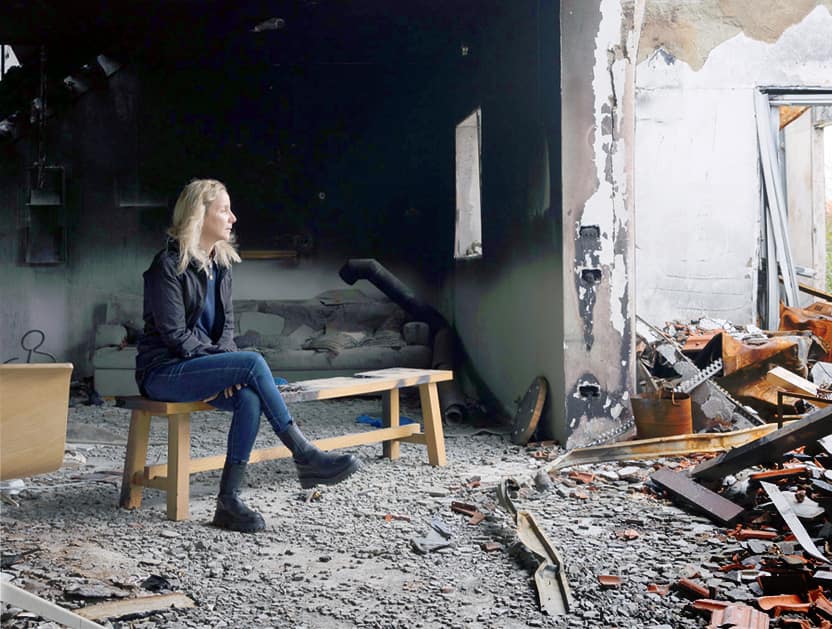
“When you’re in deep trauma, it’s very hard to look outward, to look ahead. But there’s something about this project – when you look at an object, even if it’s burned or broken, and try to imagine what it might look like after it’s repaired or turned into something new – for a moment, you can picture a future home. Maybe otherwise it would have taken much longer to reach that point. And that gives a little hope.”
It took several months before photographer Shunit Flako-Zaritsky fully understood the depth of her work, and that of the four remarkable women who joined her in the Comfort Object project – a holistic initiative that restores belongings from the homes of families in the Gaza border communities who were affected on October 7. The process of rescuing and transforming these objects not only revived something tangible from the families’ destroyed worlds but also offered them a lasting connection to the lives they once had.
***
In September 2023, Tal Sterlin Halperin had just returned to Israel after a year in the United States and was busy adjusting to life back home. In the weeks after October 7, she watched the images of burned and shattered houses on television, alongside footage of thousands of Israelis collecting donations: clothes, shoes, and anything else that might help the residents of the western Negev who had lost everything. Having just experienced firsthand how hard it can be to feel at home in a new place, an idea began to take shape. She thought that the least she could do for those families was to help them recover something – an item, small or large, charred or intact – that could serve as a bridge, a keepsake from their old home, something they could carry with them into the future and, eventually, into a new home that would one day be rebuilt.

Tal knew that the work itself – retrieving and handling what could be found – would be physically demanding, and that documenting the process would be just as significant. Two childhood friends immediately came to mind – people she knew she could count on: furniture restorer and artist Maya Gal, as well as photographer and artist Shunit Flako-Zaritsky. Both joined the emerging project without hesitation.
Recognizing how much sensitivity would be needed when working with these families, Tal also reached out to another longtime friend, bibliotherapist Dr. Biri Rottenberg, and asked her to accompany the initiative. The team later expanded to include curator Michal Krasny, whom Shunit knew from previous exhibitions. At their first meeting together in a Tel Aviv café, they shaped the project’s concept — and came up with its name: Hefetz Ma’avar, Hebrew for “Transitional Object.” In English, the name Comfort Object was chosen. They were later joined by Dr. Shani Pitcho, a trauma and loss researcher from the Department of Social Work at Ben-Gurion University of the Negev, who is studying the project’s impact on both the participating families and the team itself.
Each of these women, feeling she had to do something in the wake of October 7, brought her own background and expertise to the collective effort.

The term “transitional object” comes from the world of therapy. It was coined by British psychoanalyst Donald Winnicott to describe a physical object that provides a sense of home and inner security, helping infants and young children move from a state of uncertainty to one of comfort and calm. Most of us are familiar with children’s transitional comfort objects – a blanket, a doll, or another soft item – but for families of the western Negev who lost so much, every surviving object now carries new weight, symbolic and emotional meanings far beyond those it held before October 7.
Once they decided to work together, the women began offering their help to evacuated families through kibbutz and community coordinators, social media, and personal contacts – anyone who could connect them with displaced residents of the western Negev now living in temporary housing across Israel. The first response came via Instagram, from a family in Kibbutz Be’eri. From that moment on, they never stopped. Since the project began, they have helped nearly forty families undergo a process centered on a rescued item from their former homes.
The relationship formed with each family is intimate, they explain – built on trust and cooperation. Decisions about what to do with each object are made through ongoing dialogue with the family. Some families are focused on documentation, creating a memory to carry forward. Others want to restore damaged pieces for everyday use. Each process is different, unfolding at its own pace, in its own way. Sometimes families ask that several new pieces be created from a single surviving item, so that it can be shared among the children.
After an introductory conversation, once trust has been established, Tal arranges a meeting with certain members of the family, either in their temporary home or in the damaged house itself, with or without other family members being present, depending on their wishes. “What amazed us,” she says, “was that some families told us, ‘Don’t bother, there’s nothing left, everything burned.’ But we went anyway, and suddenly we found things they hadn’t even noticed. Sometimes they asked us to take one thing, and we ended up finding something completely different. We look at what survived through different eyes.”

The work on the transitional objects takes place in Maya’s studio, where she restores different kinds of furniture, household items, and tools recovered from the homes. When a specific craft is needed – embroidery, jewelry, ceramics – the team collaborates with artists who specialize in those fields.
Comfort Object enables families to go through a process on several levels: documentary – preserving a tangible piece of their world before October 7; artistic -creating an aesthetic object to decorate their new home; and emotional – beginning to process what they went through by working with the objects themselves.
The Bench at the Heart of the Home
The first family the project worked with was the Segev family from Kibbutz Be’eri. That winter, they met Sharon, the mother, in her burned home, a place she had believed held nothing left to save. When they entered the Segev home, in the middle of the charred living room that had once been the center of family life, they found an ordinary Ikea bench, half burned and warped.


Sharon and Doron Segev and their three children survived October 7 after spending long hours sealed in their home’s safe room, without air, food, or water. When they visited the burned house together with the project team, Sharon told the women how the terrorists set fire to their home and how the family began to suffocate. Ironically, when the terrorists tried to blow up the safe-room window with an explosive charge, they created a small crack through which the family members could, one at a time, take in a bit of air.
When Maya saw the bench, she could already imagine how she would restore it: filling in the burned parts, painting the blackened areas in gold, and sealing the missing sections with transparent epoxy. She created an object that represents three moments in time – life before October 7, the blackness that was added on that day, and the present, represented by the fact that the bench remains strong and functional, still standing in the middle of the Segev family’s new home. The family, together with other Be’eri residents, has relocated to temporary housing in Kibbutz Hatzerim. Maya worked on the bench for many long hours, and when she finished, she broke down in tears. Those moments of work and release were documented by the project’s photographer, Shunit Flako-Zaritsky.

Photo: Shunit Flako-Zaritsky.

***
Collecting the objects from destroyed homes, working on them in the studio, documenting the process of restoration and transformation, and the final result – all of these allow for a rare glimpse into a process that usually remains hidden. Those who look at this documentation experience a process of discovery and renewal, alongside an emotional process that arises from working with an object that reveals itself as something new – different from what it was before. The photographs combine aspects of documentation, art, and testimony to what took place on October 7.

Shunit’s documentation work in the burned and destroyed houses posed many challenges. “Most of the homes are very dark, with no electricity, and to keep animals out, the windows are boarded with wooden planks, so no light enters. The spaces inside the homes are small, and everything is black and covered in soot. I shoot mostly with a tripod and long exposures,” she says.
The entire project was done on a volunteer basis, initially without any financial support, so the women often relied on help from their families. The sensitivity required in handling these materials also meant they could only work with people they completely trusted. “With every object that needed to be moved to the studio – I needed to know I could trust the person carrying it with my eyes closed,” Tal shares.
The House’s Pillar of Memory Becomes Tables of Love
In the home of the late Adrienne Neta, 66, from Kibbutz Be’eri, there was a single distinctive pillar covered in beautiful sky-blue ceramic tiles, all handmade by Adrienne herself. Her daughter, Dror Neta, contacted the women of the project and asked them to help remove the ceramic tiles that remained as a silent testimony to her beloved mother who was murdered on October 7, though she did not yet know what she wanted to do with them.

Photo: Shunit Flako-Zaritsky.

Adrienne was born in the United States. She fell in love with and married Yisrael, a member of Kibbutz Be’eri. The couple had four children. She worked as a beloved and respected midwife at Soroka Hospital. Even after her retirement, she continued to volunteer and to be present in the lives of her children and grandchildren. On that terrible day, Adrienne was alone in her home, where she was murdered.
The fragile tiles required special care. They were extremely delicate, and removing them without damage required precise, patient work. To do this, photographer Shunit enlisted her brother Jonathan, who, with great care and reverence, succeeded in removing them all intact. Together with the family, and with artist Maya Gal, who suggested viewing the tiles as a kind of special mosaic, they decided to create five small tables from them. Maya worked on the tables with great attention to detail, and today each family member has a unique keepsake in memory of Adrienne.

Photo: Shunit Flako-Zaritsky.

A New Picture When No Pictures Remain
Hanna andShlomo Margalit of Kibbutz Nir Oz survived that terrible day thanks to stamp albums. The elderly couple realized that they needed to somehow secure the handle of the safe-room door in their home. They pushed a rolling cabinet against it, but it wasn’t tall enough. With quick thinking, Shlomo stacked stamp albums that were stored inside the safe room on top of the cabinet until they reached the height of the handle, making it impossible to open the door, and that saved their lives when terrorists entered their home and took it over.
Hanna and Shlomo asked to have an armchair and a standing lamp restored – both dear to them – that had been in their living room that day. When Hanna was asked why she chose those particular items, she said, “They were witnesses to everything that happened in the house, to the chaos while we were closed inside the safe room.” The house was looted but not burned, perhaps because the terrorists broke a pipe and flooded the house. The armchair was riddled with bullet holes, and the lamp, a gift to Shlomo from his mother, was broken. Artist Maya Gal restored both pieces lovingly, and Hanna and Shlomo were deeply grateful.

Then Shunit, the photographer, had another idea: to create a special photograph of the couple with the restored objects. When she develops ideas for staged photos like this, she first consults with Dr. Biri Rottenberg, the bibliotherapist who accompanies the project, to assess whether the idea makes sense, whether it might hold meaning for the family, and if so, how best to approach them and present it. The teamwork and close multidisciplinary collaboration among the women of the initiative have led to remarkable results, and people around the world are eager to learn about this unique aspect of Comfort Object.

Photo: Shunit Flako-Zaritsky.
When they arrived at the kibbutz, they searched for the right location to take the photo. Not far from their home, Hanna saw a burned tree with new green branches beginning to sprout from its trunk, exhibiting the unstoppable, incredible force of nature. She asked Shunit to include it in the frame. “She saw in it hope,” says Shunit. “Just as it came back to life, she felt they too would be able to return to Nir Oz and rebuild.”
“The day of the shoot was surreal,” she recalls. “The Gaza border was turbulent – there were constant explosions and gunfire. I brought the restored armchair and lamp, and we placed them on the road that circles the kibbutz, very close to their home, at a spot from which you can see Gaza.” The photo shoot went smoothly, and the result remains a lasting source of pride.

The photograph of the couple, with the surviving objects from their home and the burned tree sprouting its new green leaves, was printed and displayed in an exhibition organized by the women of Comfort Object in Tel Aviv in 2024. “At first, they were embarrassed to see the large, staged photo printed and exhibited,” says Shunit. “We asked if they wanted us to take it down. They said, ‘No, of course not.’ At the end of the exhibition, they asked to take it home, and now it hangs in their living room in Karmey Gat. Every time someone visits, they see the photo and ask about it, and it makes them happy to tell the story.” Like many other families, the Margalits have become close friends of the women behind Comfort Object. “I visit Hanna and Shlomo whenever I can,” says Shunit. “I just miss them, so I go for a visit.”

“Beyond the terrible physical and emotional losses, they also lost their sense of control over their lives on that horrific Saturday. We’re trying to give them back just a little of that,” explains Shunit. For this reason, everything in the project is done through full cooperation and ongoing dialogue with the families.
***
Another staged photograph that Shunit produced was for Nira Sharabi, the widow of Yossi Sharabi, who was abducted from his kibbutz, Be’eri, and killed in Hamas captivity. Nira reached out to the women of the project after learning that Yossi was no longer alive. By then, their home in Kibbutz Be’eri, where they had lived with their three daughters, had already been demolished. It was badly damaged on October 7 and was in danger of collapsing. All that remained for Nira were a few small decorative objects that she wanted to have restored, to decorate her new home in Kibbutz Hatzerim. When Shunit met her, a special bond formed between them. “I realized,” says Shunit, “that the most important thing for Nira was to tell Yossi’s story.”
Out of their conversations about Yossi, the idea for the photograph emerged. “She told me about who Yossi was: someone who lived life to the fullest, who loved soccer, surfing, traveling, and for whom family was everything. I tried to imagine how to stage a photograph that would somehow include him, perhaps with his surfboard, but it was impossible. Not a single one of his belongings had survived. There was absolutely nothing left in the house. The only items Nira still had were a few clothes that Yossi had sent to the kibbutz laundry, which had remained there. Of course, they no longer carried his scent, but still, it was something.
“The photograph was taken on the site where their home once stood. You can see two chairs from the Be’eri dining hall: Nira sits on one, and on the other are Yossi’s few remaining clothes, the only things she has left of him.”


The Comfort Object project is scheduled to conclude at the end of this year. “The connections we’ve formed remain with us,” says Shunit. “Knowing that we were able to offer an act of kindness in the face of the terrible evil they experienced gives a sense of meaning, that we gave something, a little light and hope in a dark place.”
***
You can learn more about the Comfort Object project here. The initiative operates with the support and funding of private donors who wish to remain anonymous, with assistance from the Jewish Agency’s Fund for Victims of Terror, the Azrieli Group, F2 Venture Capital, and in partnership with key organizations including the Eretz-Ir Association and Yad Yitzhak Ben-Zvi’s Eretz Hefetz initiative.
Comfort Object is a partner project of the Bearing Witness October 7 Archive, coordinated and managed by the National Library of Israel in cooperation with the Ministry of Heritage. The archive is a national effort to document all materials related to October 7 and the ensuing war, and is preserved at the National Library so that it will remain accessible to researchers, educators, the general public, and future generations.
To date, the archive has collected more than two million files of various types: testimonies, WhatsApp messages, photographs, videos, eulogies, diaries, and more. The October 7 Archive works with over one hundred initiatives and partner projects and is now in the process of integrating these materials into the Library’s catalog and preparing them for public access.


