“To be able to have coffee whenever we want” - that was how David Meir, of blessed memory, defined economic independence. He worked to help those around him gain financial literacy. David grew up in the community of Kochav HaShachar, founded by his parents, and served in the IDF's elite Sayeret Matkal unit. On October 7, he was among the first to reach the Gaza border communities and was killed in battle at Kibbutz Be’eri. A special edition of the book "The Psychology of Money" has now been released in his memory.
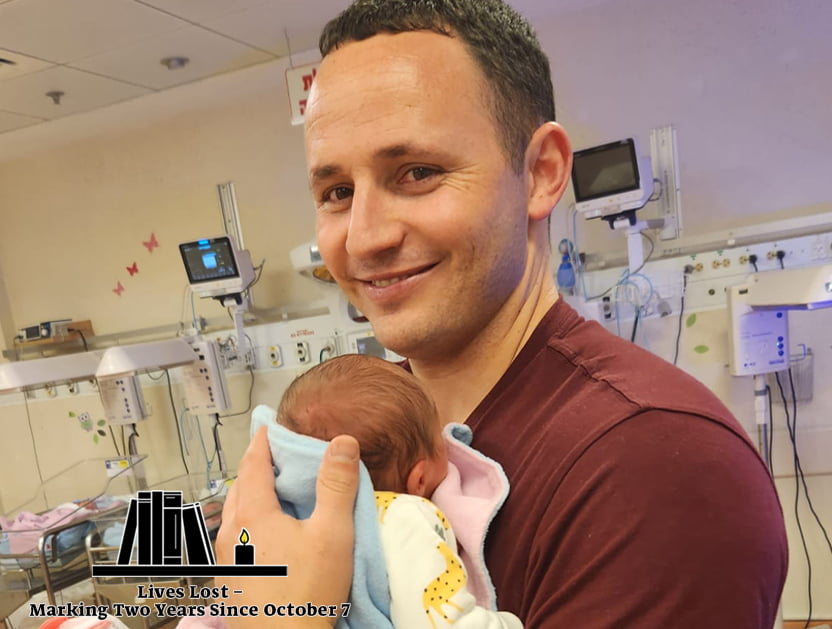
David Meir z”l and his son Shaked, from a family album.
Unlike many other couples across Israel, David and Anat Meir did not wake up early in panic on October 7, 2023. On the contrary, they slept soundly and only got up around 10:30 am. The night before, at the “Korazin” synagogue in the Nachlaot neighborhood of Jerusalem, where they regularly prayed, David had danced the hakafot for the first time with his eldest son, Shaked, then a seven-month-old baby. Even the sirens that sounded in Jerusalem that day, piercing through the usual silence of the holiday morning, did not manage to wake them. They rose peacefully, and David began preparing for synagogue, contemplating whether to take Shaked with him.
Anat, David, and Shaked Meir. All the photos in this article appear courtesy of the family.
But soon after they woke, they realized something was terribly wrong. His widow Anat recalls: “Suddenly my commander called me. At the time I was working in the police spokesperson’s office, and I said to David, ‘What is this, why is Efrat calling me on a holiday?’ At first I thought not to answer, but then David told me, ‘If she’s calling, it means something has happened – answer.’ So I picked up, and while I was still in bed she put me on a conference call, and they started talking about the many police casualties and fatalities, and I couldn’t understand what was going on. David’s phone was off because of the holiday, and he immediately went to turn it on. Within a minute of switching it on he said to me, ‘Honey, I’m leaving.’ And that was it. He grabbed a bag, and within ten minutes he was gone. I walked him to the door, crying, and just before he left he turned back for a moment, gave me a hug, and then went. During the day we exchanged a few messages, and from time to time he wrote me that he was okay, until he no longer replied.”
David Meir, of blessed memory, was a reservist in the IDF’s elite Sayeret Matkal unit and among the first to be called up and reach the combat zones in the south. His team was one of the first forces to arrive at Kibbutz Kfar Aza, and by midday they were dispatched to Kibbutz Be’eri.
David Meir z”l served in the Sayeret Matkal unit
David was at the head of the force together with Yadin Gellman, and around 3 pm they entered Kibbutz Be’eri. The unit went house to house, trying to clear the buildings of the terrorists barricaded inside and to rescue the trapped residents. In the evening, as they stormed one of the kibbutz buildings, Yadin and David were shot from a side window of the kibbutz library. Under fire, they managed to drag themselves to cover beneath the library building, where they waited for evacuation, both critically wounded. They remained fully conscious as they waited together. After about an hour, they were evacuated under heavy fire. On the evacuation helicopter David lost consciousness, and shortly before 9 pm his death was declared. Yadin, critically wounded, fought for his life but in the end survived and recovered.
*
David was the youngest child in a large family of pioneers and builders. His parents, Yair and Chaya, were among the founders of Ofra and later helped found the community of Kochav HaShachar, where he was raised. David was very close to his family and parents. “Once I asked him, what are you afraid of?” Anat recalls. “The only thing he said was, ‘Losing my parents.’”
David Meir was a man of action, the kind who sets a goal and does everything it takes to achieve it. “He was very straightforward. If something needed to be done, then it was done, that’s all. Without agonizing over questions like ‘Do I feel like it, do I not feel like it.’ If it meant calling the CEO, then you just picked up the phone and called the CEO, and that was it. He wasn’t the kind of person to get tangled up in life,” says Anat.
Even during his mandatory army service, David began to take an interest in the world of finance. One of his teammates had a father who worked as a financier dealing with the stock market, and David seized the opportunity and began to learn. For years, in his free time, he would travel for long study sessions with his friend’s father. They started with basic concepts, then moved on to economic and financial models and even the psychology of risk. As with everything in David’s life, he learned finance first and foremost in a practical, self-taught way. Later he completed a degree in economics at Bar-Ilan University, but according to Anat that was mainly just to check a box for his résumé: “He already knew everything he needed.”
“When you grow up in a very values-driven home, it can sometimes create dilemmas around money. The feeling is that ‘dealing with money’ can contradict a life of values,” Anat explains. But for David, the opposite was true. It was precisely his commitment to living a life of values that led him to take an interest in money and investments. For him, money was a means, never an end in itself. “Two weeks before he was killed,” Anat shares, “we were sitting in a café in downtown Jerusalem. He looked at me and said: ‘Honey, this is what I want – for us to be able to have coffee whenever we want.’ For him, that was what money was for, to give you the freedom to live the life you want.”
Anat and David Meir.
The more David learned about financial literacy, the more he realized how little ordinary people understood. He saw that most people did not even know the basic terms of economics and finance that are essential for everyday money management. “When we first met,” Anat recalls, “I had already been working for a few years and was still living with my parents. I had managed to save up some money, and on one of our dates he asked me where my money was. I said, ‘What do you mean where? In my checking account at the bank. I need to see it there to feel safe that it’s there.’ He laughed and made it his own personal project to explain things to me. Today I tell myself – ‘How many years did that money just sit in my account? What a waste!’ I knew nothing. I was afraid of the whole subject. It didn’t interest me, and without David I would have gone on not knowing and being afraid of it.”
“It bothered him that people didn’t even know the basics,” Anat says. “So he took it upon himself to teach and explain. He would sit with people, break things down, simplify, and try to turn big concepts into clear, everyday examples. Once he even ran an entire evening Zoom session on financial fundamentals for anyone who wanted to join,” she adds.
“We’re a big family,” says Dr. Chaim Neria, David’s cousin and curator of the Haim and Hanna SolomonJudaica Collection at the National Library of Israel. “David was among the younger cousins, while I was closer in age to his older brother, Uri. I remember one family wedding when David sat next to me, with that smile of his, and started asking me more and more questions about business and international affairs. It was the beginning of his path, but he already had big dreams and a drive to branch out into new directions. At first I was surprised, but pretty quickly I saw he was one of those people who had that special spark. He had motivation, the will to succeed, the readiness to take risks, and the ability to make his own way. It was clear that even if it took time, this young man was going to succeed.”
One of his favorite books, which he quoted often, was The Psychology of Money, by Morgan Housel. Even Anat, who usually had little interest in finance, was drawn in after David introduced it to her. “It’s a book about people more than a book about money,” she says. “About how the mind works, about fear and greed and patience and liquidity. It’s written in a very straightforward, simple style. Very human.” David recommended the book to many of his friends, quoted from it constantly, and often sent out photos of entire passages.
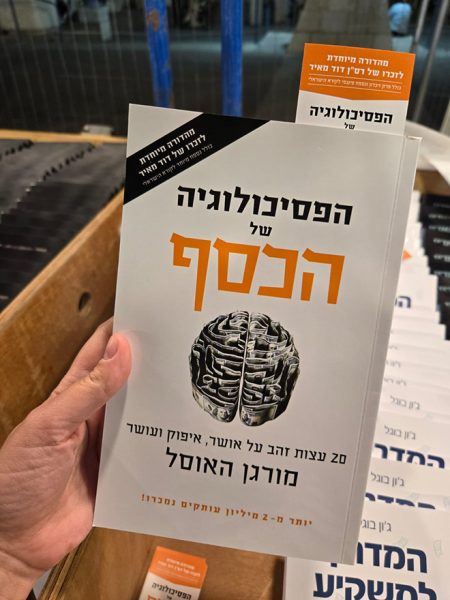
A special Hebrew edition of The Psychology of Money by Morgan Housel, printed in memory of David Meir, z”l.
***
Seven months before he was killed in the fighting at Kibbutz Be’eri, David became a father to Shaked. Fatherhood, Anat says, brought out a new tenderness in him. “He was one of those fathers who walked around with stars in their eyes. He was utterly in love with Shaked,” she shares.
David, who loved old Israeli songs and whose favorite pastime was community sing-alongs, loved to sing to Shaked. One of the songs he often sang to his son was Shiro Shel Aba (“Father’s Song”), written by the iconic Israeli songwriter Naomi Shemer.
A few days after he was killed, Anat found a video on her phone of David singing the song to Shaked. The family decided to engrave a line from the song on his gravestone. Here is the translation:
“Not in vain, my brother, did you quarry stone for a new building, for from these very stones a sanctuary shall be built.”
Choosing that line “was very, very precise for us,” Anat explains. “For us it was like a testament, a message that gave us faith and strength, that ‘there’s no way all of this happened in vain.’ Something good has to come out of this disaster, out of everything that happened. And I also think the song really reflects David. On the one hand it’s a song by Naomi Shemer, but it’s also a song about the sanctuary, the Temple. That combination, between Israeli identity and Judaism, that connection was something that very much defined David.”
David and Shaked.
***
When the time came to think about a memorial project for David, Anat knew it had to involve financial education. Together with the Barak Hess Consulting and Investment firm, where David had worked in the last year of his life, they decided to publish a special edition of the book in his memory. The publishing house Sela Meir, which had originally released the book in Hebrew, agreed immediately.
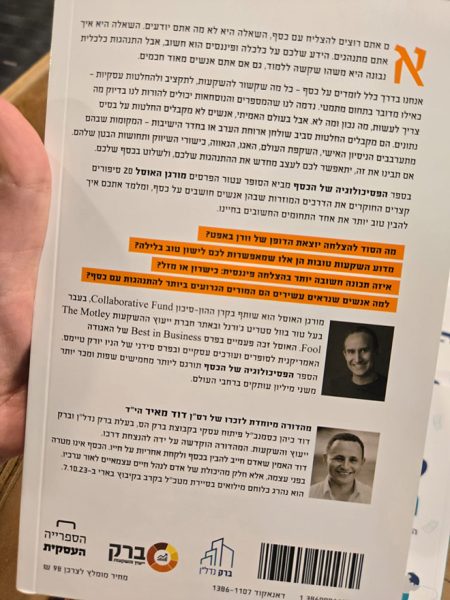
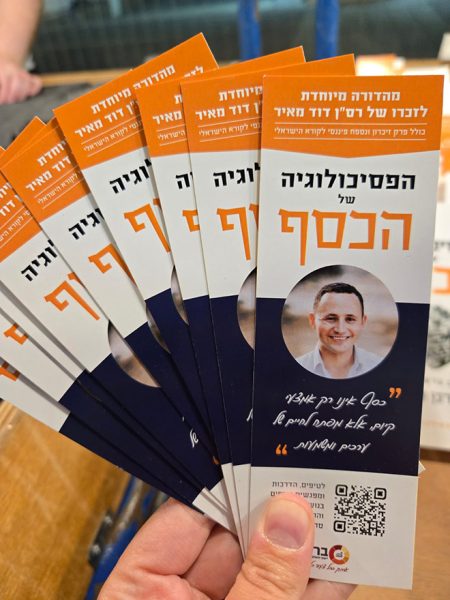
Thus a special memorial Hebrew edition of Morgan Housel’s The Psychology of Money was created in David Meir’s name: a new cover featuring a dedication and his photograph; a first chapter that is a memorial profile, telling his life story with photographs; and at the end, a financial appendix for Israeli readers, adapting the book’s core ideas to the local context: pensions, savings funds, the Israeli stock market, basic taxation, rules of thumb for making decisions, and key questions to ask before signing. The books also features a number of introductions written by people who knew David.
The back cover of the special edition of The Psychology of Money, published in memory of David Meir z”l.
“The news of his death was devastating,” says Dr. Neria. “David was not the first to fall in our family. Before him was our cousin Ahikam Amichai HYD, and it felt as though the family’s wound had been reopened. David’s father, Yair – a strong and remarkable man who for years helped people through the Paamonim program and in other frameworks to manage their budgets and expenses – also passed away a few months after David was killed. I see Anat, David’s widow, his brothers and sisters, and Chaya, my aunt, coping with this double loss. I am deeply moved by their strength, and especially by the unconventional ways they have chosen to face their grief and commemorate him. It takes courage to speak about money after what happened, but that courage is so very David.”
The hope is that this special edition of the book will be just the first step in a broader initiative to make financial education accessible to the wider public, following David’s vision and in his memory. David often said, “Money is not a goal, it is a responsibility.” A responsibility to understand how to manage the life you want to create, what it takes to make it happen, and how not to lose your heart and values along the way.
The special edition can be purchased at a subsidized price through the Sela Meir publishing website at https://bit.ly/3ZRFMgE using the coupon code BARAK for a discount.