
By Amir ben-Amram
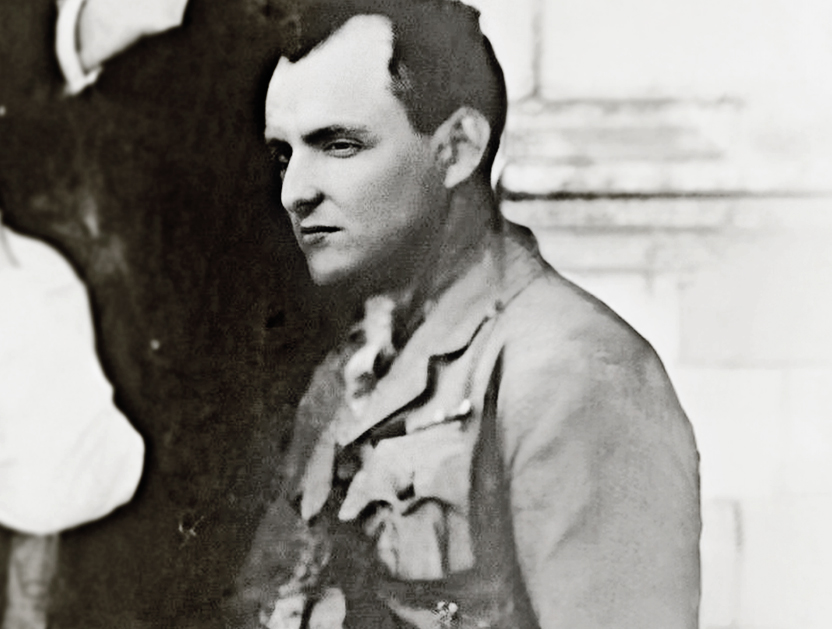
In the Haim Harari Archive at the Gnazim Institute, nestled among yellowing papers and memories from the First World War, a French military postcard was discovered some time ago. It contained a brief message in French, written under the restrictions of army censorship – yet beneath the surface, the message also carried another voice, a Hebrew voice. The card was sent by a soldier in the French Foreign Legion on the Western Front: Menachem Asher Saphir. Here is what he wrote, loosely translated:
“Dear Mr. Harari,
I’m puzzled not to have received a reply to my last letter. How are you? Have you had any news from Palestine? […] I’m well, thankfully, for now – though tomorrow, who knows. […] Shalom, yours, Saphir”
What was a Jewish native of the Land of Israel doing in the trenches of the French army? What would drive a young man from Jerusalem to risk his life under foreign fire on a faraway front? That postcard stirred my curiosity – and led me to the story of a nearly forgotten figure: a journalist, a diplomat, a behind-the-scenes mediator whose face flickers in the background of press photos and in passing mentions scattered through diaries and confidential reports. This is the story of Menachem Asher Saphir – as told by the documents.


Roots and First Steps
His family settled in the Land of Israel as early as 1832, among the disciples of the Vilna Gaon. But they weren’t confined to the study hall. His grandfather, Rabbi Yaakov Halevi Saphir, carried a different kind of title: he was a shadar, an emissary to Yemen, a researcher of Jewish communities, and the author of Even Sapir – a travel narrative that also stands as an ethnographic document and an early work of Zionist thought. His brother, Eliyahu Saphir, was one of the founders of the Anglo-Palestine Bank. His uncle, Zalman Natan Saphir, wrote for the newspaper HaLevanon. In fact, all three men were writers who contributed to the paper. It was into this Eastern European–Jerusalemite mosaic that Asher Saphir was born, likely in 1893. There are no surviving records of his childhood – perhaps because it was unremarkable – but by the early 1910s, he took an unexpected step: a journey to the capital of the Ottoman Empire, Constantinople, to study law.
Constantinople: An Intellectual Hub
He wasn’t alone. At the time, Constantinople was a hotbed of intellectual ferment in the Middle East. Clubs, cafés, salons – new political and cultural currents emerged from every direction. The Young Turks had already overthrown the Sultan, and Pan-Arabism was on the rise. There, in the thick of it, Saphir forged surprising friendships: ties with figures like Emir Shakib Arslan, Aziz Al-Masri, and Nuri al-Said – names that would later be etched into the annals of Arab political history.
Between café conversations and university debates, Saphir began to write. His first journalistic post was as a correspondent for the German newspaper Osmanischer Lloyd – a step that might be seen as the beginning of his public career. But it quickly became clear that Saphir wasn’t content with writing alone.
1913: From Reporter to Diplomat
One day, he turned up at a hotel where sensitive negotiations were underway between a Bulgarian delegate and a representative of the Ottoman government, right in the midst of the Balkan Wars. Somehow, this young man in his twenties found himself at the heart of a delicate diplomatic effort, earning the trust of both parties and helping to move the talks forward. The result: a signed agreement. In the years that followed, Saphir’s acquaintances would recall how he proudly displayed the silver pen used to sign the deal. The event caused a stir and was reported in several Jewish newspapers of the time, which celebrated the young diplomat as “one of our own.”

Perhaps this early success inspired the driven young man to pursue his future in “the cultural capital of the world,” Paris. His young Arab peers may have acknowledged Constantinople as the capital of the Ottoman Empire, but they considered it provincial next to Paris. So Saphir made his way to the Sorbonne, where he continued his studies and remained close with members of the Arab nationalist movement – many of whom found Paris a more comfortable base of operations than the Turkish capital. It was there that they founded the society Al-Arabiya Al-Fatat (“The Young Arabs”), and there, in June 1913, that a “Pan-Arab Congress” was convened. Among those Saphir was in contact with were Awni Abd al-Hadi, who would later serve on the Arab Executive Committee, and Jamil Mardam, a future Prime Minister of Syria.
1914: War and a Twist
The good times in Paris came to an abrupt end with the outbreak of World War I. As Ottoman subjects, students from Palestine were barred from continuing their studies. While some escaped to neutral Switzerland, Saphir took a different, unexpected path: he volunteered for the French Foreign Legion. He was not alone. In fact, during the first three weeks of the war, some 6,000 Jews enlisted in the French military. It’s unclear exactly how much influence Saphir had on this development, but David Tidhar, author of The Encyclopedia of the Pioneers of the Yishuv and Its Builders, wrote that Saphir “helped organize 4,000 Jews to volunteer for the Legion.”

These Jewish volunteers fought with great courage, despite often being treated with condescension by French officers. Saphir’s unit – the 2nd Regiment – was deployed to the Artois front in northeastern France. During the Battle of Carency, Saphir, who served as a communications officer, was decorated for bravery under fire. According to Tidhar’s encyclopedia, he was wounded twice over the course of the war.
By 1915, Saphir had been transferred to Thessaloniki, where he served as an adjutant – a position requiring linguistic skill and the ability to mediate across cultures. By this point, it seems, he was already seen as an officer with a head on his shoulders, an orientalist, a mediator. It was a role that foreshadowed his later career.
Jerusalem, 1918: A Zionist in French Uniform
In 1918, Saphir arrived in Jerusalem. (A French delegation led by François Georges-Picot – of Sykes–Picot fame – had been stationed in the city since Allenby’s entry in 1917.) In a photo from that year, Saphir appears in uniform alongside a Zionist delegation at the Western Wall.

Even while still in uniform, he wasted no time becoming involved in Zionist affairs. Throughout the interwar period, he moved between Jerusalem, Thessaloniki, and Paris.
A glimpse into this period appears in a letter written by Ze’ev Jabotinsky to Harry Friedenwald on March 9, 1919 (Friedenwald was then acting chairman of the Zionist Commission). Jabotinsky wrote:
Lieutenant Colonel Havard, the former military governor of Jaffa, said in the officers’ lounge of the YMCA building in Jaffa – in the presence of both British and French officers – that if pogroms were to break out against Jews in Jaffa, he would not intervene. Two French officers who were present at the time – Dr. Lindsay and Saphir – reported these remarks to the Zionist Commission.
In 1920, Saphir attended the Zionist Conference in London as the representative of the city of Thessaloniki – though he seems to have spent most of his time in Jerusalem (which likely already had a representative). From London, he filed reports for his newspaper Doar HaYom – but more on that later.
1922: Secret Diplomacy
In 1922, Saphir played a central role in one of the most significant events of his career – acting as a covert envoy for the Zionist Organization under Chaim Weizmann. The event was a secret round of negotiations between the Zionist movement and “Arab representatives from Syria and Palestine.” The talks took place in Cairo. Representing the Zionist side were Dr. David Eder, a British Zionist and trusted aide of Weizmann; Felix De Menasce, an Egyptian banker and Zionist leader; and Asher Saphir. For Saphir, it was a rare chance to realize his vision of Jewish–Arab cooperation between the two national movements. On the Arab side were Sheikh Rashid Rida, a leader of the Syrian Unity Party; Rida Bey al-Solh, also from Syria; and Emil Kuri, a Christian Arab journalist from Egypt.

The agreement the negotiating parties sought to formulate was based on shared interests: the Arabs’ desire for independence from colonial powers, and their willingness to cooperate with the Jews, whom they viewed as “bringing with them a progressive culture, but not representing a colonial force.” In return, the Jewish side agreed not to base their demands on the Balfour Declaration. In exchange, they asked for an end to incitement and acts of hostility toward the Jewish population of the land (the Yishuv), and a commitment to maintaining good neighborly relations in the future. The discussions were seen as a preliminary stage toward the establishment of a joint committee that would formalize the agreement. That committee was never formed, and the hoped-for accord was never signed.
The 1922 talks were kept secret, but in 1937 Saphir published them in a self-funded pamphlet. He had hoped to testify before the Peel Commission; when that opportunity was denied, he sent them the pamphlet instead. A summary was also published in the newspaper Davar. This may have marked a breaking point. The idea of Zionist–Arab cooperation was pushed to the sidelines, and Saphir – who had tried to be a bridge between the sides – was left holding only documentation and a sense of missed opportunity.

“Doar HaYom”: A New Voice, an Old Struggle
In 1919, in Jerusalem, a young but determined group set out to create a different kind of journalistic voice. They called themselves the Hasolel Group (named after a Jerusalem street), and included figures like Itamar Ben-Avi, Alexander Aaronsohn, Rivka Aaronsohn – and Asher Saphir.
They weren’t content with idealistic declarations or eloquent phrases. They founded a newspaper that appeared in three languages:
Doar HaYom in Hebrew, Palestine Weekly in English, Barid al-Yom in Arabic.
Itamar Ben-Avi served as editor-in-chief. Asher Saphir took on the role of managing director – but he was also a writer, fundraiser, liaison, and policy shaper. This was a different kind of journalism – not the restrained, Western tone of Haaretz, but an Eastern, energetic, and direct voice.
Why create a new newspaper?
Rivka Aaronsohn put it simply in an interview with the American newspaper, The Hebrew Standard:
“We wanted freedom of expression… We wanted a paper with an open policy and a desire to improve all of Palestine… We couldn’t express our views in the existing paper [i.e., Haaretz*].”*
Indeed, the first issue of Doar HaYom, published on August 8, 1919, proclaimed:
“The time has come for the young Land of Israel – especially for those born here… We are free birds […] Easterners we wish to remain, […] and Westerners – along with all the rest […] Give us electricity and Orith [light], give us airplanes and wireless.”
Saphir and his colleagues spoke in a new voice – native-born, Zionist yet cosmopolitan, hopeful yet sharply critical. Not everyone was a fan.
Clash With “Haaretz” – and With the Establishment
The reactions were swift. Moshe Glickson, writing in HaPoel HaTzair, accused Doar HaYom of being “yellow journalism” and said it was “becoming more harmful to our national cause by the day.” Haaretz simply called it a threat to the revival of a Jewish state.
Eliezer Ben-Yehuda, however, defended the paper with sharp words:
“Haaretz may be respectable, but it’s not a newspaper. Doar HaYom may not be respectable – but it is a newspaper.”
The controversy wasn’t only about tone and style. It was also about content and ideology. Doar HaYom promoted Arab–Jewish cooperation, cultural integration, and even criticism of core Zionist figures like Menachem Ussishkin. It was a political stance – and during that period, Saphir was the one shaping it. A photo from the Gnazim Institute shows the newspaper’s three founders: Saphir seated on the right, Itamar Ben-Avi standing, and Alexander Aaronsohn beside them. A fresh issue of Doar HaYom lies on the table. It’s more than just a press photo – it’s a portrait of cultural rebellion.

The End of a Partnership
According to Itamar Ben-Avi’s memoirs, Saphir left the newspaper after his shares were purchased by Shmuel (Sam) Aaronsohn. Was it a matter of profit? Disillusionment? Ideological differences? Possibly all three. In any case, Saphir stepped away from journalism – and turned to a new arena.
Paris Again
With journalism behind him, and Jerusalem in the rearview, Saphir did not vanish. He returned to Paris – a city he knew well – this time not as a student, but as an entrepreneur, a businessman, and go-between. His story splits here into two threads: the documented version, and the version that can be read between the lines.
What do we know? An obituary published in HaMashkif after his death in 1944 claimed that he operated a publishing house in Paris, though it did not specify what he published. In British Mandate records, Asher Saphir, listed as a Tel Aviv resident, appears as the local representative of Etablissements Sainraph et Brice, a French construction firm. In other words, he continued moving between worlds: Palestine and Paris, commerce and the Middle East.
But that’s only the surface. David Tidhar – who devoted ample space in his writings to Saphir’s character – offered a more intimate portrait:
“In his home in Paris, Jewish and Arab activists would gather – locals or visitors passing through – and he always sought to bring hearts closer… Jewish writers and artists were also among his guests.”
He held no official diplomatic post, was appointed to no public office – yet people still seemed to see him as a figure of significance. Moshe Sharett, who would later serve as Israel’s Prime Minister, wrote in his diary in 1939, following a conversation with a PICA (Palestine Jewish Colonization Association) secretary:
“Someone who does not mince words – that is, Asher Saphir – claimed to possess documents showing that extremist Arab factions are prepared to make peace based on large-scale immigration.”
Sharett, characteristically terse, added: “I told him to send such people to us. If they don’t come – it means they’re charlatans.”
It was a familiar pattern: Saphir would try, propose, mediate, hope – but the political world no longer had ears for him. Between ideals and realities, between dreams and diplomacy, the gap had only widened.
1940–1944: Final Chapter – Intelligence Officer, Exile, Soldier
Then came World War II. Saphir was in Paris when the Germans invaded. Nearly fifty, he didn’t make way for the younger generation. On the contrary – just as he had once before, he found himself facing a burning European map, and once again, he chose to act. In June 1940, as France fell, he escaped occupied Paris at the last possible moment. On June 24, he boarded the British ship SS Ettrick, which carried exiles and French activists to London. Among them were figures soon to join General Charles de Gaulle’s Free French Forces.
In London, Saphir was commissioned once again – first as a lieutenant, and later (according to some accounts) promoted to captain. His role: intelligence officer for Middle Eastern affairs, Palestine expert, liaison – once again, the discreet go-between straddling multiple worlds.
After Saphir’s death, René Cassin recalled:
“Beyond his intelligence work, he enjoyed the personal trust of General de Gaulle. Before he died, de Gaulle visited Saphir at his bedside and promoted him to the rank of captain.”
In the eyes of the French Republic, Saphir remained a man of honor.
He died in 1944, in a hospital of the Free French Army. The cause of death remains unclear – an old injury? illness? The surviving documentation is sparse. What is known is that he was buried in England, in the St Mary the Virgin churchyard cemetery, in the town of Horsell. Notices of his death were published in the Palestine Post and the Yiddish newspaper Forverts. Not front-page headlines. No bold fonts. But they were there. His memory, at least in part, was preserved.
Epilogue: A Bridge No One Crossed
Saphir’s name appears now and then in historical works on Zionist–Arab relations, or in academic research on the press in Mandatory Palestine. But more often, it is absent.
That may be no accident. Perhaps his identity, and the ideas he championed – regional partnership, non-colonial Zionism, a mediating Hebrew–Eastern identity – didn’t fit what came next.
And yet the postcards, the photographs, the quotes in the press, the letters, the pen that signed agreements – all of them bear witness to a remarkable and unusual figure in our history.


