
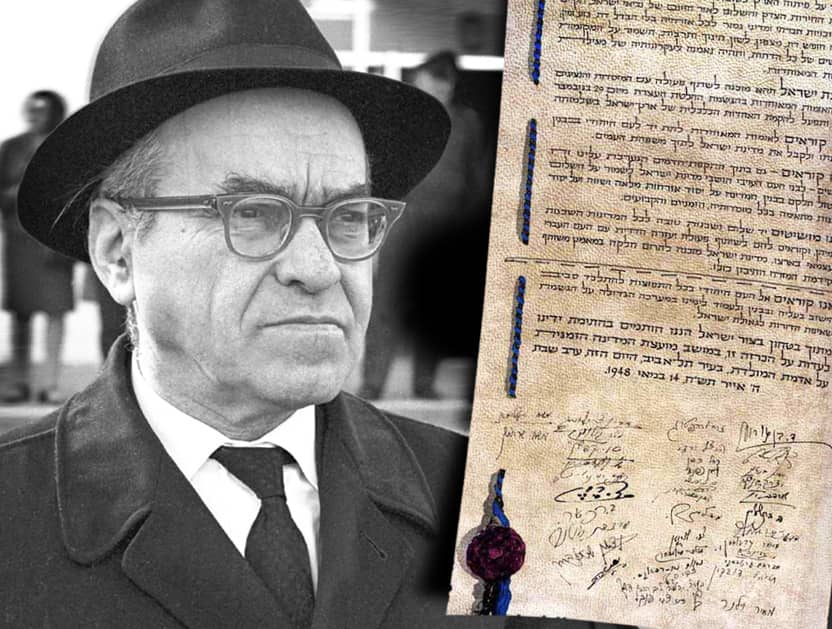
In the election in 1947 for the board of the Jewish Agency, Israel’s pre-state government, Zerach Warhaftig lost by one vote.
That was because the ballot he cast wasn’t for himself.
But had he won, his son Jacob pointed out in a recent phone conversation, Warhaftig might not have been elected the following year to Israel’s Provisional State Council, which governed the country following Great Britain’s withdrawal. Nor would he have won election in 1949 to the first Knesset, beginning a parliamentary tenure extending 29 of the next 33 years, until his retirement in 1981; it is among the longest Knesset tenures in Israel’s history. At various points along the way, Warhaftig, a rabbi, represented the United Religious Front, Hapoel Hamizrachi and the National Religious Party (Mafdal).

The Knesset’s consisting of 120 seats, in fact, is thanks to Warhaftig’s drawing on the number who served in the Knesset HaGedolah, the Great Assembly, during the Second Temple period.
Warhaftig, who died at age 96 in 2002, was born 120 years ago. His life was among the most full and admirable of any Israeli public official.

Warhaftig was one of 37 signatories to Israel’s declaration of independence, although he was trapped then in besieged Jerusalem and couldn’t reach Tel Aviv for three weeks to make his mark official. The document’s employing the term “Rock of Israel,” (Tzur Yisrael, צור ישראל) rather than “God,” was a Warhaftig-brokered compromise between secular and religious factions.
“He was someone with great insight, who understood people,” Jacob said of his father’s role in the compromise.

Zerach Warhaftig — he also was called Zorach, the Ashkenazi pronunciation — earned two law degrees. He served for 13 years as minister of religious affairs. He helped to found Israel’s religious courts imbued with the authority of national courts. He authored the Law of Return, 1950 legislation that defined who could immigrate to Israel.
All of that came after Warhaftig, a native of Belarus, was a vital cog in the rescue of thousands of Jews — including himself, his wife Naomi and their eldest child Emanuel — from the Nazis’ claws in Lithuania.

That occurred while Warhaftig was based in Vilna and then in Kovno (Kaunas), where he enlisted the aid of three diplomats: Jan Zwartendijk of the Netherlands, Chiune Sugihara of Japan and Great Britain’s Thomas Hildebrand Preston. Zwartendijk and Sugihara issued visas for Jewish refugees to enter Curacao and Japan, respectively, while Preston provided visas to pre-state Israel, then under the British Mandate.

Warhaftig also obtained the consent of Soviet authorities for fleeing Jews to travel through the U.S.S.R., usually on trains heading east to the Russian port city of Vladivostok, from where they sailed to Kobe, Japan. Warhaftig warned Kovno’s leading rabbis, including the heads of yeshivot, of the dire situation and urged them and their students to evacuate.
A 1998 documentary, Zorach, by Israeli filmmaker Adir Zik, followed Warhaftig, by then in his 90s, as he retraced his steps in Poland, Lithuania and Japan. Warhaftig had originally met Naomi at the Jewish Agency’s office in Warsaw, where they worked to advance the aliyah (immigration to Israel) of Zionist youth.
Even after reaching Japan in 1940, Warhaftig travelled to Tokyo and Shanghai, China, to lobby diplomats for help in rescuing more endangered Jews.
Warhaftig could have escaped Europe earlier than he did, “but didn’t leave because he felt an obligation” to save people, Avraham Melamed, a Lithuania native who worked alongside Warhaftig in Kaunas and later served with him in Knesset, said in the film.
Warhaftig “played an important role” in persuading Kovno Jewry to avail themselves of the Curacao-Japan option, Nathan Lewin said in an e-mail. Mr. Lewin is a noted Washington, D.C., lawyer who as a boy was rescued with his parents, grandmother and uncle thanks to Sugihara-issued visas.

Another lawyer, Zalli Jaffe, remembers Warhaftig best as the leader of a Talmud class held every Shabbat afternoon at Jerusalem’s Great Synagogue, which both attended.
Warhaftig’s occasionally asking Jaffe to substitute as the class’s leader “was a great compliment,” he said.
Warhaftig “carried on his shoulders a massive amount of history,” Jaffe said.
His father so enjoyed studying, Jacob Warhaftig said, that during the synagogue choir’s sometimes-lengthy crooning, he’d open his shtender (book holder) and examine a Talmud, Five Books of Moses or Maimonides commentary that he kept on hand, including in his car, for idle times.
Jaffe said Warhaftig was “an extremely humble man” who never sought honors in the synagogue. Jacob called his father honest as can be, someone who always returned unused travel funds from his meetings abroad.

Warhaftig the private man was so busy that he rarely played with his four children at home. But every Friday afternoon, he reliably executed his domestic responsibilities: polishing everyone’s shoes, preparing tea concentrate, inserting Shabbat candles for ritual lighting and tearing toilet paper for bathroom use.
Jacob recalled his father consistently wearing a suit, tie and hat when going outside, even to fetch the morning’s newspaper. When they walked together on the street, Naomi insisted on carrying all purchases and trailing her husband in an apparent show of respect, he said.
“They had a great love,” he said.
Warhaftig was awarded the Israel Prize in 1983 for lifetime achievement. He lectured on the Talmud, even for small groups of neighbors, until the onset of eye problems at age 95.
His children all have grandchildren named Zerach or, in one case, an offshoot of the word. Two of Warhaftig’s great-grandsons fought Hamas in Gaza in the ongoing war. When their units met there, the cousins were photographed with an Israeli flag on which was taped a question once asked of their great-grandfather, who’d helped to found their homeland, and his response:
What do you think about the country?
It’s less than I hoped for and more than I expected.
Writer-editor Hillel Kuttler may be reached at hk@HillelTheScribeCommunications.com.


