
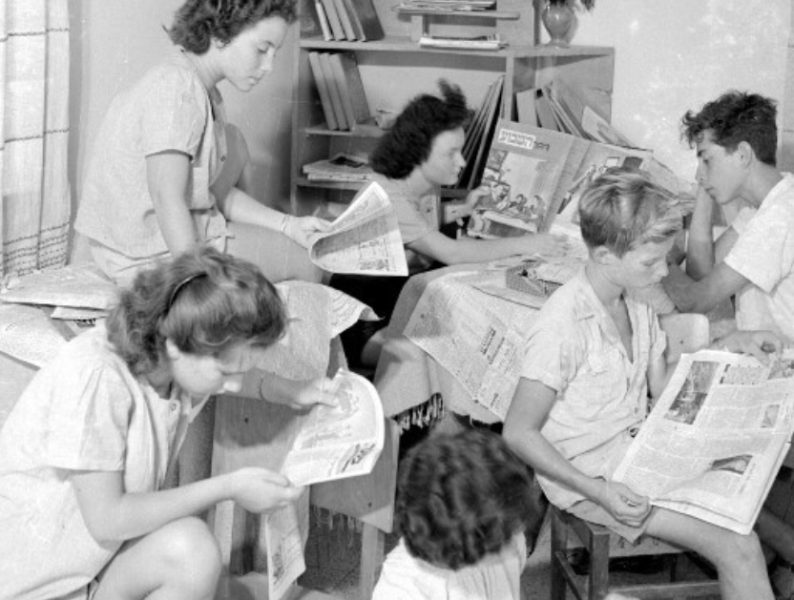
Professor Yaron Tsur—one of the founders of the NLI’s Historical Jewish Press website—has been awarded the Israel Prize. The honor recognizes, among other achievements, his role in helping create one of the National Library’s most significant initiatives. This is the story behind the Historical Jewish Press – a project that allows anyone, anywhere to explore nearly every Jewish newspaper published over the last 250 years—and embark on a captivating journey through Jewish history.

Keepers of Jewish Treasures: Meet the Participants of the International Judaica Curators Conference
Some 50 men and women charged with preserving the cultural treasures of the Jewish People came from all over the world to attend a professional conference which now took on a different, deeper, and more urgent significance. “Here, we felt a little less alone” was something we heard from everyone we spoke to. Here’s a peek behind the scenes into the world of those who seek to protect the cultural heritage for the Jewish People.

What Happened to Libyan Jews in the Holocaust?
The horrors of the Holocaust did not pass over the Jews of North Africa, but theirs is a story that is rarely told. This is the story of those who were called “schwarze Juden” (“black Jews”) by the Nazis. Some were sent to concentration camps erected in the desert, and others shipped off to Europe as prisoners of war…

“Half of My Soul Is Made of Longing”: One Man’s Mission to Preserve the Jewish Heritage of Debdou
If not for the efforts of “Rabbi Eli”, much of what we know about this particular Moroccan Jewish community would likely have been lost forever…

Why Did Moroccan Jews Bring Moses Into the Passover Haggadah?
Moroccan Jews (and the Jews of Western Algeria in the areas adjacent to Morocco) to this day begin the Passover Seder with a short text in Judeo-Arabic at the center of which is the figure of Moses…

Who Are You Calling a “Shluh”?!
In modern-day Israel, the word “shluh” is sometimes used as an offensive term to describe a person of disheveled or messy appearance. The word in fact hails from Morocco, where it referred negatively to a certain ethnic group, and was used disparagingly by city dwellers to describe uncultured village folk…

The Daring Life and Tragic Death of Tunisia’s Jewish Pop Sensation
Habiba Msika reveled in the pleasures of free love in 1920s Tunis. A rejected paramour ultimately took her life

For the Sake of Love: The Jewish Women Left Behind
We never heard these stories. Forgotten stories of Jewish women who lived in Egypt and chose to remain there with the Muslim men that they loved, even though their families had immigrated to Israel. It’s time we shared these stories.

Girls’ Day: Celebrating Girl Power During Hanukkah!
This is the story of a holiday that originated in the Jewish communities of North Africa and the Middle East and its revival here in Israel

Our Exodus from Egypt
“When we left Egypt we could only take one suitcase and twenty Egyptian lira. That was all,” my grandmother said. “It was forbidden to take more than that, and we were very worried how we would manage in a new land without anything.”


