Romance and Reason: Islamic Transformations of the Classical Past

Organized by the Institute for the Study of the Ancient World in partnership with the National Library of Israel (NLI), a stunning exhibition of Islamic manuscripts, including twenty-four from the NLI's own collections, is set to open in New York City.

Romance and Reason: Islamic Transformations of the Classical Past, opening on February 14, 2018 brings together an exceptional group of rare Islamic manuscripts that testify to the fertile relationship between medieval Islam and the classical world. Covering medicine, philosophy, the exact sciences and poetic retellings of the Alexander Romance in Persian and Turkish, the exhibition includes lavish illustrations of Alexander the Great’s adventures and intricate mathematical, astronomical, and medical diagrams.
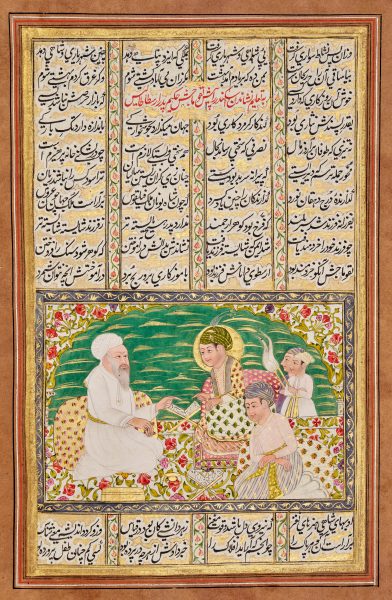
Nicomachus, the father of Aristotle, teaching Iskandar while Aristotle looks on, “Khamsa”, Nizami Ganjavi (1141–1209), India, 17th century. From the collections of The National Library of Israel / Photography by Ardon Bar-Hama

This exhibition provides an engrossing visual record of how, over the course of centuries, scholars, scientists, doctors, artists, and others in the Islamic world transformed ancient Greek material for their own day. Conceived and organized by ISAW in partnership with the National Library of Israel, Romance and Reason is curated by Roberta Casagrande-Kim, Research Associate, ISAW; Samuel Thrope, Selector, National Library of Israel, and Raquel Ukeles, Curator, National Library of Israel. Jennifer Y. Chi is curatorial and design manager for the project.

“This exhibition is an extraordinary opportunity for the Library. Including 24 manuscripts from the NLI’s Islam and Judaica collections, it is the largest exhibition of NLI manuscripts outside Israel, and the largest exhibition of our Islamic manuscripts ever,” said Raquel Ukeles, Curator of the National Library’s Islam and Middle East Collection. “Not only does Romance and Reason give us a chance to showcase some of the finest manuscripts from our Yahuda Collection to an international audience, it also allows us to build and strengthen relationships with leading cultural institutions in New York City and beyond.”

Background

From about 750 CE to the end of the tenth century, Muslim translators, scholars, and commentators rendered a large portion of the extant classical Greek works of literature, science, philosophy, medicine, magic, and astronomy into Arabic. Seeking to learn from and make use of the knowledge the translations contained, these scholars expanded, updated, reimagined, corrected, and otherwise remade the documents to serve contemporary use.

In so doing, they shaped the intellectual contours of the Islamic world up to the dawn of modernity.

Romance and Reason opens a window into this fruitful interaction between Islam and the classical world with two thematic installations: one devoted to Islamic versions of the story of Alexander the Great, the other to scientific and mathematic topics.

Romance and Reason presents some thirty illuminated versions of the Persian accounts of the life of Alexander: the Shahnamah, or Book of Kings, an epic poem written by Abu al-Qasim Firdausi between 977 and 1010 CE, and the Khamsa, or Quintet, by Nizami Ganjavi, dating from the late 12th century CE. With a variety of exquisitely executed illuminations, the manuscripts in the exhibition were created over the course of five centuries. Together, they portray the evolution of Iskandar’s character and identity, showing him as warrior, king, seeker of truth, prophet, and more.
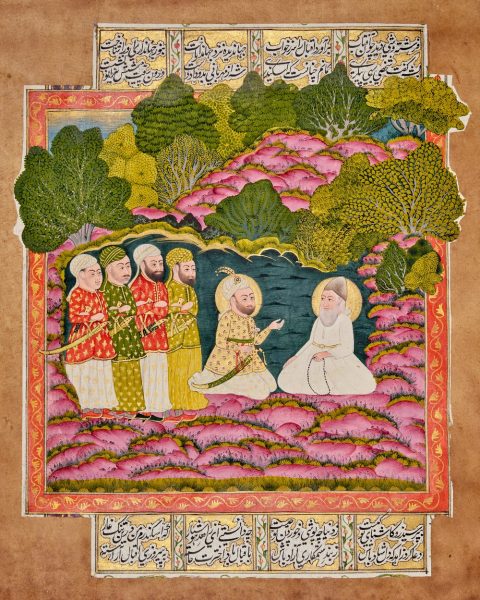
Iskandar and his retinue meeting with a hermit who then opens the gates of the Fortress of Darband by his prayer, “Khamsa”, Nizami Ganjavi (1141–1209), India, 17th century. From the collections of The National Library of Israel / Photography by Ardon Bar-Hama

The second section of Romance and Reason is devoted to Islamic developments in medicine, mathematics, astrology, and astronomy, with manuscripts that illustrate the ways in which Muslim physicians, mathematicians, and scientists elaborated on their classical predecessors’ discoveries, transforming works of the past into materials of use in their own place and time.

For example, highlights of the exhibition’s especially rich assortment of medical materials include four 12th century manuscripts, all by different artists, illustrating vignettes from the Greek physician Dioscorides Pedanius’s De materia medica; as well as one of the most important medical works written by an Islamic scholar: The Canon of Medicine, by the physician and philosopher Avicenna (980-1037 CE). Avicenna’s work remained a major medical textbook until the nineteenth century, as important to the Islamic world as Hippocrates was to the Greeks.
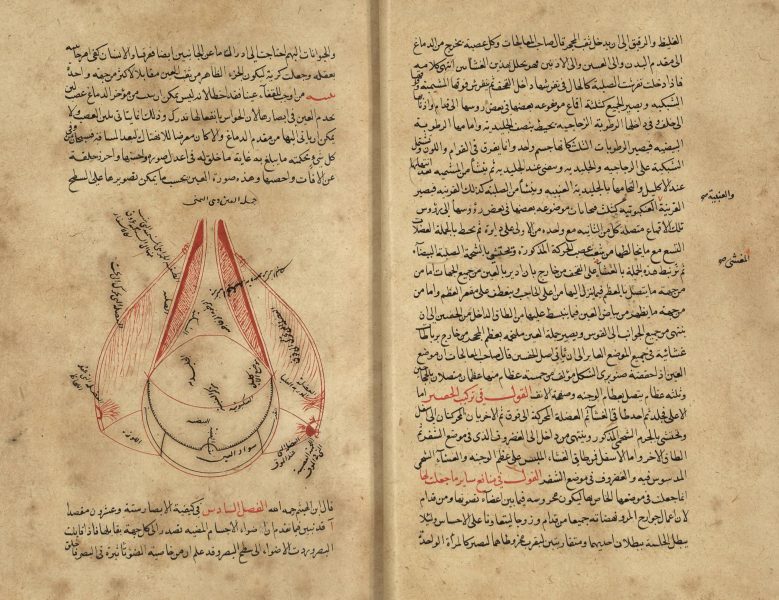
Diagram of the Eye, “Revision of The Book of Optics for Those Possessing Sight and Insight by Ibn al-Haytham,” Kamal al-Din al-Farisi (1260–ca. 1320), Ottoman Turkey, 1511, From the collections of the National Library of Israel

The exhibition will run until May 13, 2018 and will be held at the Institute for the Study of the Ancient World, 15 East 84th St., New York, NY.


“At the Source”: Sharing knowledge to protect Jewish heritage in Europe

Archivists and librarians from the Balkans convened for a special training course at the NLI.

At The Source Participants. Photo: Refael Wachnish

At the Source is a training course for European librarians and archivists who work with Jewish collections.  In addition to learning important professional skills, At the Source participants form strategic connections with National Library colleagues and with each other that will support them through their careers as the custodians of significant, and sometimes endangered, Jewish archives and libraries throughout Europe.

This regional At the Source course was especially developed by NLI and the Central Archives for the History of the Jewish People to address the needs of representatives from 16 Balkan institutions – Jewish museums and community and state archives – from Bosnia, Bulgaria, Croatia, Greece, Macedonia, Serbia, and Slovenia.  The course gave participants hands-on experience working with materials that reflect the context of their own collections.  The first stage of the training was held in Belgrade in October 2017, and was followed by a week at the NLI in Jerusalem in January 2018.

Laila Sprajc from the Jewish community of Zagreb with Dr. Stefan Litt of the NLI Archives Department. Photo: Caron Sethill

The course, delivered by staff across all NLI departments, was very well received and has helped position the NLI as a beacon of excellence and knowledge for archivists and librarians working with Jewish heritage in Europe. Below is a taste of some of the feedback from participants:

It was wonderful to meet people with a shared passion for Jewish culture – this is the beginning of many connections.

I was very grateful to hear from people doing the same work as I do – I feel less alone. The individual sessions were very productive.

Exceptional lectures and mentoring – you have made my job so much easier. I now know who to talk to and go to for help.

My mentor has already sent me materials and step-by-step guidance.

And we wish to spotlight one particular participant: Dr. Janez Premk, Director of the Research and Documentation Center for the Jewish Archive of Slovenia.

Dr. Janez Premk with Dr. Ezra Chwat of the Archives Department. Photo: Caron Sethill

The Jewish population of modern-day Slovenia is tiny, with around 150 registered community members nationwide, in a country of just over 2 million citizens.  And Janez Premk has taken it upon himself to almost single-handedly document the long history of the Jews in his country.

Janez’s recent participation in the National Library of Israel’s At the Source training program for archivists and librarians working with Jewish heritage in Europe was “a real eye-opener.”  The program gave Janez an overview of Jewish collections and projects that exist in the Balkan region; a distinct opportunity to meet and have direct access to people who work in the field; and a connection to the National Library of Israel and various Library experts. Janez loved being in Israel in an academic setting and raves about the At the Source program and the exposure to the National Library.

 “For me there was not a single moment of wasted time in this program. I cannot imagine any other institution that would be as invested in sharing knowledge [as the National Library of Israel was]…I love the approach here.  Central Europe is more ‘old school,’ not a place to ask questions.  Here the focus is renewal, launching new initiatives. Everyone here is passionate and knowledgeable. My experience was fabulous,” Janez said after the training.

After earning a BA in Art History from the University of Ljubljana, in the capital city, Janez began working on his graduate degree, focusing on the medieval Jewish community and synagogue in Maribor, Slovenia’s second largest city. During this process, Janez was awarded an Israeli governmental scholarship to study for a semester at Hebrew University’s Rothberg International School. These studies were the springboard for Janez’s launch of the Research and Documentation Center – Jewish Archives of Slovenia (JAS).

Janez invested time in photocopying many documents from the Eventov Archives (the records of the Association of Immigrants from the former Yugoslavia in Israel), which only more recently began to formally catalogue their documents in an electronic database and digitize a portion of their archival materials.

At the Source is a flagship project within Gesher L’Europa, an initiative funded by the Rothschild Foundation Hanadiv Europe, providing opportunities for exchange and enrichment between the National Library of Israel and European scholars, library and museum professionals, and Jewish educators.

What Can You Find in the World’s Oldest Yiddish Letter? Exactly What You Would Expect

Looking for proof that nothing ever changes? In this ancient letter a mother complains to her son that he doesn't write to her often enough… Sound familiar?

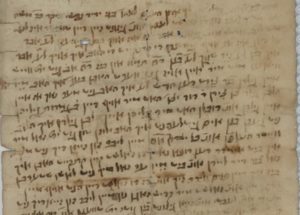
The letter in the photograph is stored in the Cambridge University Library, TSMISC36. Line 5: I was, lo aleinu {may it not happen to us}, very sick, lo aleinu, from the first day of the month of Tamuz until the first day of the month of Av…

Among the treasures discovered in the Cairo Genizah are also documents written in Yiddish.

In fact the Cairo Genizah is the source of the oldest Yiddish texts in the world – an anthology of midrashim and parables, and even a German folk legend about a valiant duke who performs acts of gallantry to win the heart of a Greek princess.

But daily life interests us more than legends of knights and princesses, so we decided to present excerpts from a series of letters from Rachel Zussman, an elderly widow who lived in Jerusalem, to her son Moshe, who settled with his family in Cairo for business reasons. The letters were written in Yiddish in the mid 1560’s, and eventually made their way to the Cairo Genizah. They teach us much about the composition of the community in Jerusalem, its economic state, and communication and travel between Jerusalem and Egypt, as well as a mother-son relationship dating back 500 years.

From what we can tell, Rachel Zussman seems to have been a comparatively educated woman who was relatively financially stable. Nonetheless, she appears not to have written the letters herself, but instead dictated them to a professional scribe, who may have incorporated verses and proverbs. Her husband died in Jerusalem, and it was there that her financial situation deteriorated, as we will see.

As typified by the stereotype of the “Jewish Mother”, Rachel complains about the lack of letters from her son (and a letter from her son explaining why he didn’t write back was even found in the Genizah). Less stereotypically, her son Moshe married a woman named Masuda, in other words a Jewish woman who originated from the Arab countries, and Rachel was very satisfied by the match, even suggesting that his daughter Beila (her granddaughter), who had reached marriageable age, be married to a young man from Masuda’s family.

Here are excerpts from Rachel Zussman’s letters, translated into English from the Hebrew translation of Chava Turniansky, who translated and published the letters:

“My dear son, may you live and be well…I, lo aleinu, am very sick, lo aleinu, God Almighty knows what will be my end due to our sins…my dear son, do not be distressed. I also ask the faithful doctor (in other words, God) for you not to be sick – for me to suffer instead of you. And I also ask that He not let me die until I see you once again and you place your hand over my eyes and recite Kaddish after me. And so, my dear son, do not be distressed, live and be well…

I do not know where to obtain money from. Poor people have no money. My dear son, bring me a linen garment with you. I do not have, due to our many sins, a sheet on my bed, or a cover for my pillow. If I was, God forbid, to die I would not have a sheet to be covered in when they remove me from the bed. I am ashamed before other people. I do not have a turban for my shrouds to put on my head. If you are able to buy me one there cheaply, do so. And bring barley with you. I could not find any here at all. Bring two.”

A reply from Moshe to his mother was also discovered in the Genizah:

“Know, my dear mother, that we are all healthy and invigorated… therefore, my dear mother, I was unable to even send you a letter throughout the above period, and I was also unable to buy the things you wrote to me…”.

Further on in the letter he also reports about the boys’ studies with their teacher, and about the idiotic son, about whom he says that talking to him is like “talking to a plank”.

Moshe’s letter was sent to his mother Rachel in Jerusalem, so how did it end up back in the Cairo Genizah? Because his mother wrote her reply on the blank spaces on the page, and sent it back to Cairo. She had much room to write, as her son Moshe’s letter was relatively short… Here is a quotation:

“To my beloved son, my dear Moshe, and to your dear and modest wife my daughter-in-law Madam Masuda. I understand that you did not receive all my letters… My dear son, I am very very hurt and distressed that you distress me so much due to our sins with your deliveries… my dear son, God will forgive you for distressing me so much. Had you at least sent me the [the page is torn here] and the barley for an entire year…” However, the letter is also full of motherly good advice, from the way every loan should be meticulously recorded, to the following:

“Go and bathe in the river as little as possible. In this way it will not be able to harm you.”

Which is true.

(The seven letters discussed in this article were published and translated into Hebrew by Chava Turniansky in an article in volume 4 of the ‘Shalem’ journal. They are all in Cambridge, except for one which is in the National Library in Jerusalem. A decade ago, more excerpts from letters in Yiddish to and from Rachel Zussman were discovered in Cambridge.)


`;