
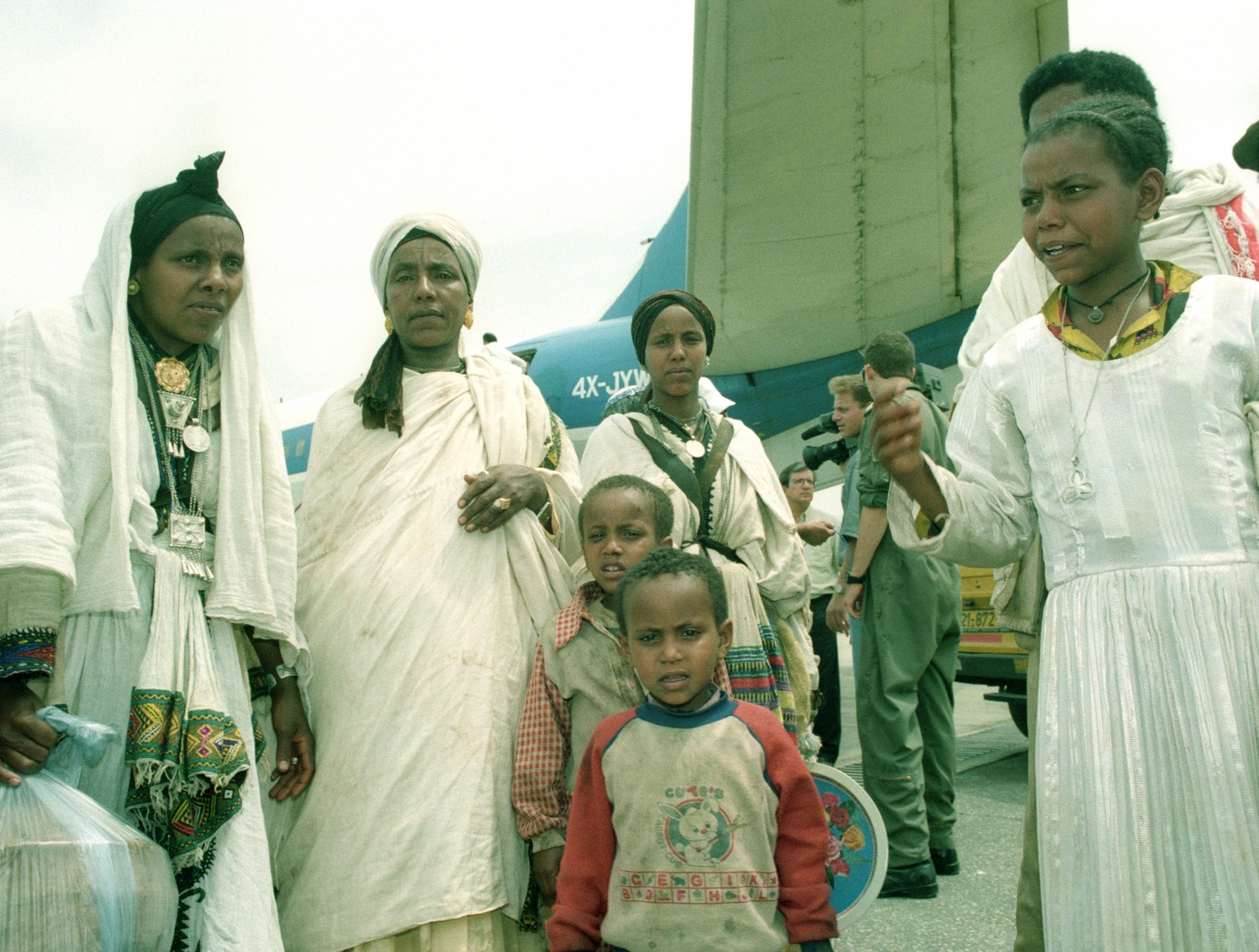
Batel Malkam took her first airplane trip when she was eight years old. It was a four-hour flight and highly unpleasant, so crowded that she regularly was stepped on, and so no-frills that food wasn’t served … and she didn’t have a seat. No one did. Malkam sat on the floor. So did her two sisters, two brothers, their parents — and everyone else aboard.

Whatever the shortcomings in comfort, the plane safely brought the Degoo family to Israel. They were just seven of the more than 14,000 Ethiopian Jews who, in a two-day airlift in May 1991, were flown as immigrants from the African nation in a secret rescue organized by Israel and international Jewish organizations. It was nicknamed Operation Solomon and followed the airlift in late 1984 and early 1985 of 8,500 Ethiopian Jews to Israel known as Operation Joshua.

I spoke with Malkam as she sat in the living room of her apartment overlooking the Mediterranean Sea in the town of Nahariya on a Friday morning this spring, while her husband, Osher, cleaned the kitchen. She related what she remembered of the journey, switching periodically from Hebrew to Amharic to clarify points by phone with her mother, Tagav, and father, Tekala, who live in the nearby town of Kiryat Tivon.
The big picture is that Operation Solomon “was a majestic and swift fulfillment of the Israeli mission to rescue endangered Jews” and “was the the story of a people who wanted to go home [who] had longed for generations to return to Jerusalem, their homeland according to their tradition,” said Stephen Spector, a professor of English at New York’s Stonybrook University and author of the book Operation Solomon: The Daring Rescue of the Ethiopian Jews.
But this is the journey of one family.

The Degoo household came from Simien, a village in northern Ethiopia where most residents were Jewish and earned a living as shepherds or, like Tekala, farmers. “Such a view! Such mountains!” Malkam said of the lush and rolling greenery she displayed on her phone’s screen. She and her elder sister, Nanu, would be dispatched to draw water from a well and to gather wood for heating and cooking.
The village homes were built by each family. The residences were round, made of dried cow dung and topped by straw. For Shabbat, Tekala and his father would dress in special white garb and attend the village’s small synagogue for services.

Their non-Jewish neighbors in Simien and the surrounding area lived cordially with the Jews, Malkam said.
But an opportunity arose to move to Israel, and her parents seized it.
It was in the waning days of a 17-year civil war. Simien’s Jews had met secretly, and one night they all — 75 Jewish families — just left. They’d been surreptitiously planning their departure for the better part of a year, even scouting roads to plot the best route out. The Degoo family carried whatever clothing they could manage and bread Tagav had baked in preparation for the journey. The parents took money. They’d sold their cows and goats, their house and property, their utensils and personal possessions, to trusted neighbors.
When Malkam mentioned that Tagav over the years had earned income as a potter, she took off a kitchen shelf a black coffee pitcher to display. It resembled those Tagav crafted, but it wasn’t her original work.
That’s because, she said, “We came with nothing. Nothing.”
“We walked for five days to Gondar, and from Gondar two days by car to Addis Ababa,” she said, mentioning two Ethiopian cities, including the capital. “We paid someone to drive us.”

Soldiers accompanied the Jews throughout the trek — in gratitude, she explained, for her father’s previous military service. The soldiers kept them safe from potential robbers, “and they also protected us from snakes,” she said. At night, everyone slept outside. It was extremely hot and uncomfortable. To make the food last, they subsisted on small quantities of the bread, chickpeas and groats Tagav had packed.
On the two-day ride in cars and trucks, the drivers several times zig-zagged to avoid gunshots — not fired at the vehicles for transporting Jews or attempting to flee, Malkam said, but because that’s what happens in war.
The family reached Addis Ababa and stayed in a rented apartment for three months while awaiting a flight to Israel. On a Friday morning, they were instructed to go to the Israeli embassy but not given a reason. There, they were told they’d be leaving that day for Israel. They returned to the apartment, but the landlord had locked them out. They couldn’t retrieve their clothing or food. Off to the airport the Deegos went.

Malkam relayed my question about how her parents felt upon realizing that Israel was within grasp, just hours away.
“They couldn’t believe it,” she said, cupping the phone. “They always dreamt of Jerusalem.”
Being in disbelief wasn’t rhetorical. Even after landing and being taken to the town of Beit Shean, Tekala and Tagav weren’t convinced they were in Israel until Tagav’s brother, Ayeli Adgoitchu, who’d been airlifted to Israel in 1985, came to visit them.
“That’s the first time she realized she was in Israel,” Malkam said of her mother. They cried.

Tekala got a job farming for the Jewish National Fund, a nonprofit organization that manages many of Israel’s national parks, forests and historical sites. He gardened in his free time, too, and his plantings still adorn the grounds of the couple’s apartment building. Five years ago, Tekala, now 84, suffered a paralyzing stroke. Tagav, 77, takes care of him.
“It’s good for us here in Israel. We’re happy we live here,” Tagav said through her daughter’s translation. “We live okay. We’re not complaining like [typical] Israelis. We live within our means, so we’re grateful.”
Writer-editor Hillel Kuttler can be reached at hk@HillelTheScribeCommunications.com.


