
“Is that Wingate?” asked British historian Lord Andrew Roberts, pointing to the large portrait hanging in my office. I had no idea that this casual question would, within a few short months, lead to the return of a rare historical collection to Israel.
In the summer of 2024, Lord Roberts visited Israel as part of research he was conducting for the 7th of October Parliamentary Commission Report. Among other things, the renowned historian sought to learn about the role played by police officers in the fighting that day. To that end, he contacted Chief Superintendent Mirit Ben Mayor, who serves as Head of Communications for the Israel Police. Since the Police History and Heritage Branch— which I head — had documented both the events and the police combat operations of that day, Ben Mayor invited Lord Roberts to visit the Israel Police Heritage Center near the city of Beit Semesh and meet with me.
During our meeting, we discussed the fighting in detail. I presented the various arenas and explained how the courage of police officers on that terrible day saved the country from an even greater disaster. Lord Roberts was deeply impressed and visibly moved. It was then that he pointed to the portrait on the wall and asked: “Is that Wingate?”

Spoiler alert: yes — it is Wingate. But who was this man, and why does his portrait hang in my office?
“The Mad Captain”
Orde Wingate (1903–1944) was a British army officer with an extraordinary life story. During World War II, he gained fame as a brilliant commander who developed unconventional methods of operating deep behind enemy lines. His personality — outspoken, uncompromising, and intolerant of what he considered mediocrity — made him a controversial figure even during his lifetime. This was intensified by the combination of striking operational successes and heavy losses among his troops. His soldiers tended to admire the hard-driving commander and visionary leader, while some of his fellow officers regarded him as insolent, a charlatan, or even a psychopath. His death in a plane crash in Burma at the age of just 41 added to his mystique, but the debate over his complex and polarizing character has never truly been resolved.

The reason Wingate’s portrait hangs in my office, however, lies in an earlier chapter of his military career. In September 1936, a few months after the launch of the Arab Revolt in Mandatory Palestine, Wingate was posted to the region as an intelligence officer with the rank of captain. In the course of his duties, he established close ties with senior figures in the Jewish Agency and with members of the local Jewish community’s armed organizations. Wingate openly presented himself as a Zionist and even declared that he intended to establish — and command — a Jewish army.

It is easy to understand the skepticism with which Wingate — a British imperial intelligence officer — was initially received by the Yishuv, the Jewish community in the Land of Israel. Nevertheless, two of his contacts within the Yishuv leadership, Emanuel Wilenski and David Hacohen, became convinced of the sincerity of his intentions and worked to persuade others who opposed cooperation with the eccentric officer. In early telephone conversations, Wingate was dismissively referred to as “Wilenski’s friend,” until he proved that his deeds matched his words. The mocking nickname was soon shortened, and Wingate became simply “the friend” – hayedid.
The Special Night Squads
By May 1938, the Arab Revolt was at its height. Armed groups controlled large swaths of rural Palestine and operated with near impunity, murdering Britons, Jews, and Arabs suspected of collaborating with the authorities. In the Jezreel Valley, the rebels repeatedly attacked the pipeline carrying oil from northern Iraq to the port of Haifa — the British Empire’s most important strategic asset in the country. The small British garrison in the Land of Israel, consisting of only two brigades, was stretched to its limits. Without substantial reinforcements, offensive action against the rebels was impossible, yet the international situation prevented the British army from sending additional forces.
Wingate saw opportunity where others saw only crisis. Although officially a staff officer, he began touring the northern Land of Israel to study the rebels’ methods and identify ways to counter them. For nearly two months, Wingate traveled alone throughout the Upper Galilee and the valley, visited Jewish settlements, and joined young pioneers on night patrols. What he observed convinced him that British counterinsurgency doctrine was fundamentally misguided.
Wingate approached the commander of British forces in Palestine and Moshe Sharett, head of the Jewish Agency’s Political Department, with a proposal to establish a special counterterrorism unit composed of British soldiers alongside Jewish members of the Notrim – essentially police guards maintained by the British authorities, who were often also members of the Haganah. The unit would operate in small teams, at night, relying on intelligence and employing deception and surprise — a clear departure from prevailing British military doctrine at the time.
Wingate commanded these “Special Night Squads” for only a brief period, from June to October 1938. During those months, the young officer refined his innovative doctrine and led his force — approximately 40 British soldiers and 80 Jewish fighters — in numerous operations against rebel groups in the Jezreel Valley.

The results were swift and dramatic. In a short time, the unit eliminated three leaders of armed groups and forced a fourth to flee the country — an unprecedented achievement. The Special Night Squads were responsible for roughly one-sixth of all rebel casualties and seized about one-fifth of all weapons captured throughout Mandatory Palestine in the second half of 1938 — an extraordinary accomplishment for a unit no larger than a single company.
The British authorities were quick to replicate the model Wingate had developed and establish similar units elsewhere. In fact, the Special Night Squads were one of the first modern counterterrorism units, and the framework Wingate devised can still be found — under different names and forms — in nearly every army or police force in the world.
The Hebrew Legacy
In the Land of Israel, Wingate’s impact was even more profound. The Special Night Squads were the first military unit in the country since the disbandment of the Jewish Battalions in 1920 in which Jews took part in offensive military operations. Under the command of “the friend,” the Jewish guards — members of the Haganah — learned how to fight, plan operations, command forces, and lead men into battle. Among Wingate’s trainees were Moshe Dayan, Yigal Allon, and Pinchas Kopel (later the founder of the Border Police and Commissioner of the Israel Police), along with many others who would go on to lead the pre-state Hebrew fighting forces and, later, the security services of the State of Israel.
Wingate’s influence on the Israel Defense Forces remains visible to this day — even in the commonly used Hebrew term sayeret (“reconnaissance unit”), a linguistic echo of the grueling foot patrols carried out by the Special Night Squads.
This legacy — of initiative, creativity, courage, and leadership in moments of crisis — was also passed down to the Israel Police. Wingate’s emphasis on initiative, offensive action, deception, and focused operations became guiding principles for the police as well, particularly for its special units. When Lord Roberts came to Israel to study the events of October 7, he encountered this legacy very much alive: the Yamam counterterrorism unit, the “Gideonim,” the MATPA and Yoav units, and the undercover Border Police forces were among the first organized units to respond to the brutal Hamas attack.
Yet the values Wingate instilled were not confined to elite formations alone. On that terrible Saturday, countless police officers — men and women from across the organization — acted in that same spirit, fighting under impossible conditions, improvising solutions in real time, and saving lives at great personal risk.

Naama and the Portrait
Wingate and the Special Night Squads were the subject of my research during my master’s degree studies. Under the supervision of Dr. Gad Kroizer at Bar-Ilan University, I examined the unit’s structure, organization, combat doctrine, and operational achievements. The findings were published in my book, First to Dare: Orde Wingate’s Special Night Squads (Hebrew, Yehuda Dekel Publishing, 2017), and in a second volume, soon to be published in English.
The research also allowed me to take part in preserving the legacy of “the friend,” alongside Moshe Har-Zion and Ofra Baram, initiators of the annual Wingate Day events and the exhibition on the Special Night Squads at the Beit Shturman Museum in Kibbutz Ein Harod.
Through this work, I came to feel a deep personal connection to the complex figure of “the mad captain,” as his men called him. When I completed my studies, I asked my daughter Naama — a talented artist — to paint his portrait for my office. That is the very image Lord Roberts noticed, and admired.
The Collection Comes Home
Wingate’s story, however, did not end with that visit. In early October 2025, I received a message from Roberts, accompanied by a catalog from an auction house. “Take a look at item 163,” he wrote. “I think it belongs in Israel.”
The item was Wingate’s personal collection of documents from his service in Mandatory Palestine. The opening price was far beyond my means. I forwarded the message to the National Library of Israel, hoping they would find a way to secure the collection. The Library’s dedicated staff immediately set to work, and within two months, with the help of a generous donor, the archive arrived in Jerusalem. I was invited to examine it.
The donor, British Jewish collector Clive Lewis, visited the National Library in early 2026 and explained how the extraordinary donation came about:
“I had visited the National Library of Israel last May and was deeply impressed. The idea that I could buy something that the National Library of Israel would be interested in was extraordinary. I understood they would care for the materials properly, make them accessible to researchers, and open them to the public. To me, if something like this archive is of interest to a major research library, then that is exactly where it belongs. I also felt deeply right that these papers should return to Israel. Wingate wanted to come back to Israel. He wanted to be here. So his papers should be here. I realized this was an extraordinary opportunity to bring something important to one of the world’s great libraries – and this is a great library.”
The connection with Lewis was established by Dr. Raquel Ukeles, Head of Collections at the National Library, and Dr. Hezi Amiur, Curator of the Library’s Federmann Family Israel Collection. Amiur joined the crucial Zoom conversation with the British collector while serving in the reserves, in uniform:
“He asked us to explain the historical importance of the archive and why it mattered so much to us that it be housed at the National Library. We described how central Wingate’s activity was to shaping Israel’s security ethos, right up to the present day. He replied that he understood the archive belonged in Jerusalem and that he would purchase it for us. His response surprised us and deeply moved us.”
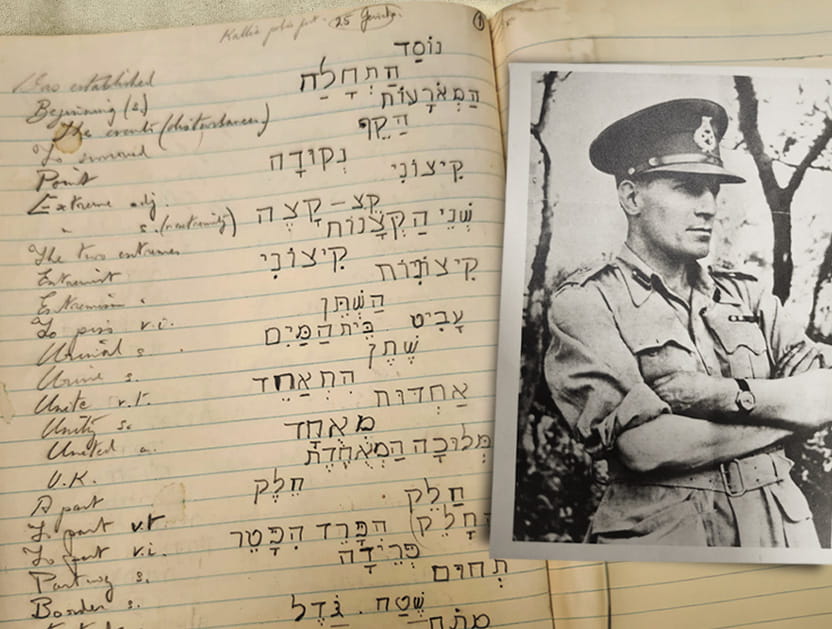
Like Mr. Lewis, I find it hard to put into words the emotion of holding documents written by Orde Wingate himself. I thought back to the years of research, to the many hours spent trying to understand his way of thinking — and suddenly, it was all there, in his own handwriting. In the end, the historian in me prevailed over the admirer, and I devoted several hours to carefully examining each page of the collection.


The documents trace the evolution of Wingate’s thinking throughout his service in Mandatory Palestine, as well as the various stages in the formation and development of the Special Night Squads. The archive includes operational summaries and proposals, analyses of operations and manuals for establishing and operating similar units. Together, they offer an unusually direct glimpse into the process that led to a turning point in both global and Israeli military history — seen through the eyes of the man who helped bring it about.
Other materials in the collection shed light on Wingate’s work as an intelligence officer and on the network of relationships he cultivated within the Yishuv.
Perhaps the most remarkable items, however, are those Wingate created for himself. Two notebooks — used to study Hebrew and to record operational activity — provide a rare window into the inner workings of the young officer’s mind. Similar insight can be found in letters he wrote to his mother and in history papers he submitted during his studies at the Royal School of Artillery in the early 1920s.


The operational documents, together with notebooks and personal letters, reveal the individual behind the legend: the committed Zionist, the inventive intelligence officer, and the man who dreamed of leading a Hebrew army. Taken together, these materials document a formative moment in the intertwined histories of counterterrorism and the emergence of a modern Hebrew fighting force.
Collections of this kind — combining operational military records with intimate personal materials — are exceptionally rare in British Mandate–era archives. The overwhelming majority of such documents are preserved in state repositories in London. This collection, however, has returned home — to the place where it was created.
The arrival of the Wingate Archive in Jerusalem is therefore not an end point, but a beginning. The documents now await careful examination, digitization, and public access, enabling historians and the broader public alike to gain a fuller understanding of the remarkable figure known as “the friend,” and of the doctrine of warfare he helped shape.
I cannot help but think that Wingate would have smiled had he known his papers would return to this land; that the portrait painted by my daughter Naama now hangs on the wall of a police office, quietly safeguarding the legacy he left behind; and that his archive is now preserved at the National Library of Israel in Jerusalem — the city where he lived, and to which he dreamed of returning as the commander of a Hebrew army. More than that, I am certain he would have been proud of the police officers — women and men alike — heirs to the Jewish guards of the Special Night Squads, who acted in the spirit of the methods he developed and the values he instilled to protect the citizens of the state.
***
Interested in learning more about Orde Wingate and the Special Night Squads? You are invited to visit the exhibition dedicated to their work at the Beit Shturman Museum, Kibbutz Ein Harod Ihud. Further details are available at this link.
***
Chief Superintendent Dr. Shlomi Chetrit serves as Head of the Israel Police’s History and Heritage Branch. His research focuses on the history of law enforcement and internal security organizations in the Land of Israel.


