
“I liked him. I had fun,” said Robert Rockaway of his experiences interviewing a notorious man in person several times in Israel and Florida in the late 1960s and early 1970s and more often by telephone.
Israel refused to allow that man to settle in the country, a decision Rockaway said he thinks “was such B.S.”

The person of interest was Meyer Lansky, a leading figure in organized crime in the United States beginning in the 1920s and one of the subjects of But He Was Good to His Mother: The Lives and Crimes of Jewish Gangsters, a book Rockaway, now a retired professor of history at Tel Aviv University, authored in 2000.

“If I close my eyes now, I can see us sitting at a table,” Rockaway, a native of Detroit, Michigan, who lives near the Mediterranean Sea north of Tel Aviv, said by telephone from a coffee shop on a mid-May afternoon. “It was enjoyable.”
People whom Lansky roughed up, or worse, might beg to differ.
Lansky claimed he never killed anyone, but Mob protocol didn’t exactly follow Robert’s Rules of Order and he certainly asserted control in uniting Jewish gangsters, forming an alliance with the Italian-American Mafia as he established and expanded casino-hotels in Las Vegas, Florida and Cuba.
Lansky was born in Poland in 1902 and as a child moved with his parents to New York City’s Lower East Side, where he befriended Jewish- and Italian-American boys who, like him, went on to become hoodlums and underworld figures. Lansky would make his mark in gambling, pairing with Italian Mafia leaders and another infamous Jewish gangster, Benjamin “Bugsy” Siegel. He was a pivotal figure in bringing hotels-casinos to Cuba in the 1950s, a successful venture until the Communist revolution of 1959 seized his operations.

Lansky was arrested several times in the United States by federal and local authorities, but was convicted and imprisoned only once, in New York, on a gambling-related violation. Concerned that he could be charged in a money-skimming and tax-evasion scheme involving Las Vegas’s Flamingo Hotel, Lansky and his second wife Thelma, known as Teddy, traveled to Israel in July 1970 from their home in Miami Beach, Florida. They intended to settle down in the Jewish state.
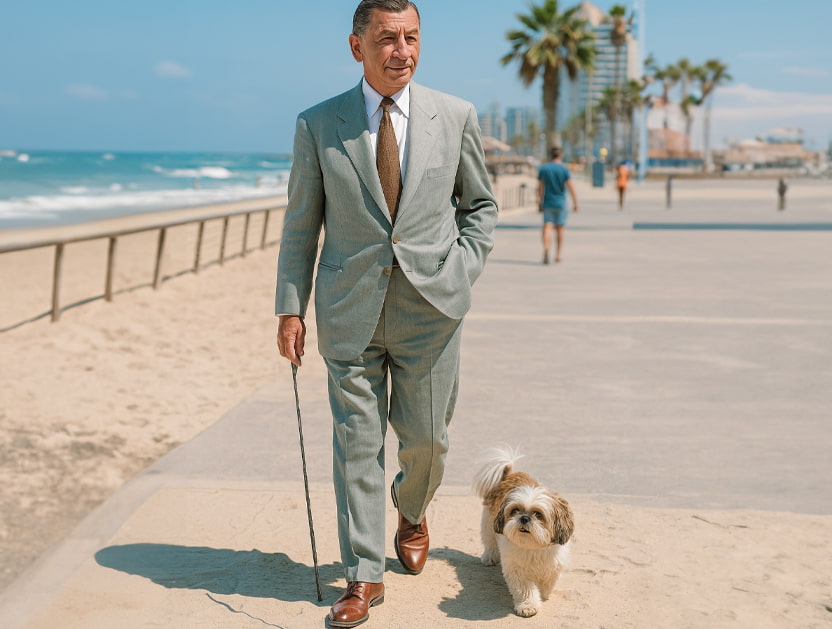
They stayed in hotels and rented apartments in the Tel Aviv area. Lansky frequently would walk Bruzzer, the shih tzu he and Teddy brought over from Florida. He’d meet and speak with Israelis, who often had no idea who he was. Paparazzi eventually stalked him.

The couple had come on three-month tourist visas, which they renewed in Israel. In December 1970, they applied for citizenship under the Law of Return, which grants Diaspora Jews the right to settle in Israel. The documents Lansky submitted to Interior Minister Yosef Burg stated that he was born Jewish, always considered himself Jewish, was a member of a Florida synagogue and over the years supported Israel. He attached letters of recommendation from Jewish Floridians — character witnesses, as it were.
In his unique way, Lansky projected Jewish pride. In New York in the 1930s, his henchmen reputedly broke up meetings of the pro-Nazi Bund party and attacked attendees, and in 1948 he procured weapons to be shipped to Israel during the War of Independence and bribed dockworkers to sabotage private arms shipments to Arab armies.
“I would like to spend the rest of my days in Israel,” stated an excerpt of Lansky’s application published in Little Man: Meyer Lansky and the Gangster Life, a biography written by Robert Lacey and published in 1991. “I have no criminal past which is likely to cause a breach of the peace and I am not now likely to endanger the peace in any country.”

Burg didn’t see it that way and refused Lansky’s application, citing the Law of Return’s allowing exceptions for applicants likely to undermine public order. On Sept. 21, 1971, Burg had ceased renewing Lansky’s visas.
The United States did not seek Lansky’s extradition because, the State Department’s spokesman explained at the time, his offense was not covered by a relevant Israeli-U.S. treaty.

Lansky sued Burg, and the case reached Israel’s Supreme Court, which ruled against the retired gangster on September 11, 1972. The court concluded that Burg was justified in basing his denial, in part, on the findings of a U.S. congressional committee’s 1950-51 investigation into organized crime.
Lansky “had operated within the framework of organized crime in the United States and had been closely associated with it,” Burg determined, as quoted in Lacey’s book, and Israel’s court ruled that Burg’s conclusion “could not be said to be unreasonable.”

In November, Lansky left Israel, never to return. The State Department had revoked his passport (Lansky refused to surrender it at the U.S. embassy), and Israel provided a travel document enabling him to leave the country; his wife stayed behind, temporarily, in Israel. Lansky was arrested by Federal Bureau of Investigation agents on contempt-of-court charges upon landing in Miami. A subsequent trial found him innocent. Lansky died in Florida in 1982 at age 80.
Rockaway is asked how Lansky and his Jewish underworld colleagues, most prominently Abner “Longie” Zwillman and Siegel, might have handled today’s anti-Israel agitators’ harassing and attacking of Jews on America’s college campuses and streets in the aftermath of Hamas’s Oct. 7, 2023, massacre.
“If he were in his 40s, he would be active against them,” Rockaway said, speaking of Lansky.
Rockaway harked back to the Jewish gangsters’ attacks on Nazi sympathizers.
They saw themselves, he said, “as defending the Jewish people.”
Writer-editor Hillel Kuttler can be reached at hk@HillelTheScribecommunications.com.


