
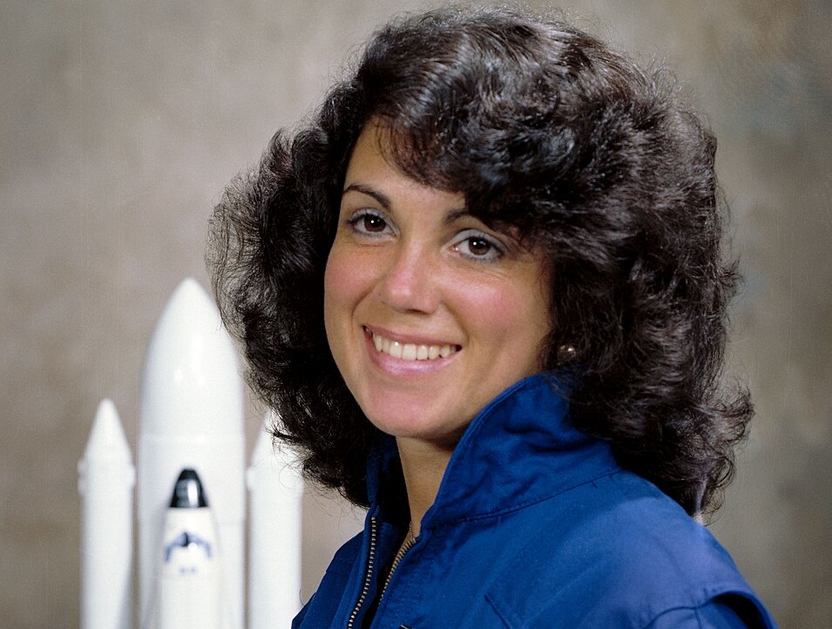
Gary Rosen was the chief prosecutor for Akron, Ohio, when he was given a plum assignment for October 18, 1984: escort a celebrity around town.
The famous person was someone he knew: Judith Resnik. Rosen and his sister Fredda grew up in Akron with Resnik and her brother Charles. As classmates, Fredda’s and Judith’s desks were adjacent because of seating dictated by alphabetical order.
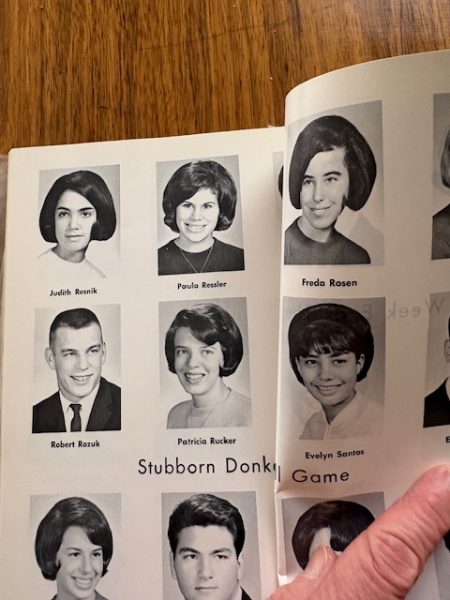
“She was the best in everything she did. She was even the best typist,” Fredda Rosen said. “She was very quiet and studious.”
The honoree was back in town for Judith Resnik Day, celebrating her as an astronaut who’d just returned from a week-long space mission aboard the shuttle Discovery on its maiden voyage. Resnik met the mayor, addressed an audience of 800 people and answered questions at another forum.

“She was absolutely charming, relatively quiet,” said Gary Rosen. “She was not someone necessarily comfortable in the limelight.”

Three months later, the National Aeronautics and Space Administration (NASA) tabbed her for a second mission, this time aboard the Challenger space shuttle.
But on January 28, 1986, almost exactly a year after the announcement, Challenger exploded 73 seconds after liftoff, killing all seven astronauts on board. Resnik, the first Jewish-American in space, was 36 years old.

Resnick was a 1966 graduate of Akron’s Firestone High School, where she attained a perfect 4.0 grade point average and was a member of the chemistry, math and French clubs. She went on to study engineering, earned her doctorate, became certified as a pilot and worked for two corporations and the National Institutes of Health before NASA recruited her in 1978.
Aboard Discovery, her duties included deploying commercial satellites, operating the shuttle’s exterior robotic arm and conducting experiments.


NASA’s biographical page for Resnik states that on the mission, she logged 144 hours and 57 minutes in space and completed 96 orbits of the earth.
In his 2006 book Riding Rockets: The Outrageous Tales of a Space Shuttle Astronaut, Mike Mullane, one of six people aboard Discovery, said he was “happy to be crewed with Judy,” calling her “smart, hardworking, and dependable, all the things you would want in a fellow crewmember.”
On Challenger, Resnik’s key assignment was to operate the shuttle’s robotic arm. The crew was the first in U.S. history to include two females — the other being Christa McAuliffe, a teacher in New Hampshire who was the first non-astronaut sent into space. McAuliffe’s selection engendered additional excitement for the mission, and she planned to conduct science lessons from space.
Instead, the launch turned into disaster due to a defect in the seal of the solid rocket booster. Examination of the debris also determined that either Resnik or Ellison Onizuka activated the emergency air packs of three of their comrades sitting in the forward seats, meaning that Onizuka or Resnik or both survived the initial blast before the spaceship crashed into the Atlantic Ocean.
The astronauts’ remains were buried in a common grave beneath a Challenger memorial at Arlington National Cemetery near Washington, D.C.
At her funeral at Temple Israel of Akron, Gary Rosen served as a panelist on a local television station’s coverage. Fredda Rosen and Resnik had attended Hebrew school at Beth El Congregation, a Conservative synagogue in town.

In 2004, President George W. Bush awarded the Challenger crewmembers, posthumously, the Congressional Space Medal of Honor, which goes to “any astronaut who in the performance of his or her duties has distinguished himself or herself by exceptionally meritorious efforts and contributions to the welfare of the Nation and mankind.”
Numerous other tributes to Resnik and her colleagues were initiated shortly after the disaster, and the effects endure.
Firestone was renamed the Judith A. Resnik Community Learning Center, one of several schools across the country memorializing her.
As a girl in New Jersey, Jessica Grapentine became fascinated with space while attending a summer program at the Buehler Challenger & Science Center near her home. It was established by the families of the Challenger crew three months after the explosion to interest children in STEM (science, technology, engineering, mathematics) subjects.

Now 24, Grapentine works at NASA’s Texas headquarters. Fittingly, her job as a biomedical flight controller is to keep astronauts safe and healthy in space.
In an interview last year with the Challenger Center, Grapentine explained the summer program’s influence.
“My time there helped me realize my passion for space,” Grapentine said. “It was a crucial step in my pursuit of this passion as a full-time career.”
The Challenger Center consists of 33 facilities across the United States that provide immersive experiences for middle schoolers, including working in teams to solve scientific challenges. Each location’s walls feature quotations from the Challenger seven.
The center has reached 6.5 million students since its founding, said communications director Julia Austin.
For the 40-year commemoration, the center will honor the Challenger crew with a digital time capsule consisting of students’ expectations of how space travel will look four decades hence, she said.

In Akron, a scholarship in Resnik’s name was launched soon after her death. Like the Challenger Center, it continues to operate.
Resnik’s “success, career and life are still used as a model for students in Akron for how to succeed in STEM, and she especially was a model for young women,” Gary Rosen said.
“I think there’s a tremendous legacy here in town, especially for students in the Akron public schools, because she was a product,” he said. “She was respected, admired and serves as a role model for what students can accomplish.”
Writer-editor Hillel Kuttler may be reached at hk@HillelTheScribeCommunications.com.


