
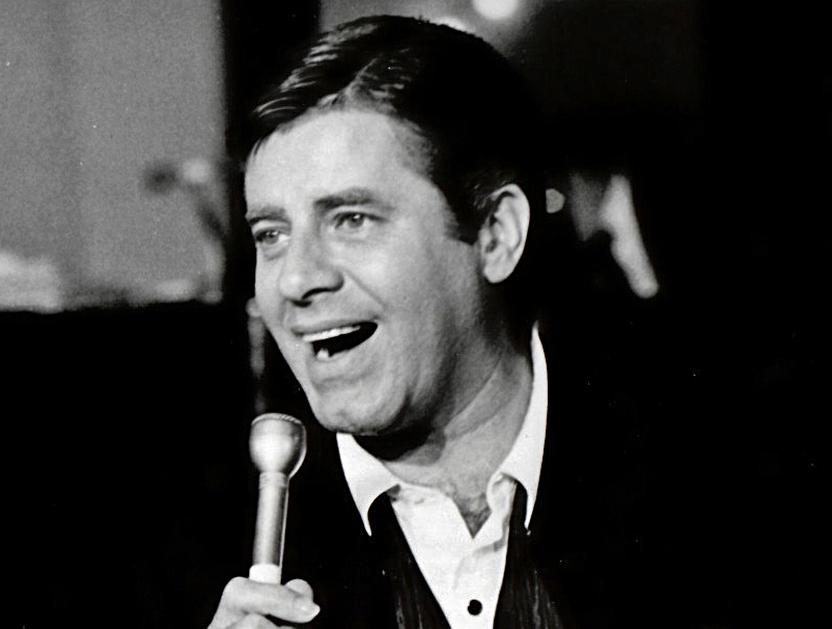
Jerry Lewis once was known as The King of Comedy, but, to be fair, not everyone was enamored of him. The actor-comedian’s breakup with performing partner Dean Martin reportedly was so acrimonious that the duo did not speak for about 20 years. Lewis’s relationship with several of his children was strained. His film characters’ physical contortions, facial expressions and high-pitched yelps — Lewis’s “Hey, lady!” remains his most famous line — cracked up some viewers; others, not so much. “I saw nothing funny about him,” said Israel resident Stan Fischler, a teenager in Brooklyn when Lewis burst onto the scene with Martin on radio and then television shows in the late 1940s.

But ask his fans about Lewis, who died at 91 in 2017, and warm memories flood forth.
“Anytime he was on TV, we’d make sure to watch it. We loved his slapstickness. He wasn’t afraid to make a silly face or move like a jerk. He influenced us in a silly, wonderful way. We couldn’t get enough of Jerry Lewis,” said Lydia Wilen, harking back to her and her late sister Joan’s childhood in Brooklyn.

Ana Maria Vazquez, of Buenos Aires, Argentina, offered this: “I always admired the property of gesticulation. He talked a lot with his body. His characters were full of innocence and even clumsiness that made him so lovable. He did his best to make people laugh. … He was a complete artist. He danced and sang and had a very beautiful voice despite the one he always used to do for his characters.”
Mark Eisler said he was “hooked” on Lewis’s comedy from age 5, when his parents took him in 1963 to a drive-in movie theater to watch The Nutty Professor. “It sounds so simple, but the man just made me laugh,” said Eisler, a South Carolinian by way of the Bronx.

Even Lee Levinson’s German shepherd, Heidi, was a fan.
Back in the late 1970s or so, Levinson was walking Heidi near a hotel by Manhattan’s Central Park when Lewis left the building, entered a limousine and rolled down the window.
“Hi, sweetheart. Want to come home with me?” Lewis called out to the dog, who Levinson remembered “bounced for joy” at the stranger’s interest.
“She had smelled Jerry’s cologne,” said Levinson, who, like Eisler, mentioned liking Lewis after watching The Nutty Professor.

With the approach of the centennial of Lewis’s birth on March 16, fans’ memories will naturally gravitate to his decade-long partnership with Martin through the mid-1950s, Lewis’s solo career in movies after the pair split, his nightclub act in Las Vegas and his nearly half-century of emceeing a telethon every Labor Day weekend that raised hundreds of millions of dollars to benefit children with muscular disorders.
Some fans and other intrigued parties have taken a scholarly approach to Lewis’s work.
One, Steven Shaviro, wrote in a 2013 essay that Lewis deserves recognition “as one of the great artists of world cinema.”
That is so because Lewis’s comedy often went beyond being “infantile,” Shaviro, a retired professor at Detroit’s Wayne State University, said in an interview for this article.
“The humor wouldn’t be funny without all the superstructure in it. Individual gags would be silly in a stupid way. At the same time, there’s the context all around it,” he said.
Shaviro cited Lewis, playing the title character in The Nutty Professor, taking pills that turned him into a nasty person. In a different scene, he sought to persuade another professor to appear in a campus performance, simultaneously praising and mocking him. In one of Lewis’s last films, Cracking Up, his character attempted through convoluted means to kill himself and failed each time; he then saw a psychiatrist, who cured him by hypnosis, but the psychiatrist in the process became a hopeless wreck.
“He was an extremely physical comedian, but it was the combination of going low and, at the same time, he could have a sophisticated way of presenting it,” Shaviro said. “It’s a very weird space to be in, and I think it’s what [made him] pretty unique.”
Another professor, Kathleen Newman, who teaches in the English department of Pittsburgh’s Carnegie Mellon University and authored an article titled “Jewish Comedy Writers of the 1950s and 1960s,” said that Lewis is notable as a Jewish figure — including a “kind of a Jewish intellectual nerd” in The Nutty Professor — in an era of burgeoning ethnic diversity.
Lewis’s parents, Daniel and Rachael Levitch, were Jewish immigrants from Russia who worked in New York’s entertainment industry.

“TV had an openness for that kind of goofiness,” Newman said.
In research for this article, interviewees responding to questions about their fondness for Lewis cited the power of their personal encounters with him.
Dave Jackson, who worked as Lewis’s personal assistant from 2007 to 2012, called his boss “generous … to a fault.”
“There was a misconception that he was not nice to people,” Jackson said from his home in Florida, thinking back to a Saturday morning in Wabash, Indiana, when diners at a breakfast place gave Lewis a standing ovation upon recognizing him.
Lewis saw several women staring at him and invited them to pull up a chair. They gabbed and he gave them tickets to bring their husbands to his performance that night.
“He was fun to be out with in public,” Jackson said.
In May 2001, Eisler went to the 92nd Street Y, a noted center of Jewish life in Manhattan, to attend an event in which Lewis was interviewed on stage. During a question-and-answer session with the audience, Eisler mentioned seeing Lewis perform 10 times in the Broadway stage version of Damn Yankees. Eisler said he dreamt of being photographed with Lewis.
“ ‘Mark, get the hell up here now,’ ” Eisler remembered Lewis telling him. “I thought I was hearing things. I went up. I was trembling.” Afterwards, Lewis summoned Eisler to his dressing room, where they chatted some more.
“It was a dream come true,” Eisler said. “I was up all night.” Two weeks later, the photographs arrived at Eisler’s New Jersey home.

From Argentina, Vazquez had to travel much further to see Lewis — Los Angeles in 2014 and New York in 2016 — where he spoke about his career against a backdrop of slides from his films.
“My heart never beat as hard as the first time I saw him and heard his voice live. I had succeeded!” she said of attending the Los Angeles event. As a nine-year-old in Buenos Aires, Vazquez first saw Lewis star in The Geisha Boy. She liked him in Fight for Life, Arizona Dream, Max Rose and The King of Comedy. Her favorite remains Rock-A-Bye Baby.
“Seeing him so close, that Jerry Lewis that I saw for years in black and white, as a young man, and then in technicolor with his histrionic characters, the one who made me learn by heart the dialogues of his movies, his songs, the one who made me laugh and cry was also there, in front of my eyes!” she wrote in an e-mail.
“Without a doubt,” she continued, those were “two of the best moments of my life.”
Writer-editor Hillel Kuttler may be reached at hk@HillelTheScribeCommunications.com.


