
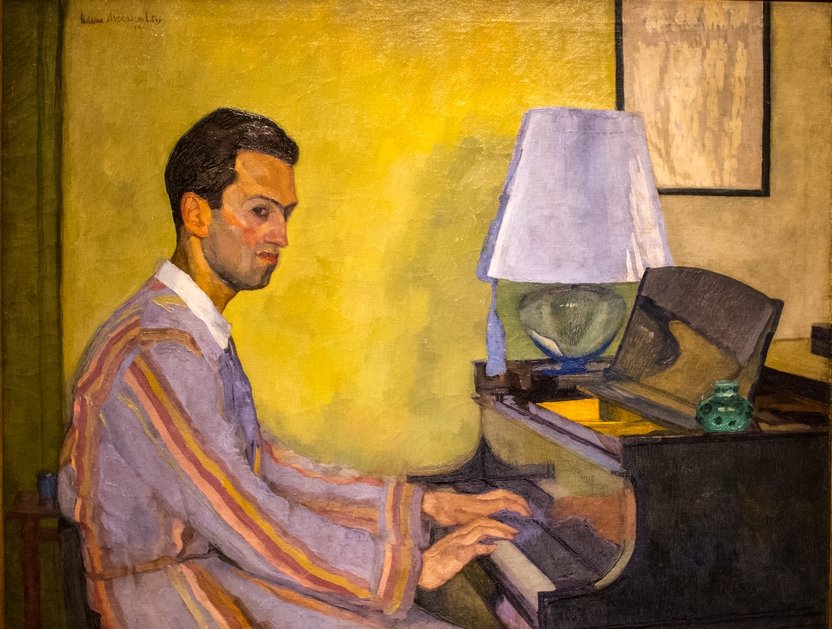
For Israeli pianist Guy Mintus, performing Rhapsody in Blue in Landsberg, Germany, in 2018 for descendants of Shoah survivors remains memorable.
That’s because Leonard Bernstein had 70 years earlier conducted a concert for Shoah survivors at a displaced-persons camp in Landsberg, and the program included the same George Gershwin composition.

“That was a pretty special moment,” Mintus said. “It closes the loop.”
With its blend of classical and jazz elements, Rhapsody in Blue was experimental when Gershwin wrote and first performed it in early 1924 — and became a monumental smash.
The piece’s eclectic nature might be said to represent Gershwin’s career.
Consider that in November of that year, he was performing as a piano soloist with the Philadelphia Orchestra. While in the city, he observed rehearsals of Lady, Be Good!, a musical Gershwin and his brother and fellow composer-collaborator Ira scored, prior to its heading to Broadway.
The Philadelphia schedule illustrated Gershwin’s “blurring of the boundary” between the classical and jazz genres, said William Everett, a retired music professor at the University of Missouri – Kansas City.
“If there’s a really concise version of why Gershwin mattered, it’s because he did that repeatedly,” said Everett.
He was “a crossover artist,” said Howard Pollack, author of a 2006 biography of Gershwin.

The man behind Rhapsody in Blue would compose the classical Piano Concerto in F the next year; 2025 is the concerto’s centennial.
Any discussion of 20th-century U.S. music must include Gershwin, who composed the music for multiple Broadway shows, wrote one of the greatest American operas in Porgy and Bess and moved from his native Manhattan across the country to compose for Hollywood movies at the dawn of “talkies,” the film industry’s synchronization of moving images with music and sound.
“One of Gershwin’s most important contributions is he straddled the line between concert-hall music and the world of popular music. He showed how these two realms — art and commercially popular music — were really not that far from each other,” Everett said. “Gershwin eradicated that barrier in so many ways. Gershwin is someone whose music you can hear played by dance bands as well as by symphony orchestras. It’s really something quite remarkable.”

Gershwin accomplished all of this by age 38, when he died of a brain tumor in 1937. He never married and died childless, but his siblings’ descendants manage the Gershwin brothers’ estate today.
George’s compositions attracted an impressive following at the highest levels. “Swanee” became a hit when Al Jolson recorded it. Gershwin wrote the song as a teenager. “I Got Rhythm,” “I’ve Got a Crush on You” and “Someone to Watch Over Me” were songs he penned for Broadway shows in the 1920s that became classics, with such vocal legends as Frank Sinatra, Ella Fitzgerald and Linda Ronstadt recording them separately decades later. Gershwin’s An American in Paris, an orchestral work that premiered at New York’s Carnegie Hall in 1928, remains one of the most popular compositions in American music. So does Rhapsody in Blue, excerpts of which continue as staples of United Airlines’ television commercials. Woody Allen’s 1979 film Manhattan opens to montages of the city set to Rhapsody.
Rhapsody in Blue also was the title of a 1945 film about Gershwin, while a 1951 Gene Kelly film, An American in Paris, was inspired by that work.
As to Lady, Be Good!: Gershwin wrote it for another dancing great, Fred Astaire, and Astaire’s sister Adele.
Gershwin is “still a presence in the jazz world, the popular-music world. He stands the test of time and is performed often,” said Pollack, remarking that the Houston Grand Opera will in October open its season with Porgy and Bess.

Gershwin’s parents were Jewish immigrants from St. Petersburg, Russia. George, born Jacob Gershowitz, like many other Jewish, musically gifted immigrants or children of immigrants of the day — they included Irving Berlin, Jerome Kern and Richard Rodgers — was strongly influenced by his cultural background, although he didn’t write on overtly Jewish themes.
Still, “George Gershwin and Jewish Music” is the theme of a talk Pollack will deliver at a Gershwin-themed conference in Milan in October.

Gershwin’s parents hosted actors working in Manhattan’s lively Yiddish theater scene, and young George would play piano and sing Yiddish songs for them, Pollack said.
“To write good music, one must have feeling. This quality is possessed to a great degree by the Jewish people. Perhaps the fact that through the centuries the Jews have been an oppressed race has helped to intensify this feeling. As a result, we have had many great Jewish composers,” Pollack’s biography, George Gershwin: His Life and Work, quoted him as saying. He also wrote that Gershwin stated, “While I actually do not know much about Jewish folksong, I think that many of my themes are Jewish in feeling, although they are purely American in style.”
Mintus’s style is partly Gershwinian. His 2020 album A Gershwin Playground is comprised of his trio band’s interpretations of nine Gershwin compositions. And Mintus’s orchestral work Rhapsody on My Mind, he said, is “an evolution” of the Gershwin classic, one that he renews and improvises with each playing.
“As I grow, I discover new things. I reimagine new things,” he said, adding that Rhapsody in Blue occupies “a special place in my heart.”
Writer-editor Hillel Kuttler can be reached at hk@HillelTheScribeCommunications.com.


