
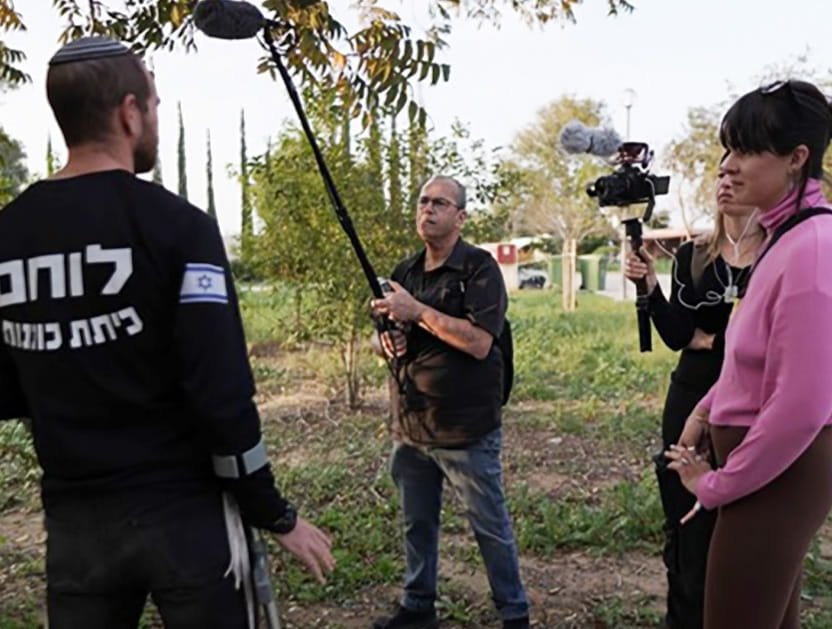
“My reserve service ended long ago,” Itay Ken-Tor recalls. “On October 7, like so many Israelis, I simply fell apart. I wanted to help, and I had no idea how.” Two days later, on the evening of October 9, he and several friends gathered on Zoom to think together. “These friends are leaders in their fields – documentation, research, education, academia, technology – and we asked ourselves what we could do.”
“I’m a documentarian, and I love listening to people,” he says. “In the past, I worked on several projects involving Holocaust testimonies, including producing films for Yad Vashem. I came with a deep understanding of the value of first-hand testimony, both for the witnesses themselves and for the public. And I remembered the frustration when testimonies weren’t filmed well, or when you simply couldn’t hear what was being said.”

That Zoom call marked the birth of Edut 710 (“Testimony 710”), a visual archive of testimonies from October 7. To date, the project has recorded 1,724 testimonies; approximately 1,200 have already been edited, and around 900 are available on the project’s website and YouTube channel.
“Some people walked in saying, ‘I have nothing to tell,’” Ken-Tor recounts. “They sit down, begin to speak, and suddenly two hours have passed.”
Volunteers quickly learn that with this project, something different is called for: “We call them listeners, which is far more accurate than ‘interviewers.’ The essence of the work is listening. One of the biggest challenges was teaching our volunteers, many of whom are experienced documentarians or interviewers, to be silent. To stop asking questions. To simply be a listening presence. At most, they ask a few basic questions to help establish the timeline of the day.”

One testimony that remains etched in Ken-Tor’s mind is that of Ruth Ben-Walid, given nearly a year after the attack. A resident of Ashkelon, she served as a regional supervisor for the Ministry of Education, overseeing teams across more than 20 schools. She described her desperate attempts to reach staff members she knew so well and her helplessness in the face of their suffering. “At one point she began to cry,” Ken-Tor says. “She said it was the first time in a year that anyone had asked how she was feeling, the first time she had been given the chance to tell her story and what she went through on October 7.”
Each testimony requires the work of more than ten volunteers. Beyond the photographer and the “listener,” there is a video editor who assembles the full testimony and creates a 5-7 minute summary. Content editors write the brief synopsis that appears with each testimony and extract keywords – names, places, events – that will later support the construction of a searchable archive. “We send the edited testimony to the witness, and only after they approve it, which can take time, as many are displaced or coping with multiple losses, do we upload it online,” Ken-Tor explains.

Ken-Tor himself has listened to dozens, perhaps hundreds, of testimonies. “One of the moments that stays with me came early in the war. In November 2023, we arrived at the David Hotel by the Dead Sea, where members of Kibbutz Be’eri were staying. We set up two recording rooms. In each room, we recorded six testimonies a day for more than a month. It was intense. I remember listening to Hadas Dagan, one of only two survivors of what is now known as “Pessi’s House” [14 hostages were held by Hamas terrorists in Pessi Cohen’s house in Be’eri, all but two were killed -ed.]. It was the first time she had told her story. The way she described it was chilling – her husband’s death, the tank fire inside the kibbutz. It stays with me.”
Choosing to expose oneself to so much trauma is not intuitive. “I hear the stories, but I wasn’t with them in the safe room,” Ken-Tor says. “I feel enormous empathy and identification, but I also create some distance. That’s what protects me.”
Even so, what drives every volunteer in the project is a profound sense of purpose, the knowledge that they are doing something meaningful, something that will remain for generations.
“It is an immense privilege,” Ken-Tor says. “Listening to someone share what they have endured is a sacred responsibility. We live in a country where listening is not one of our strongest traits. But in the end, we all need someone to listen.”

The significance of testimony for those who survived October 7 is immense. “The testimony belongs to the witness,” Ken-Tor says. “This isn’t a documentary film, I’m not thinking about an audience. Testimony allows someone who has lived through trauma to reclaim a sense of control. They tell their story in their own words, in their own order: what comes first, what is included, what is left out. That [control] was taken from them on that day, and giving it back provides a measure of emotional grounding.”
One witness Ken-Tor cannot forget is Yaniv Riz, a paramedic who survived the Nova music festival. He gave his testimony just a few weeks after the attack, on November 11, 2023. “We traveled north to film him, to the small community where he lives,” Ken-Tor recalls. “The tension along the border was so high that throughout the recording you can hear a military drone circling overhead.”
Riz had already appeared on television, where he had been instructed not to describe anything graphic. “He asked us, ‘How much detail can I go into?’” Ken-Tor says. “The testimony gave him the opportunity to tell everything – truly everything. I told him, ‘We’re here for you. Say whatever you want, however you want.’ It allowed him to go deep.”

“Telling one’s story also provides recognition, validation,” Ken-Tor explains. “Once it’s recorded, the witness knows their story is preserved. They no longer need to carry the full burden of remembering on their own. And on a broader scale, creating this archive will allow us to understand the larger narrative, to connect the dots, to learn what happened in each community, to assemble the full picture. Our task is to gather as many pieces of that puzzle as possible.”
The project continues to reach out to communities across Israeli society. Some groups, such as Bedouin and Arab communities, foreign workers, and civilians who fought on that day, have been more difficult to access, and the team is actively seeking more points of contact.
One ethical dilemma the initiative faced concerned the testimonies of minors: should testimonies from children under 18 be published? Opinions varied, and the team consulted psychologists. “In Be’eri,” Ken-Tor recalls, “we recorded just a month after the attack. Families stayed together constantly; children did not leave their parents’ side, so they heard their parents giving testimony. When a 9-year-old girl heard her mother telling her story on camera, she wanted to share hers, too. Hearing the same events from her perspective was extraordinary.” Ultimately, the team decided that children’s testimonies would be recorded but not made public, with rare exceptions, such as a teen whose family specifically requested that his testimony be published.

The project is far from finished. “Around 70,000 people were in the Gaza border region that Saturday,” Ken-Tor notes. “We won’t reach 70,000 testimonies. But we do want as many perspectives as possible. There are groups we still haven’t heard from, not enough police officers, not enough soldiers, rescue and medical teams. And now, two years later, people are returning to us asking to testify again, because so much has changed. Their story has changed. Their experience is different. And of course we welcome that.”
The partnership between Edut 710 and the National Library of Israel formed quickly, out of a shared understanding that preserving video testimony is complex work requiring professional expertise, constantly evolving technology, and significant resources. Drawing on their experience with Holocaust testimony, Ken-Tor and his colleagues adopted a guiding principle: innovation.
“Accessibility is crucial to us,” he emphasizes. “We don’t want these testimonies to disappear into an archive. We want people to hear them, use them, study them, and build educational materials from them.”
Indeed, testimonies on the project’s website can be searched by category, organization, name, or location. Their YouTube channel features complete testimonies as well as selected excerpts in both Hebrew and English. “But to continue this essential work,” Ken-Tor stresses, “we need additional financial support.”

If there is one message Ken-Tor hopes listeners will take from these testimonies, it is the importance of listening itself and, more broadly, of ensuring that future generations will have a reliable source to learn from about what happened here on October 7.
***
Explore the remarkable and wide-ranging work of Edut 710, the historical testimony archive of the events of October 7, 2023: https://www.edut710en.org/
Edut 710 is a partner initiative of Bearing Witness – The October 7 Archive, coordinated and managed by the National Library of Israel in collaboration with the Ministry of Heritage. The archive is a national effort to document all materials related to October 7 and the ensuing war. Preserved at the National Library, it will remain accessible to researchers, educators, the public, and future generations. To date, more than two million files – testimonies, WhatsApp messages, photographs, videos, eulogies, diaries, and more – have been collected. The archive works with over 100 initiatives and partners and is now in the process of integrating all materials into the Library’s catalog and making them fully accessible.


