
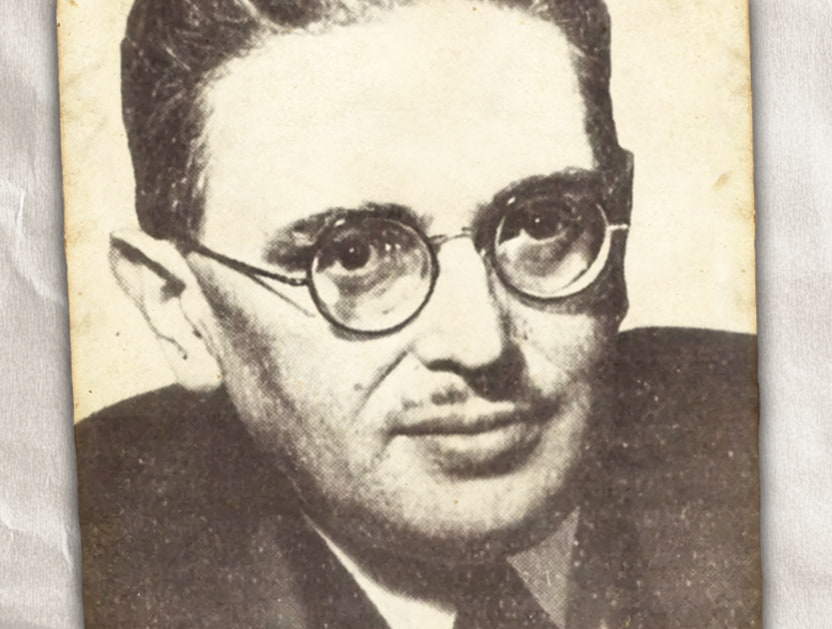
The only surviving photograph of Karl M. Baer looks rather ordinary. There is nothing in it that stands out. A European man in a suit and glasses, with neatly combed hair. No one would be surprised to learn that the man in the photo had worked as an insurance agent in 1950s Bat Yam, a town located just south of Tel Aviv,
Yet behind this plain exterior was an extraordinary life filled with political and medical drama. A life that began in Berlin, where Karl was born a Jewish baby girl named Martha, and ended in the State of Israel in 1956, when he was buried at Kiryat Shaul Cemetery as Karl M. Baer. In fact, Karl M. Baer was nothing less than a trailblazer. He was the first documented person in the world to undergo gender affirmation surgery. The operation was performed in 1906 by the Jewish sexologist Dr. Magnus Hirschfeld. His institute, founded in Berlin at the end of the 19th century, was one of the first and most prominent centers for the study of sexuality. It was later burned and destroyed by the Nazis in 1933.
Karl’s Early Life
From the moment he was born, Karl defied accepted norms. In the hospital where he was delivered in 1885, the nurses debated the baby’s sex because the newborn exhibited “unusual” characteristics. It is believed that Karl was born intersex, with physical traits of both sexes. After some hesitation, the nurses decided to register the baby as a girl, and the name Martha was given.
From a young age, Karl felt a profound disconnect between his gender and his body. During adolescence, the physical differences between him and the other girls in his class became more and more pronounced. Facial hair began to appear, and his voice grew deeper. At first, Karl feared he might have contracted tuberculosis. He also began to experience sexual attraction toward women, and suffered frequent bouts of depression and anxiety.
In the early 20th century, Karl began working at a large department store. It was there that he was first exposed to feminist ideas. The realities of day-to-day work in the store, including sexual harassment, wage discrimination and the patronizing attitudes of customers and managers, led Karl to become an activist.
As a feminist activist, Karl focused on one of the most painful issues facing the Jewish world at the time: the trafficking of Jewish women into prostitution. At the turn of the century, many Jewish women from Eastern Europe, desperate to escape the harsh conditions of life in the Pale of Settlement, sought opportunities to emigrate by various means. Often, they fell victim to fraudsters who promised them safe passage but instead trafficked them into the sex trade. These women were exploited in brothels across Western Europe, the United States and even Argentina. Karl worked to improve the situation of Jewish women who had been trafficked in Germany, and soon became a sought-after lecturer on the subject throughout the country. He also began publishing opinion articles in the press.
Although there were no known cases at the time of anyone transitioning from female to male, Karl began to live publicly as a man. As early as 1904, he began using masculine pronouns and presenting himself as male.
During this period, Baer met Beila Halperin and fell passionately in love. The two carried on a tempestuous affair, but two obstacles kept them from living openly as a couple. Beila was already married, and Karl, although living as a man, was still legally registered as a woman. Same-sex marriage was far from recognized at the time. Like Romeo and Juliet, the young lovers decided that if they could not live together openly, they would rather die together. They planned to commit suicide as a couple.
On the appointed day, Baer waited at their meeting place in Berlin. But as he stood there, he was struck by a tram, a new technology sweeping through the city. He was seriously injured, and the planned double suicide had to be abandoned.
During his recovery in the hospital, Karl confided in his doctors about his struggles with depression and his public identity as a man. After hearing his story and observing his “unusual physical characteristics,” one of the doctors reached out to Dr. Magnus Hirschfeld, one of the most prominent physicians and sexologists in Berlin and in the world at the time.
Dr. Magnus Hirschfeld, the Jewish Sexologist Who Changed the Study of Sexuality

Dr. Hirschfeld was one of the most prominent and pioneering researchers of sex, gender and sexuality in Germany, and indeed the world, during his time. To this day, he is recognized as one of the most influential figures in the study of sexuality in the 20th century. Hirschfeld, who was himself gay, was among the first to call for the decriminalization of consensual same-sex relations between adult men.
At the end of the 19th century, in Berlin, he founded one of the first research institutes in the world dedicated to sexuality, known as the Institute for Sexual Science. In 1910, Dr. Hirschfeld published Die Transvestiten: Eine Untersuchung über den Erotischen Verkleidungstrieb (later translated as Transvestites: The Erotic Drive to Cross-Dress), one of the earliest studies of cross-dressing and transgender identity. In this book, he also called for recognition of what he described as a “third gender” for those who sought it. Four years later, he published Die Homosexualität des Mannes und des Weibes (The Homosexuality of Men and Women), considered one of the foundational texts on homosexuality.
Hirschfeld was not merely an academic. He was also a practicing physician and surgeon, one of the first to perform gender affirmation surgeries. Among his early and most famous patients was the artist Lili Elbe, whose story later inspired the novel and film The Danish Girl.
Dr. Hirschfeld accepted Baer as a patient and recommended what he called “a small operation” to affirm his male identity. Baer accepted the recommendation and in 1906 underwent the surgery performed by Hirschfeld. As far as we know, this was the first procedure of its kind ever documented.
What precisely was the nature of Baer’s operation? Unfortunately, we do not know. Not because of any lapse in Hirschfeld’s medical records, but because of the Nazis.
To the Third Reich, Hirschfeld embodied everything they opposed. He was Jewish, intellectual, liberal, and openly gay. It is no surprise that he and his institute were early targets of the Nazi regime. Within six months of the Nazis taking power, they moved swiftly to close the institute and destroy it publicly.
Indeed, one of the main targets of the infamous book burning of May 1933 was Hirschfeld’s Institute for Sexual Science. The well-known photographs of that event were taken at Opera Square, near the institute’s location. On the night of the burning, Nazi forces raided the institute, looted more than 20,000 books and research papers, confiscated all of its property, and then set fire to the entire building. Among the documents lost in the flames were many patient records, including those of Karl M. Baer.
At the height of the book burning, Joseph Goebbels addressed a crowd of some 40,000 enthusiastic Germans at Opera Square. “The era of Jewish intellectualism is over,” he declared. “From this day forward, we will cleanse Germany.”
The destruction that night did not stop with books and documents. The institute’s director, Kurt Hiller, himself a Jewish intellectual, a gay man, and an outspoken advocate for LGBTQ rights and opponent of Nazism, was arrested during the raid. He was sent to a concentration camp but managed to escape after nine months, first to Czechoslovakia and then to London. After the war, he returned to West Germany and tried to re-establish the institute, but was unsuccessful.
Dr. Hirschfeld himself managed to escape to Paris soon after the destruction of the institute. He died there in 1935 at the age of 67. Not all of the institute’s patients were as fortunate as Hiller and Hirschfeld. Dora Richter, the first German woman to undergo gender affirmation surgery under Hirschfeld’s care, was severely injured during the violence but later managed to flee Germany. Many other patients of the institute would ultimately perish in concentration camps as part of the Nazis’ persecution of homosexuals in the years that followed.
Karl M. Baer was among the fortunate few. While the exact nature of his surgery is unknown, it was sufficient in the eyes of the German authorities to legally recognize him as male. One year after the operation, in 1907, Baer was issued a new birth certificate and identity papers listing him as male. The name recorded was Karl M. Baer, with the middle initial “M.” as a subtle reference to his birth name, Martha. With his new documents, Karl was finally able to marry Beila. They wed, but sadly, Beila died shortly afterward of pneumonia. Karl soon remarried, this time to Else Max.
Karl M. Baer Immigrates to Israel
After receiving his updated documents, Baer and Hirschfeld published his story, which, as expected, caused a sensation in Germany. Baer released an autobiography under the pseudonym N. O. Body, a name full of layered meaning and also a playful reference to Theodor Herzl’s Altneuland, which included a character with the same name. The book became a bestseller in Germany and was later adapted into two films.
Alongside his growing public fame, Baer served as chairman of the Berlin branch of B’nai B’rith, then Germany’s largest Jewish philanthropic Zionist organization. He held the post until 1937, when the Nazis banned the organization and arrested its staff. Baer was arrested by the Gestapo and tortured during interrogations. After his release, he and his wife Else decided to immigrate to Mandatory Palestine. They settled in Bat Yam, where Karl retrained as an insurance agent.

From their arrival in the late 1930s until his death, Karl and Else lived quietly in Bat Yam, much like other middle-class German-Jewish immigrants, with few aware of their extraordinary story. In June 1956, Baer passed away at the age of 71. He was buried in Kiryat Shaul Cemetery. Although the “M.” in his name continued to hint at his birth name, Martha, his headstone simply reads: Karl Meir Baer.
Few visitors to the cemetery today know the story of Karl M. Baer, who died nearly seventy years ago. A life that began in a German maternity ward with bewildered nurses at the close of the 19th century, passed through the upheavals of 20th-century Germany and Europe, and ended in the quiet, ordinary life of a Bat Yam insurance agent.


