The Israeli Declaration of Independence as You’ve Never Seen It Before

Arthur Szyk's magnificent artwork on the Declaration of Independence highlights the deep, meaningful connection between the new Jewish state and the ancient Jewish past.

On May 22, 1948, Jewish-Polish artist Arthur Szyk finally received his long awaited American citizenship. He loved and cherished his adoptive country. America had spared Szyk the horrors of the Second World War. It was where he established himself as a well-known artist with a passion to combat the fascist, Nazi ideologies that destroyed Europe. Yet for Szyk, the experience of becoming an American was entirely dwarfed by the realization of his ultimate dream that occurred just eight days prior to his receiving his citizenship: The establishment of the State of Israel.

His wife, Julia Szyk, would tell the story of her husband, the famed artist, who burst into tears as he listened to the founding of the Jewish state on the radio.

The Artist Who Refused to Shirk the Burden of History

Arthur Szyk in his home, 1945. Photographer unknown

For as long as he could remember, Arthur Szyk found himself torn between the two opposing forces of history and modernity. From an early age, growing up in a secular Jewish family, Szyk found himself drawn to the stories of the Hebrew Bible. As a teenager, Arthur was sent to Paris by his family who encouraged him to cultivate his craft and to experience the modern art movement in the capital of European culture. It was there that Szyk developed his artistic style that combined his love of comic caricatures and the decorative illustrations of Medieval manuscripts.

At age 20, Szyk returned from Paris to his hometown in Lodz, Poland, and was quickly swept up in the activities of the local Zionist movement. In 1914 Arthur had the opportunity to join a delegation to the Land of Israel and got to see the developing Jewish Yishuv with his own eyes. He was especially taken by the first Hebrew city, the fledgling five-year-old Tel Aviv. When the First World War broke out, Szyk returned to Poland. Szyk lived in Paris and London between the two World Wars and by the time the Second World War was in full force in 1940, he left Europe for good and made his way to the United States.
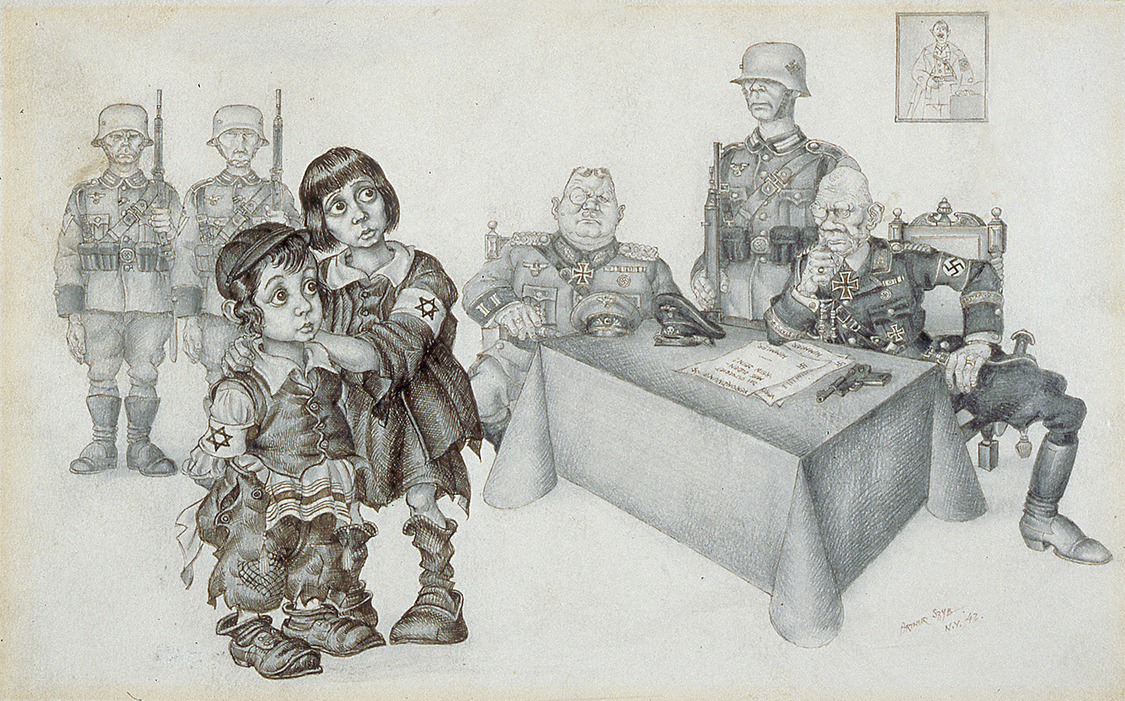
“The Dangerous Enemies of the Third Reich are to be Shot!” by Arthur Szyk, 1943, New York

When Adolf Hitler initially came to power, Szyk recognized the danger that the dictator posed to the entire world. With the outbreak of World War II in 1939, Szyk abandoned his personal projects and committed himself to fight with the Allies against the Axis of Nazi Germany, Fascist Italy, and Nationalist-Imperial Japan. His caricatures earned him a reputation as a single minded artist, relentless in his pursuit of justice and in following the tumultuous politics of his day. His critics however, labelled him as nothing but a propagandist – an opinion that is still commonly held today.

“We Declare…”

The Declaration of Independence designed by Arthur Szyk

Upon hearing of the establishment of the State of Israel, Arthur Szyk turned to the new Israeli government and requested permission to illustrate the Israeli Declaration of Independence and the  declaration that immigration to Israel was now free and open for the Jewish Diaspora.
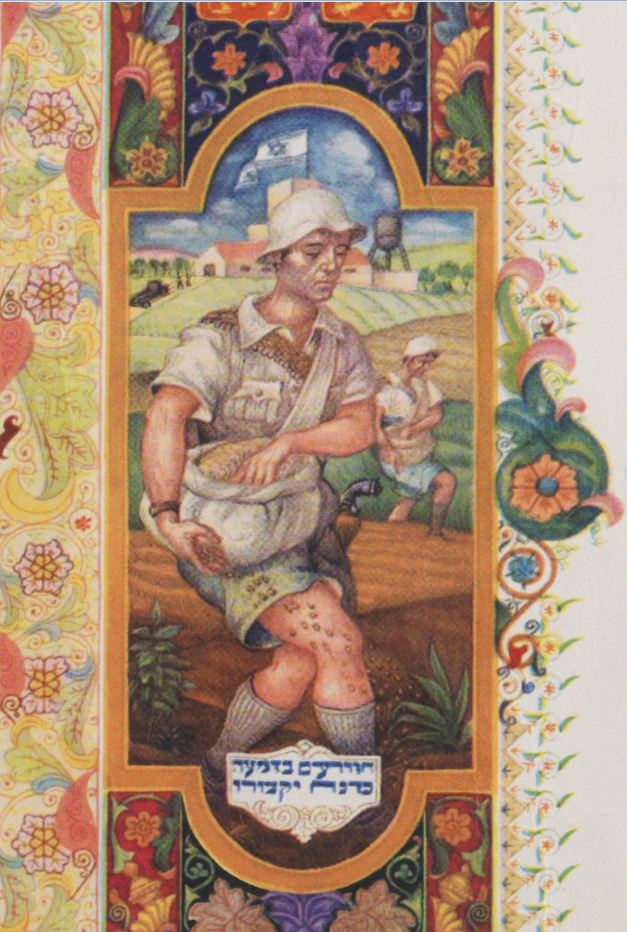
A Weeping Farmer Seeds a Field: Image from the Israeli Declaration of Independence Illustrated by Arthur Szyk

As befitting a Jewish Modern artist with a passion for Zionism, Szyk created a series of magnificent images for the declaration scroll. These images included multiple Stars of David, prayers to the Almighty, famous biblical figures including Moses and Aaron, as well as the depictions of more modern characters, including a Jewish farmer planting a field and an IDF soldier bearing a flag in one hand, and rifle in the other.

Defending the Newborn State – “If not me, then who?” – Image from the Israeli Declaration of Independence Illustrated by Arthur Szyk

It is possible that in this project, Arthur Szyk worked to artistically settle the conflict between the traditional position of trusting in God to protect the Jewish people from their enemies and the Zionist declaration that the Jews must stand strong and independent, protecting themselves from their enemies. As the phrase from Pirkei Avot, the Ethics of our Fathers, states, “If not me, then who?”

If you liked this article, try these:

Naming the Soldiers: A Special Joint Project by the National Library and Facebook

The Initial Proposals That Fell Short: How the Israeli National Emblem Was Chosen

What was Hidden Behind the Curtains at the Declaration of Independence?


The Haggadah That Brought the Nazis to the Seder

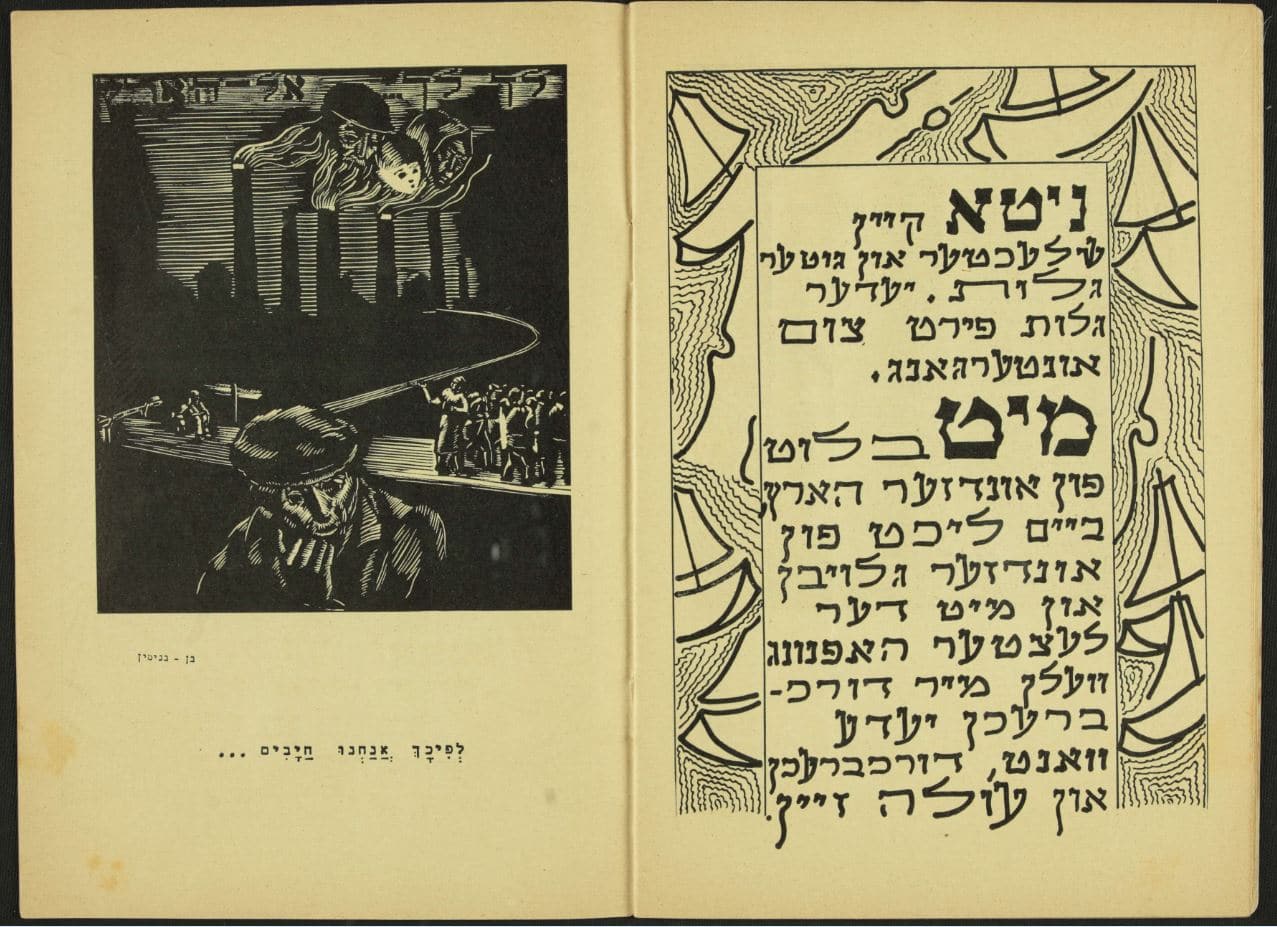
A glimpse into a Haggadah written for the residents of the displaced persons camp in Munich, illustrated by a Holocaust survivor.

For many of the residents of the displaced persons camp in Munich in April, 1946, the upcoming Passover Seder symbolized more than the Jewish people’s historical redemption; it was the reality unfolding before their eyes. Many of the survivors clustered together in the displaced persons camp had hoped that they would celebrate Passover of 1947 far from the land where their loved ones had been slaughtered, far from the land in which the Nazis and their collaborators aimed to destroy them and the entire Jewish nation. Those in the know spoke about that Passover night as the “Seder of the exodus from Europe”.

Yosef Dov Sheinson, a resident of the camp, wanted to express this sentiment in a Haggadah which he wrote for the Seder in the displaced persons camp. The excerpts in Hebrew and Yiddish which Sheinson added to the traditional haggadah are accompanied by woodcuts by the Jewish-Hungarian artist Zvi Miklos Adler, who signed his name in the Haggadah as “Ben Binyamin”.

Depicting the horrors of the Holocaust which he himself experienced during the war years, Adler’s harsh drawings complement the text of the Haggadah. In an illustration corresponding with the well-known sentence “for not only one has risen against us to destroy us” we see a soldier shooting several wretched looking prisoners, while another soldier leads a group of stooped prisoners toward an unknown destination. The picture gradually fades away as the prisoners move away from the center of the event.

“For not only one has risen against us to destroy us”

The intertwining of traditional text and modern pictures illustrates the way the creators of the Haggadah grasped the historical moment in which they lived: in each and every generation a person must see himself as if he left Egypt, but it is not in every generation that a person undergoes horrors which darken his world and dwarf the suffering experienced by his ancestors.

“For Pharaoh only made decrees against the males, and Laban wished to uproot everything”

The need to talk about and deal with the terrible topic is tangibly and explicitly expressed in the Haggadah in an illustration which is hard to look at, and under which is written, “Therefore we are obligated…”

While this excerpt in the Haggadah is usually dedicated towards praise and thanksgiving to God for redeeming us from Egypt, the expression on the face of the survivor at the bottom of the picture shows quite the opposite.

“Therefore we are obligated…”


“And they oppressed us and imposed hard labor upon us”

Passover Seder in the U.S. Army

A copy of this haggadah reached Rabbi Avraham Klausner, an American army chaplain who was in the midst of preparing for a Seder of the U.S. Army forces stationed in Munich. He decided to conduct the Seder according to this haggadah, making a single change – he added an introduction addressed to soldiers in General Eisenhower’s army (whom Klausner compared in his introduction to a modern-day Moses).

Rabbi Klausner’s introduction is in the same vein as Sheinson and Adler’s work, equating Hitler with Pharaoh and the suffering the Jews endured in Egypt with what the Jews went through in the concentration and death camps.

“We were slaves to Pharaoh in Egypt”

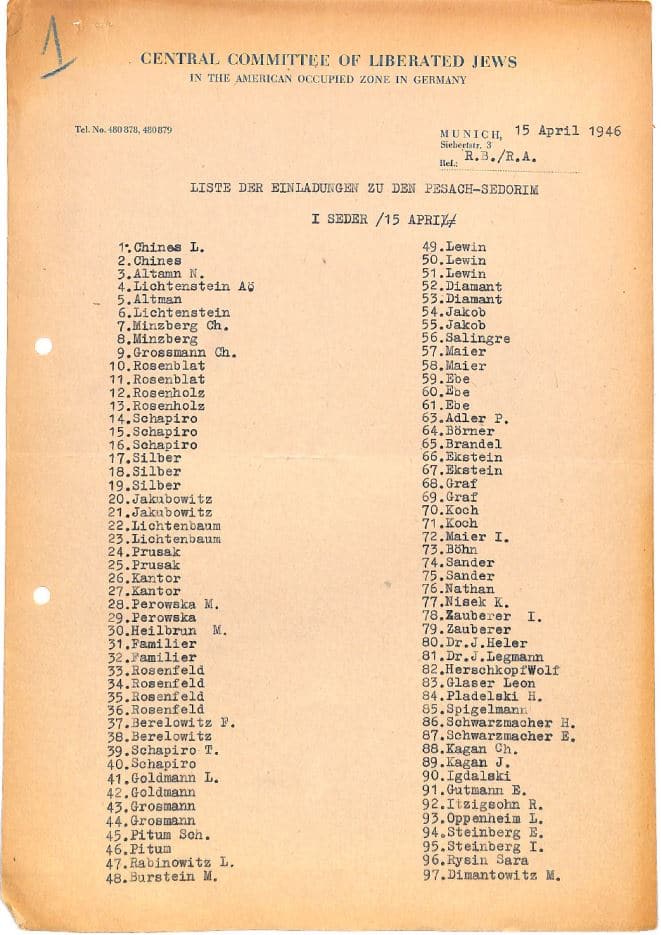
The invite list to the Seder conducted by Rabbi Klausner in the Munich Theatre, held on the same night as the Seder of the displaced persons camp in Munich, is preserved in the Central Archives for the History of the Jewish People. The list shows that only a few of the five hundred participants of the Passover Seder conducted by Rabbi Klausner were Holocaust survivors. The majority were soldiers in the U.S. armed forces.

A partial list of the invitees to the Passover Seder of the U.S. Army in Munich

The letter A was stamped on the title page of Rabbi Klausner’s private copy, indicating it belonged to the U.S. Army. On the same title page is the date and the location of the Seder at which the Haggadah was used: Munich, Germany, April 15-16, 1946″.

The title page of the Haggadah

Rabbi Klausner’s personal copy is currently stored in the Haggadah Collection of Aviram Paz. It was lent to the National Library for its “Next Year We Will Be Free Men” exhibition – an exhibition of unconventional Passover Haggadot from the years leading up to the founding of the state.

Related Articles:

How Communist Jews Made the Haggadah as Red as the Blood in the Nile

The Partisan Poet Rescued from the Woods of Lithuania

The Benghazi Haggadah: How the Jews of Libya Celebrated Victory Over the Nazis


`;