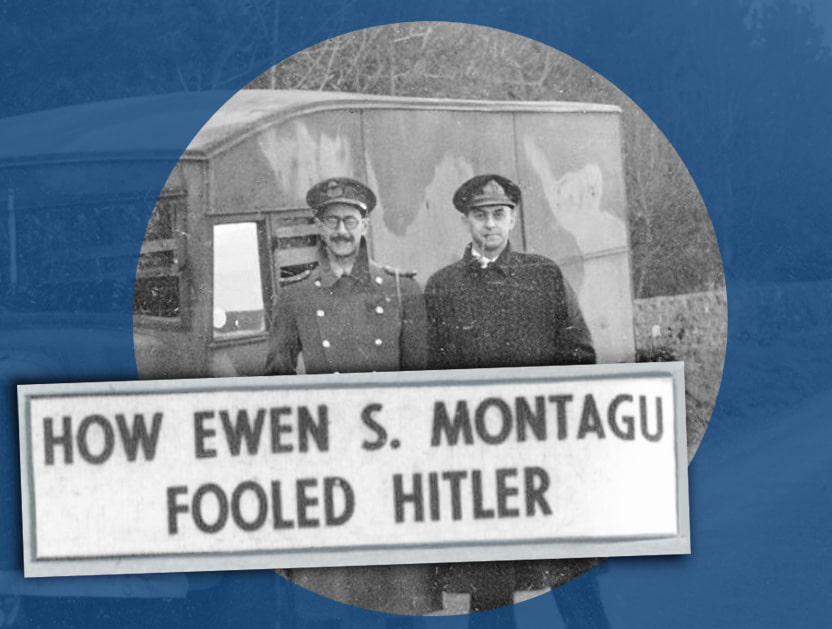
It sounds like something dreamed up by the writers of a James Bond film, and in a sense, it was. A wild idea conceived by Ian Fleming, the creator the Bond character, in the early days of World War II, gradually took shape and became one of the most daring and successful deception operations in military history. The mission, known as “Operation Mincemeat,” was carried out by Ewen Montagu, a naval intelligence officer and a Jewish-British aristocrat, who used the body of a homeless man – disguised as a fictitious high-ranking British officer – to convince Hitler that the Allies planned to invade Greece rather than Sicily. The ruse saved thousands of Allied soldiers and hastened the collapse of Mussolini’s regime.
At the start of the war, Vice Admiral John Godfrey, head of British Naval Intelligence, tasked his young assistant with an unusual assignment: to compile a list of imaginative ways to “set a trap” for the Germans, in other words, to plant false intelligence that would lead them astray.
That assistant was none other than Ian Fleming, who would go on to create the world’s most famous fictional spy. Fleming would even model the character of “M” on Vice Admiral Godfrey.

Fleming produced what became known as “The Trout Memo” – a nod to the practice of dangling bait before a fish. The memo wasn’t meant to be a practical operations plan but a brainstorming document, encouraging unconventional thinking about how to deceive the enemy. Godfrey instructed Fleming not to worry about feasibility and execution – only to generate as many ideas as possible. Fleming returned with 54 outlandish proposals. Item 28 read simply:
“A corpse […] with dispatches in his pockets, could be dropped on the coast, supposedly from a crash.”
After the memo circulated through the Royal Navy, it reached the desk of a young Jewish intelligence officer: Ewen Montagu. By 1943, Montagu was convinced that Fleming’s outrageous suggestion might actually work, and he decided to turn it into reality.
Together with Charles Cholmondeley, Montagu was appointed to lead the team responsible for the operation. Their task – given the rather unsubtle codename Mincemeat – was formidable: conjure up a senior military officer who had never existed, forge documents that would withstand immersion in seawater, find a suitable body, plant the forged papers in its clothing, and orchestrate a scenario in which the corpse would somehow end up in the hands of the Third Reich. All of this had to be meticulously believable.
The goal: persuade the Nazi leadership that the Allied invasion would target Greece, not Sicily.
Incredibly, the audacious plan succeeded. Convinced by the falsified “sensitive intelligence,” the German high command diverted major forces to the Balkans at the expense of coastal defenses in Italy. As a result, the Allied invasion of Sicily proceeded with far fewer casualties than expected. Operation Mincemeat became one of the most celebrated deception operations in modern military history. Montagu, the Jewish banker-turned-intelligence officer, had successfully misled the Nazi war machine.

The Jewish Banker Who Became an Intelligence Officer and Outwitted Hitler
Ewen Montagu was an unlikely war hero. Born in 1901 into a wealthy Anglo-Jewish family that had everything – a noble title, a banking empire, even a private mansion in Kingston, a short walk from the royal family’s residence – his early life followed the expected path: Cambridge education, a flourishing career in the family bank, and a private law practice.

When war broke out, Montagu sent his wife and children to safety in New York and enlisted in the British military. He was assigned to counter-intelligence and joined the highly secretive Twenty Committee (“XX Committee”), which oversaw all British deception operations and managed the entire network of double agents. The committee succeeded in feeding false information to German intelligence through dozens of fabricated agents. In most cases, the Germans never suspected a thing.
Montagu quickly emerged as someone with an extraordinary eye for detail – able to manage numerous agents and their elaborate fictional biographies without confusion, long before computers made such record-keeping easy. But he wanted to do more. Rather than orchestrating hundreds of small deceptions, he dreamed of a single operation so sweeping and so convincing that it would fundamentally mislead the German war effort, and change the trajectory of the conflict.
The Invasion of Sicily, and the Deception That Altered the Course of the War
“The chance to attempt such an operation arrived in 1943, ahead of the planned Allied invasion of Sicily. Following the British victory at El-Alamein, military planners concluded that Sicily, a short distance from North Africa, was the natural next step. Securing the island would open the way to mainland Italy and give the Allies their first substantial foothold on the European continent since 1940.
The amphibious invasion from North Africa to Sicily was set to be the largest seaborne assault in history – though in any case that would be surpassed only a year later at Normandy.
But Churchill and his commanders recognized the operation’s inherent vulnerability: it was almost impossible to conceal the movement of hundreds of ships and thousands of troops. Every German unit diverted away from Sicily could make a decisive difference and save thousands of Allied lives.
Montagu’s proposal, based on Fleming’s corpse-and-documents idea, was one of several deception plans personally approved by Churchill. Their shared objective was simple: convince the Germans that the obvious invasion would not take place.
The British decided to exploit what Hitler saw as Germany’s soft underbelly: the Balkans. If they could persuade him that Greece, not Sicily, was the target, the Germans would shift their forces away from the true point of attack.
Why were the Balkans so critical in Hitler’s mind?
A significant portion of Germany’s oil came from Romania. Control of Greece allowed the Germans to secure a major transportation corridor in southeastern Europe. Without the Balkans, Hitler feared, German forces fighting in the east and west could be cut off from one another if the Allies seized the region.
Hitler’s obsession with dominating the Balkans was also his answer to one of Britain’s greatest wartime strengths: the Royal Navy’s command of the seas. If Britain controlled the waters, he believed Germany must control the land routes within Europe.
How Do You Deliver a Fake Corpse to the Enemy?
One of the central challenges of the operation was determining how to place the corpse, with its forged documents, directly into German hands. Montagu’s team concluded that Spain offered the best route. Although officially neutral, Spain’s military leadership included many officers sympathetic to the Nazi regime. A body that “accidentally washed ashore” on the Spanish coast and was passed along to the Germans by pro-Nazi Spanish officials would appear perfectly legitimate.
Gibraltar, the British enclave bordering Spain, played a key role. During the war, various objects often drifted from Gibraltar’s waters to Spanish beaches and were returned through diplomatic channels. Neutrality, after all, had its rituals. British planners assumed that firm diplomatic pressure following the discovery of the corpse would convince both the Spanish and the Germans that they were dealing with the remains of a senior officer carrying highly sensitive materials.
There was another strategic reason to involve Spain: British intelligence believed Spanish pathologists were far less experienced than their German counterparts and therefore less likely to detect inconsistencies regarding the true time or cause of death.

The Officer Who Never Existed
To execute the deception, Montagu and Cholmondeley were given a small basement room at Naval Intelligence headquarters. There, they worked day and night to construct every detail of their fictional officer’s life.
What items would a British officer plausibly carry? What blend of personal effects and classified documents would feel authentic? The team obsessed over the smallest details: a love letter and photograph from his “fiancée”, (the woman in the photograph was actually a female soldier who served under Montagu) a parking ticket, bank correspondence, receipts, theater stubs, even cigarette ends and loose tobacco. All were assembled inside a briefcase meant to convince any examiner that they were looking at the belongings of a real military officer.

Montagu’s team also learned of seven actual officers in the British military named M. Martin. This coincidence made their fabricated “Major William Martin” even more believable. The British press even ran discreet obituary notices to complete the illusion.
“The only worthwhile thing that he ever did, he did after his death”
The biggest obstacle remained: locating a suitable body that could be used for this unusual purpose.
They needed someone of an appropriate age, who had died in such a way that wouldn’t immediately betray the true cause, and with no relatives likely to notice or inquire about the body’s disappearance.
Eventually they found Glyndwr Michael, a 35-year-old homeless man from Wales. Estranged from family and living in extreme poverty, he died in London after consuming bread contaminated with rat poison. His lonely, unremarkable death seemed an unlikely prelude to the pivotal role he would play in one of the war’s most consequential operations.
Because he was Welsh and not English, a pathologist had legal authority to release the body for “burial by family” in Wales, though in fact no family was informed. Instead, the corpse was quietly transferred to Montagu’s team.
When Michael’s identity was revealed years later, one description noted that “the only worthwhile thing that he ever did, he did after his death.” Yet in death he helped to save thousands of Allied soldiers, without ever knowing it.
When the Germans Took the Bait
In 1943, Spanish fishermen discovered the “body of a British officer” washed ashore. The British ambassador, already briefed on the operation, quickly demanded the return of the body and its “sensitive materials.”
This only heightened the curiosity of pro-Nazi Spanish officers, who made sure the contents of Major Martin’s briefcase reached German intelligence before the body was sent back to Britain.
The deception worked to perfection.
Hitler became convinced that the Allies intended to invade the Balkans, not Sicily. Germany reinforced its presence in Greece, leaving Mussolini’s faltering Italian army responsible for defending Sicily.

It was a disastrous miscalculation. The Italians offered little resistance; some units defected outright. In Naples, civilians cheered the Allies as liberators. Within two weeks of the Allied landing, Mussolini was deposed, forcing Germany to occupy Italy directly.
For the Allies, the invasion of Sicily was a sweeping strategic success: minimal casualties, rapid control of the island, and for the first time since 1940, Allied ground forces back on European soil. The lessons learned paved the way for the Normandy landings the following year.

Ewen Montagu After the War
Montagu did not return to banking or law after the war. Instead, he remained in the Royal Navy, eventually serving as a naval judge until his retirement in 1973. He was formally honored for his role in Operation Mincemeat.
In 1953 he persuaded British censors to allow him to publish The Man Who Never Was. The book inspired a 1956 film of the same name.

In 2010, journalist Ben Macintyre published Operation Mincemeat, which in turn led to the 2021 film starring Colin Firth as Montagu.
In the postwar years, Montagu grew closer to his Jewish heritage and emerged as a leader within Britain’s Jewish community. He served for many years as president of the United Synagogue and Anglo-Jewish Association in the UK and, in 1956, joined with a group of other British nobles who committed to supporting ORT Britain.
Montagu died in July 1985 at age 84.
In 2021, a memorial was unveiled in London honoring him and Operation Mincemeat – a daring intelligence deception that began as a wild proposal from the future creator of James Bond and was brought to life by a brilliant Jewish naval officer. A bold operation that fooled German intelligence and saved thousands of Allied soldiers by conjuring a man who never existed.
Sometimes reality surpasses even the most imaginative fiction.