
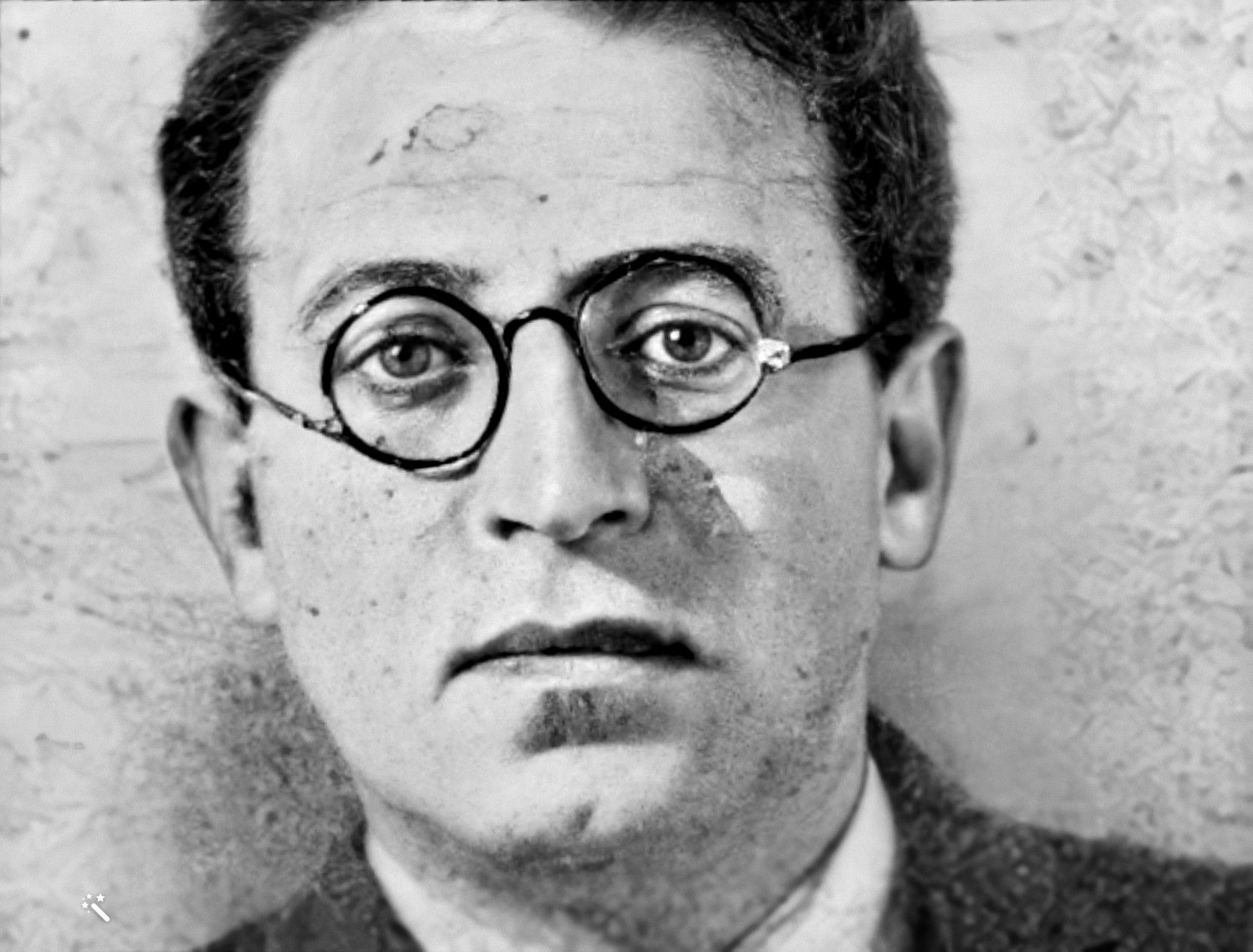
Grigory Friedman gave his first story to another Soviet-Jewish writer, Vasily Grossman, to read. Friedman, who wrote under the pen name Grigory Baklanov to avoid antisemitic criticism, attended Grossman’s seminars for young writers. This was in 1947, when Friedman, then 24, lived in the same apartment building in Moscow where Grossman had an office.
Baklanov never told his daughter, Alexandra Popoff, about any reaction Grossman might have had to his submission or about the men’s conversations. But in an interview for this article, Popoff said that Grossman “praised one of [her father’s] works,” The Foothold, a novel about World War II.
As an editor, Baklanov in the late 1980s published several of Grossman’s short stories, along with An Armenian Sketchbook, an account of his travels in Armenia in 1961. In the book, Grossman related the Holocaust to the Turks’ genocide, beginning in 1915, against Armenians.
Grossman would know. As a journalist, he’d visited the site of Treblinka, the Nazi extermination camp in Poland, in September 1944, shortly after Soviet forces arrived, by which time it was destroyed, ploughed over and abandoned.
His landmark article “The Treblinka Hell” (also translated as “The Hell of Treblinka”) includes vivid descriptions of crushed bones and scores of everyday items the Jewish and non-Jewish victims had owned and clothes they wore. Grossman and those with him continued walking over what he termed “the bottomless Treblinka earth” when they halted in horror:
It is the sight of a lock of hair gleaming like burnished copper, the soft lovely hair of a young girl trampled into the ground and next to it a lock of light blond hair, and farther on a thick dark braid gleaming against the light sand; and beyond that more and more. These are evidently the contents of one, but only one, of the sacks of hair the Germans had neglected to ship off.
Then it is all true! The last wild hope that it might be a ghastly nightmare has gone.

Popoff, a native of Moscow who has lived in Canada for the past three decades, wrote a 2019 biography, Vasily Grossman and the Soviet Century.
Grossman “was one of the most important 20th-century writers,” she said.
Grossman, who died in 1964 at age 58, would have turned 120 years old on December 12.
The Soviet-Jewish experience in World War II was a central theme for Grossman.
He and another Soviet-Jewish writer, Ilya Ehrenburg, collaborated on The Black Book of Soviet Jewry, a report documenting what befell communities throughout the U.S.S.R. during the Holocaust.

Grossman’s novel Life and Fate includes a deceased character, Anna Semyonova, the mother of Viktor Shtrum, the central character. Grossman’s mother, Yekaterina Grossman, was murdered during a Holocaust-era massacre in the family’s hometown of Berdichev in what now is Ukraine. It’s the fate that befell the Anna character in the same town; she is based on Yekaterina, and Viktor is based on Grossman himself. Like Viktor, Grossman was guilt-ridden about not having saved his mother from the Nazis.

Life and Fate is about an extended family in the Soviet Union, on both the civilian and military fronts, during World War II. Grossman’s previous novel, Stalingrad, deals with the same family’s ordeal during that pivotal battle in the war. The two novels together constitute Grossman’s epic telling of the war’s effects on ordinary Soviets.

Life and Fate contains minimal Jewish content — nothing about Jewish holidays, traditions, philosophy, prayers, peoplehood or culture. But almost out of nowhere, about midway through the book, appears a three-page chapter on the nature of antisemitism.
“Anti-Semitism is always a means rather than an end; it is a measure of the contradictions yet to be resolved. It is a mirror for the failings of individuals, social structures and state systems,” the narrator writes. “Tell me what you accuse the Jews of — and I’ll tell you what you’re guilty of.”

Douglas Murray, a British analyst of Israel’s ongoing war with the Hamas terrorist organization, has brought renewed attention to Life and Fate, which Grossman finished writing in 1960, by often quoting part of the above passage. Murray, who is not Jewish, has posited that much international condemnation of Israel’s prosecution of the war comes from those countries projecting their own evils onto the Jewish state.
The manuscript of Life and Fate was confiscated by Soviet authorities, and the book went unpublished during Grossman’s lifetime. But he had given copies of the manuscript to two friends, and Life and Fate would be published abroad in 1980 and in the Soviet Union in 1988.
The novel ran afoul of the government for its criticisms of Stalin and Soviet totalitarianism (comparing it to Nazism), and its relating of Jews’ uniquely being singled out by the Germans for liquidation (clashing with the Soviet Union’s ethos of the equality of nationalities).
The book, including its parallel to the author and his mother, along with his 1943 essay “Ukraine Without Jews,” about the Germans’ mass shootings of Jews in that Soviet republic, drew Polly Zavadivker to study Grossman and write much of her graduate dissertation on him.

Now a professor of Jewish studies at the University of Delaware who includes Grossman in her classes on the Holocaust, Zavadivker called this “a very exciting time in Grossman studies.”
Grossman “hasn’t been read and appreciated [enough] outside academic circles,” she said. “I hope that will begin to change.”
Zavadivker is weighing undertaking various Grossman projects, such as a book, workshop or in-depth essay examining Grossman as “a prophetic voice” for living humanely.
Jonathan Brent, the executive director of the YIVO Institute for Jewish Research who has taught courses about Grossman, used similar language, calling Life and Fate “a very, very important book in a genre not very well understood in the United States — and when it is, it is somewhat derided — Soviet humanism,” which he explained as interpreting the Holocaust as “ a human event, not a specifically Jewish event.”
Grossman was “very tortured” by the pulls of his Jewish identity and striving “to be a great Soviet writer,” he said.
Brent believes that Grossman made “a huge contribution” to Jewish, not only Soviet, literature.
“He carried forward Jewish memory. He didn’t pretend it didn’t exist, like so many Soviet-Jewish writers did,” Brent said. “He didn’t turn his back on Judaism. He was just tormented by it.”
Writer-editor Hillel Kuttler can be reached at hk@HillelTheScribeCommunications.com.


