
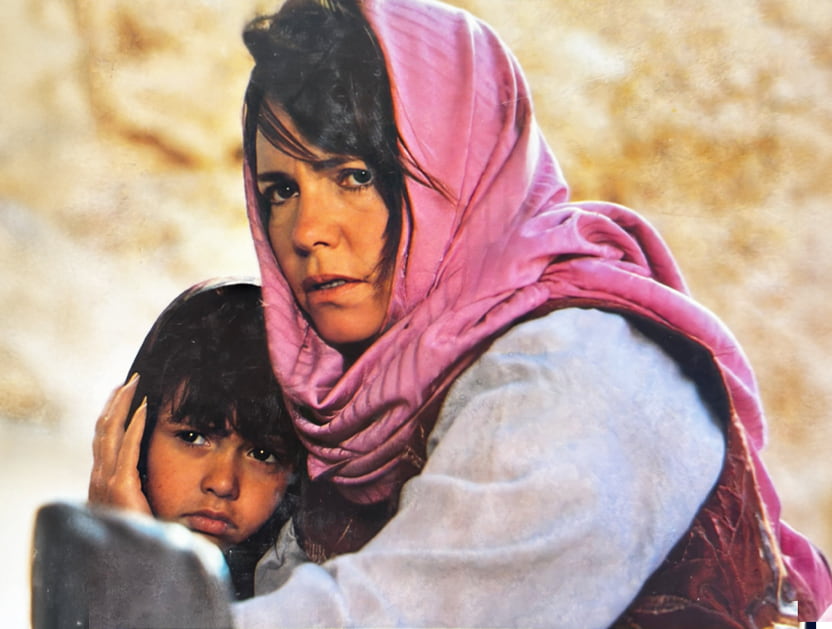
It was the dawn of the buoyant nineties. The local press – provincial in tone, perhaps – was buzzing with excitement over the arrival of an American movie star who was about to film a major Hollywood production right here in Israel.
“Sally Field,” proclaimed the headlines, “will arrive in Israel next week to film Not Without My Daughter.” And Field, a two-time Academy Award winner, indeed came, much to the delight of her fans and the Israeli paparazzi. It was not the first international production filmed in Israel, nor was she the first big Hollywood name to work here. Four years earlier, Brooke Shields had used Israeli dunes as a stand-in for the Sahara Desert, and films like Jesus and The Delta Force had sprinkled a bit of Hollywood glamour onto the local film scene. Even so, this production was unusual in many ways. The studio behind it was initially reluctant to grant journalists any access to filming locations and preferred, at first, to keep quiet about the fact that filming was taking place in Israel at all. Their first press conference came only months after shooting had already begun.

Why was this particular film special, and why was it filmed in Israel?
On August 3, 1984, an American family boarded a British Airways flight to Tehran. They looked entirely ordinary: a father, a mother, and a small daughter. They were Dr. Sayyed Bozorg Mahmoody, an American citizen of Iranian origin; his American wife, Betty Lover; and their four-year-old daughter, Mahtob – “moonlight” in Mahmoody’s native language.
“This is a mistake,” Betty thought at the time. “I wish I could get off this plane right now.” But she disembarked only upon landing in Tehran, her head covered with a scarf as required by the authorities.
This marked the beginning of an eighteen-month ordeal – a harrowing true story of confinement and then (spoiler alert) a dramatic escape from the Islamic Republic of Iran. This was their life; it truly happened.
Not long after she and her daughter returned to the United States, Betty – who, despite everything, kept her husband’s surname as a pen name – set down her story with author and journalist William Hoffer.

Published in 1987, Not Without My Daughter became an immediate bestseller and was translated into numerous languages. The book caused enough of a stir to capture the interest of Hollywood, specifically, Metro-Goldwyn-Mayer studios. It was a compelling, “hot” story: a tense, emotionally charged drama that spoke directly to a core American ideal, the belief that personal freedom is the country’s greatest gift to the world.
But one major obstacle stood in the way: filming could not take place in Tehran, and producers struggled to find American locations that looked authentic. They needed a site with a Middle Eastern feel, with appropriate exteriors and high-quality production facilities.
Israel raised its hand, and offered the G.G. Studios in Neve Ilan.
This created an irony hard to ignore. From the Iranian perspective, the “Great Satan” had come all the way to the “Little Satan” to recreate the streets of their own capital in a depiction intended for global audiences.

Relations between Israel and Iran were complicated, to say the least. On November 29, 1947, Iran – then still “the Imperial State of Iran” under the Pahlavi dynasty – voted against the UN Partition Plan. Yet in 1950, it became the second Middle Eastern country to recognize the State of Israel, even opening a diplomatic mission here.
The optimism surrounding this brief warming of ties faded quickly: less than a year later, in 1951, Iran withdrew its recognition and closed its mission. From that point onward, relations existed mostly behind the scenes, occasionally surfacing with small moments of rapprochement. In 1960, for example, the Shah declared that he recognized Israel, and in 1961 David Ben-Gurion made a secret visit to Iran.
The true rupture came in 1979, with the Islamic Revolution and the rise of Ayatollah Ruhollah Khomeini. Israel was declared an enemy state, branded “the Little Satan,” second only to the supposed root of all global corruption – seductive, modern America.

The revolution, along with the fierce antisemitism that preceded it, gave Israel an unexpected advantage when it came to filming: tens of thousands of Jews immigrated from Iran during those years. They spoke fluent Persian and possessed a deep familiarity with Iranian culture.
And so, eleven years after the Islamic Revolution had rejected Hollywood cinema entirely, Israel was chosen as the filming location for a movie set almost entirely in Tehran. Jaffa’s market transformed into Tehran’s central bazaar. Bialik Street in Ramat Gan and the Tel Aviv Central Bus Station were plastered with images of Khomeini and symbols of the Islamic Revolution. Acre’s Khan al-Umdan, a fascinating historic site in its own right, became a Muslim school, and the mountains of Eilat stood in for the rugged ranges of Kurdistan on the Iranian-Turkish border.

Sally Field arrived in Israel along with Sheila Rosenthal, who played her daughter; director Brian Gilbert; British actor Alfred Molina, who portrayed Dr. Mahmoody; and several dozen cast and crew members. A single photo of Field and Rosenthal from that time survives in the National Library archives.
In an interview with Hadashot, Lee Harmon, Field’s makeup artist on the film, described her as “the nicest of all the actresses I’ve worked with.” His résumé included such stars as Barbra Streisand, Faye Dunaway, and Jane Fonda. “I wouldn’t be here [in Israel] if I didn’t love Sally,” he said. “I had offers from places where I could play golf every weekend.” (Our apologies, Mr. Harmon, on behalf of Israel’s somewhat modest golf scene.)

Naturally, the international production gave several Israeli actors the chance to appear in a Hollywood film, even in small roles, particularly those of Persian or Turkish origin.
Producers initially approached the pop-singer Rita, likely the most famous Israeli of Persian background, but she had to decline due to her preparations for the Eurovision Song Contest in Zagreb (where she performed Shara Barhovot – “Singing in the Streets” – and finished 18th).
Those actors who did take part included Sasson Gabay as the kind-hearted bazaar vendor who lets Betty use his phone; Yosef Shiloach, who traveled from Paris to accompany Betty and Mahtob through the treacherous “Kurdistan mountains” (in reality, Eilat); and many other familiar Israeli faces: Ya’ackov Banai, Dafna Armoni, Gili Ben-Ozilio, Jonathan Cherchi, and more. The film opened in the United States under a cloud of threats from extremist groups. On the night of its premiere, someone called the Los Angeles police claiming a bomb had been planted in the theater. After a full search, it was deemed a hoax, and the screening proceeded as planned. Sally Field was assigned a security guard for a time.

Betty Mahmoody, whose name appeared on millions of book covers, lived for many years in the United States under an assumed identity, fearing retaliation from her former husband’s family. She founded an organization to assist multicultural families and campaigned against the phenomenon of child abduction within such households.
She, the book, and the film were all criticized for their portrayal of life in Iran and of Islam, though she repeatedly emphasized that her goal was simply to tell her own story as it happened. She was careful, she said, never to condemn the religion itself, only the individuals she encountered.
The true heroes, she stressed time and again, were the Muslim Iranians who appear in her book under pseudonyms – the ones who helped her, and at times risked their lives to save her and her daughter.
In Israel, the film premiered at the festive reopening of the Shachaf Cinema, a “modern and sophisticated movie center”, alongside another major release: The Godfather Part III. In Iran, the film was never screened.

And to end with – here’s a little challenge for you: According to the Ma’ariv column “Things Happen,” published on April 10, 1991, “Anyone who didn’t blink at that exact second could spot a ‘Dan’ bus – line 63 – making its way, quite innocently, down one of Tehran’s streets.”
Have you seen the movie? Let us know in the comments if you spotted the bus. Feeling inspired to rewatch it? Try to catch the bus during the film and tell us if you managed to find it!


