
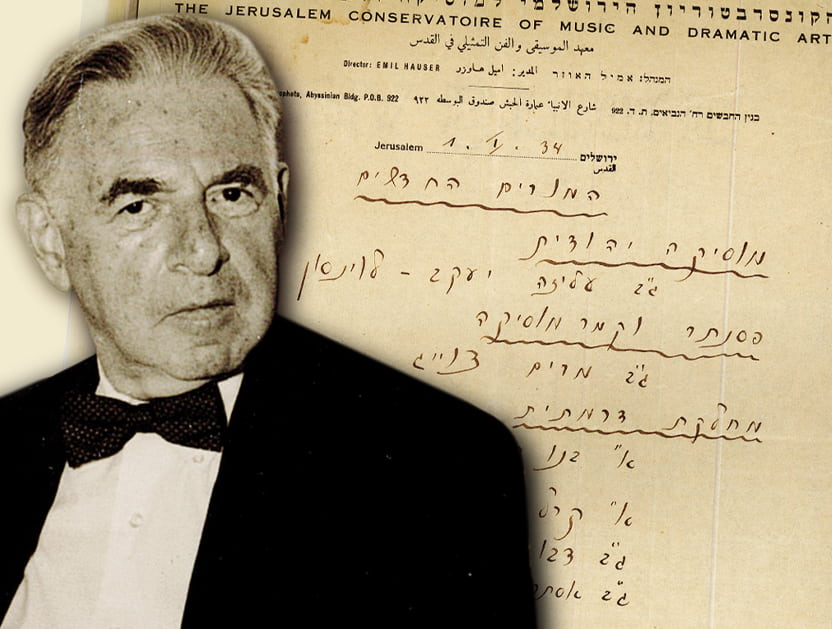
The story before us could easily be the script of a historical drama. Its hero, a Jewish violinist from Hungary, one of the most celebrated musicians in early 20th-century Europe. The settings: Jerusalem, Berlin, Vienna, and Prague. The plot: the founding of a music conservatory in Mandate-era Jerusalem, through which some 200 young Jewish musicians were rescued from Europe, saving them from an all-too-certain fate.
As remarkable as these events are, they remained in the shadows for 85 years. They are only now coming to light as researchers delve into Hauser’s archive, housed in the Music Collection of the National Library of Israel.
Perhaps one day this story will be adapted for film. For now, it is the story of Prof. Emil Hauser’s rescue project in the years leading up to World War II.
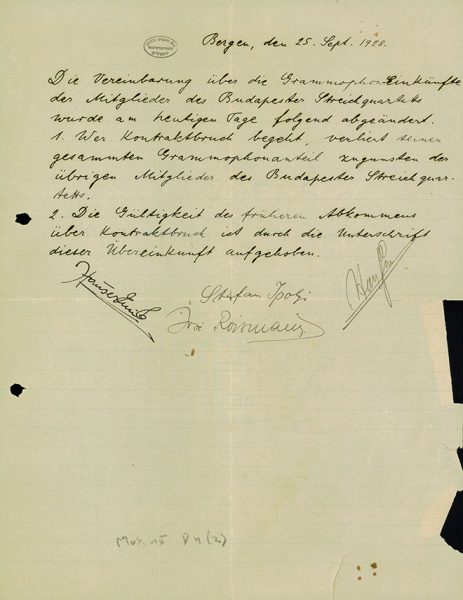
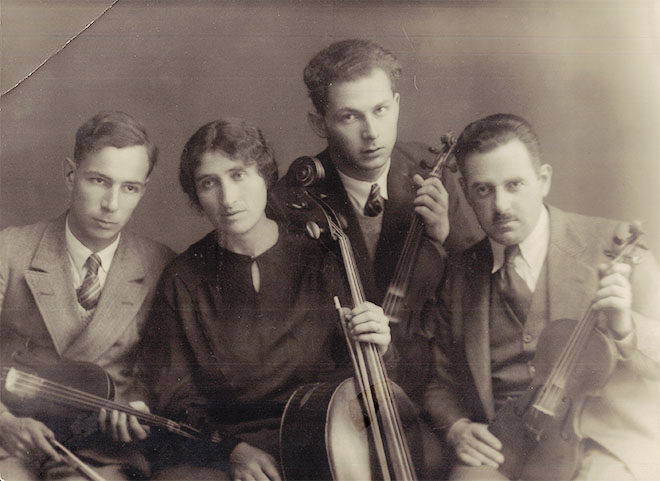
The roots of our story go back to December 1917, to the city of Kolozsvár, in eastern Hungary (today more commonly known as the city of Cluj, in Romania). In the midst of World War I, four young Jewish musicians gathered there for their debut recital under the ambitious name, “The Budapest String Quartet”:
The violinists Emil Hauser and Alfred Indig, violist István Ipolyi, all three Hungarian, and the Dutch cellist Harry Son.
The quartet remained in Budapest for only two years. In 1919, with the spread of communism in Hungary, they moved their base of operations to the Netherlands and later to Germany.
The success of the Budapest String Quartet was dazzling by any standard. Within just a few years, they conquered Europe’s concert halls, recorded for leading record companies, and became one of the most sought-after string quartets of their generation.
A rare 1928 recording of the Budapest String Quartet:
In March 1932, a meeting took place that would change Hauser’s life, and the lives of hundreds of Jewish musicians across Europe. The cellist Thelma Yellin, a Jerusalem resident, traveled from Mandatory Palestine to Germany, then teetering on the brink of another world war. After years devoted to raising her four daughters, Yellin went to the great musical centers of Germany to nurture at last the career she had dreamed of since her youth in London.
It was a solo journey, without her husband, the architect Eliezer Yellin, and without their daughters. During her stay, she wrote home regularly from Berlin, describing her days in vivid detail. In one of these letters, dated May 2, she told her husband about meeting Hauser:
“…Yesterday evening we held a musical gathering and played quartets, for the first time since we arrived here! Emil Hauser came, but only after much persuasion. He plays well – with great power, but also control. Beyond his playing, I don’t especially like him, but there’s no doubt he can help us greatly. He has excellent connections all over the world, especially with record companies and radio stations, and he very much wants to play with me. He will probably come to the Land of Israel in November and play quartets with us as first violin during that period. I’m sure it will be a great pleasure…”
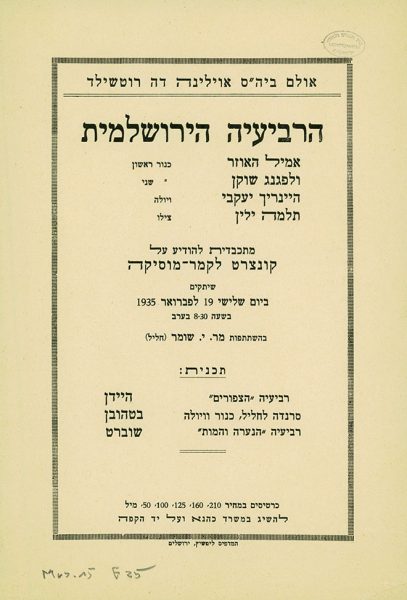
True to his word, Hauser arrived in the Land of Israel about six months later, in late 1932. During his visit, he performed recitals in Haifa and Tel Aviv with the Austrian harpsichordist Alice Ehlers (with whom he had recently played in London) and in Jerusalem in a program of string quartets. His final performance took place as part of a concert series of the Jerusalem Society for Chamber Music, a pioneering cultural institution founded and directed by Thelma Yellin.
At the same time, Hauser became part of Jerusalem’s intellectual circles and met key figures in the British Mandate administration. During this visit, he was introduced for the first time to the ideas and achievements of Zionism. Though the movement had already made impressive progress in many areas, it had yet to find its footing in music.
Hauser recognized both the need and the opportunity during his brief stay in Jerusalem. What was meant to be a short visit to the Middle East transformed his life completely. He decided to leave the Budapest String Quartet and his international career as a performing violinist (which, as he wrote, “was not unsuccessful”) and dedicate his time and energy to developing musical life in the Land of Israel – specifically, to founding a music school in Jerusalem, which would offer courses from beginner level to the highest levels of performance.
The school was still only an idea, but word of it spread quickly among Jewish students throughout Germany, who were at that time being expelled from their music academies under the Third Reich. They wrote to Hauser, asking to complete their studies at the new institution that was soon to be established in the Holy Land.
At that time, entry into the country required an immigration certificate. Hauser therefore approached the British Mandate authorities as early as April 1932, and again in July, to secure a quota of certificates for the institution. He distributed them personally to deserving candidates, according to his own discretion.
The new institution opened its doors in October 1933. Hauser succeeded in assembling an impressive faculty, which included graduates of Europe’s finest academies as well as instructors who had taught there until the Nazis’ rise to power earlier that year. This Zionist institution was given the name “The Palestine Conservatoire of Music and Dramatic Art in Jerusalem.” Its address: the Ethiopian Consulate building, #38–40 HaNevi’im Street, Jerusalem.
Unsurprisingly, the conservatory began its activity with extremely limited resources. Hauser would later recall that at the end of each school day, he would roll up his sleeves and sweep the classrooms himself. In fact, his office on HaNevi’im Street (“The Street of the Prophets”) also served as his bedroom.
According to newspaper announcements, the list of subjects offered was remarkably broad and diverse: piano, violin, cello, singing, dramatic art, flute, and guitar. “In addition,” the conservatory declared, “there will be instruction in wind instruments, viola, organ, harmony, composition, the history of music, chamber music, orchestra, choir, music education in schools, Eastern music, popular lectures, talks and courses for amateurs, ensemble music, and evening choirs for those occupied during the day.”
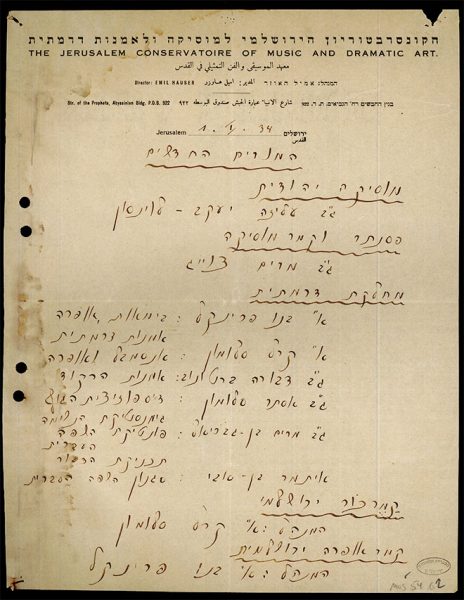
Three months later, the conservatory announced additional courses, including a special one titled “The Style of the Hebrew Language,” taught by none other than Itamar Ben-Avi, son of Eliezer Ben-Yehuda, the modern reviver of Hebrew. That same year, the cellist Harry Son, Hauser’s longtime colleague from the Budapest String Quartet, also joined the teaching staff. Tragically, shortly before the outbreak of the war, Son returned to the Netherlands, a decision that proved fatal. He and his wife were arrested, and in 1942 he was murdered at Auschwitz.
By the end of the school year, 85 students had completed their studies, and the “experiment,” as Hauser called it, had successfully passed its first test.
The appearance of the new conservatory in the Jewish cultural landscape of Mandatory Palestine was an achievement in itself. Yet it was also one of the inspirations behind another milestone in the country’s musical history: The establishment of the Palestine Symphony Orchestra (later the Israel Philharmonic Orchestra). It was the conservatory, along with other cultural and intellectual institutions emerging in those years, that convinced the renowned violinist Bronisław Huberman in 1934 that such an endeavor was both possible and necessary.
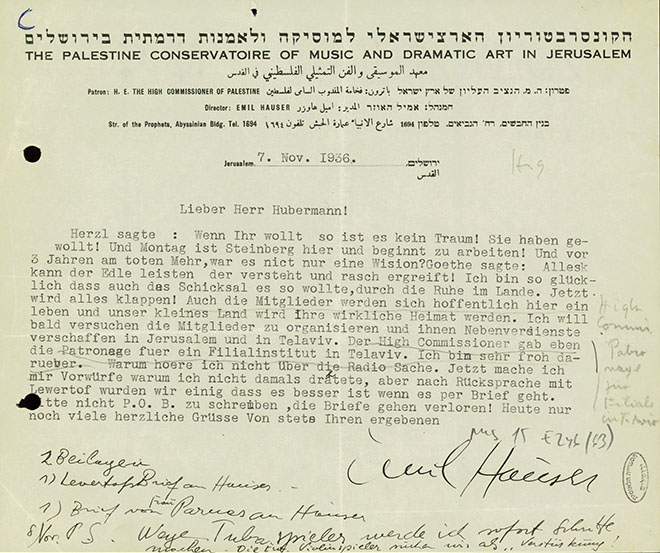
Documents from Hauser’s archive at the National Library of Israel reveal that this grand project came from humble, low beginnings. In fact, the idea was first conceived in, quite literally, the lowest place on earth, during a vacation Hauser and Huberman shared at the Dead Sea. In a draft of a congratulatory letter sent by Hauser to Huberman on November 7, 1936, marking the founding of the orchestra, he wrote:
“Herzl said: ‘If you will it, it is no dream!’ You willed it, and on Monday [William] Steinberg will be here and will begin the work! And to think that three years ago, at the Dead Sea, it was only a vision? … I am so glad that fate has arranged it this way, through the calm that now prevails in the country. Now everything will move forward! I hope the musicians will settle here, and that our little land will truly become their home. I will soon begin to organize them and help provide them with a supplementary income in Jerusalem and Tel Aviv.”


For those wondering what sort of “supplementary income” Hauser could arrange for the new orchestra’s musicians in Tel Aviv, the same letter clarifies:
“The High Commissioner has just agreed to give his patronage to a branch [of the conservatory] in Tel Aviv.”
That Tel Aviv branch would eventually evolve into what is today the Buchmann–Mehta School of Music at Tel Aviv University, an institution whose close connection with the Israel Philharmonic Orchestra continues to this day.
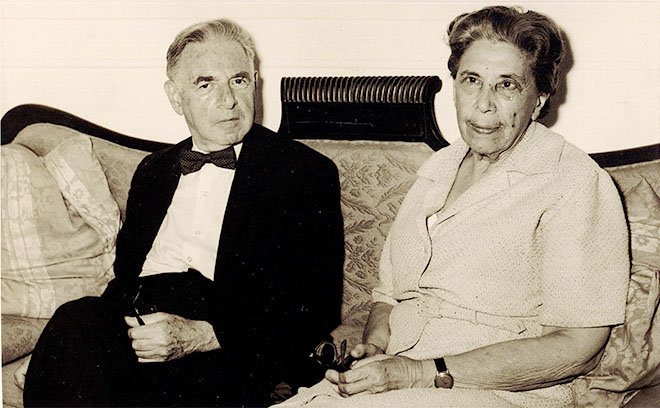
The year 1936 was a pivotal one for Hauser, not only professionally, with the establishment of the Palestine Symphony Orchestra (in whose opening concerts he performed, at Huberman’s personal request) and the growing success of the conservatory, but also personally: that same year he married Dr. Helena Kagan, a pioneering pediatrician in the Land of Israel, who stood by his side and supported his work closely.
That year also marked the beginning of a dramatic new chapter in Hauser’s life, one in which his passion for music became a means of saving lives. This chapter remained entirely unknown until recent years.
At the time, demand for admission to the Palestine Conservatory was greater than ever. Hundreds sought to enroll, though musical excellence was not always their primary motivation. Immigration certificateshad become extremely difficult to obtain, and so the opportunity to receive one through acceptance to the conservatory represented a rare and precious lifeline. As Hauser explained in a speech delivered in New York three years later, in 1939:
“Most important of all, through our work we were able to obtain from the government certificates for students. Since 1936, we have succeeded in rescuing more than 130 people, in some cases with their families, from lands of despair and persecution, enabling them to continue their studies and begin new lives. This summer we received 75 additional certificates, and only recently I returned from Berlin, Vienna, and Prague, where, from among hundreds of applicants, I selected the fortunate few.
It is impossible to describe the emotions that overwhelmed me each time – and this was my third such journey – when I could tell a young man or woman, broken in spirit, despairing, almost without the will to live: You have value. I will obtain a certificate for you.
Yet this joy is always tinged with bitterness, with the knowledge that hundreds upon hundreds of suitable, worthy applicants who come to us for help must be left behind.”
The conservatory’s archive, separated from Hauser’s personal papers, includes dozens of personal files belonging to those “fortunate few” – and to some of those left behind.
One such case is that of Kurt Burckhardt, a violinist who applied to the conservatory not as a student but as a teacher. In his résumé, he mentioned as proof of his pedagogical skill one of his pupils, who had recently been accepted as a student at the conservatory. Burckhardt was not offered a teaching position; he was later deported to Auschwitz, where he was murdered in 1941.
The personal files of those fortunate students help us today understand the conservatory’s admissions process and what candidates were required to go through in those turbulent final years of the 1930s.
One example is fifteen-year-old Heinz Alexander, the son of an unemployed banker and a choir singer. He applied to the conservatory as a piano student, with less than two years of playing experience. Hauser examined him in Berlin and recorded his impressions on a special form. Based on the results, Alexander was sent a letter of conditional acceptance.
Conditional on what? It turned out that musical talent alone was not enough. Alexander’s family was required to deposit no less than fifty pounds sterling (about 16,000 shekels in today’s terms), as demanded by the British authorities, to guarantee issuance of the immigration certificate. Fortunately, the certificate was eventually sent to the British consulate in Berlin, Alexander’s city of residence. He was instructed to collect it promptly and prepare to leave for the Land of Israel within a very short time. Like many others, Alexander made the journey alone, leaving his parents and family behind.
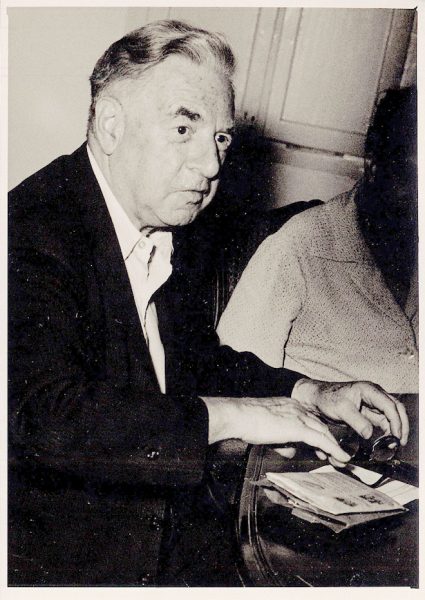
The case of Helmut Frank’s mother is a moving example of the anguish felt by the parents of these young musicians. Frank, a pianist born in 1923, was an only child, and had failed to send any word of himself to his worried mother in the Netherlands for nearly two years. Desperate for news, she asked relatives in England to try to contact the conservatory in Jerusalem, hoping for some sign of life. The conservatory’s secretary replied politely, reassuring her about her son’s well-being, but her own fate was tragic. She was murdered at the Mauthausen concentration camp in 1943.
In this way, Hauser saved around two hundred people. Most of their names can only be uncovered through the meticulous study of his archival papers. Yet for at least twenty of them, their stories are somewhat clearer. Among the documents in Hauser’s personal archive is a series of letters he received in April 1975, about twenty in all, each accompanied by a résumé.
It seems that Hauser himself had reached out to these individuals, all of them people to whom he had granted immigration certificates in the 1930s. Nearly forty years after that remarkable chapter in his life, he sought them out, asking them to write down their stories of coming to the Land of Israel and to share what they had achieved since. Their responses were letters of gratitude, each one a heartfelt tribute to the man who had saved them from the Nazi inferno, without whom their lives and accomplishments would never have been possible.
One such letter came from the violinist Wolfgang Schocken, who had played with Hauser in the quartet he founded in Jerusalem in 1933 – the Jerusalem String Quartet, also known as the “Hauser Quartet”:
Cambridge, April 28, 1975
Dear Professor Hauser,
Thank you for your letter – and this is the story of my rescue:
In 1933, when the Nazis rose to power in Germany, I wrote countless letters to America, England, France, and other countries, seeking help in finding a position. Most of my letters went unanswered; those that did were entirely negative, with one exception.I also wrote to Emil Hauser, whom I deeply admired when he was first violinist of the Budapest String Quartet. He hardly remembered me, but he replied, writing that I should come to Palestine and that he would try to help me.
Full of hope, I sailed on a small freighter that arrived in Haifa on October 14, 1933. But my visitor’s visa proved useless… The attaché had neglected to inform me that I was required to possess fifty pounds sterling, and so all my efforts were in vain.
Hauser came all the way from Jerusalem to tell me that despite every effort and all his connections, he could not secure my immediate entry, since immigration certificates had to be issued outside the country.
He gave me all the money he happened to have in his pocket – seven pounds [worth around 1,900 shekels today – O.S.] – and told me to stay in Smyrna (Izmir), the next port of call, and wait there for the certificate.
When we arrived in Smyrna, I again faced difficulties disembarking, but by good fortune I succeeded and stayed with kind people, anxiously wondering whether the certificate would ever arrive.
Eventually, it did. I traveled to Palestine on a Russian ship, reaching Jaffa on November 21 and Jerusalem on November 24.
Hauser welcomed me like an old friend, though in truth he knew almost nothing about me. He invited me to stay with him for as long as I wished. He himself lived in his office at the Jerusalem Conservatory, in the most primitive conditions. But at least I had a roof over my head. Soon I began to teach and to perform.
To this day, I wonder what would have become of me had Emil Hauser not come to my aid, a sort of “deus ex machina” in those dark days.Yours,
Wolfgang Schocken
***
Prof. Emil Hauser passed away three years later, on January 27, 1978, and was buried on the Mount of Olives in Jerusalem.
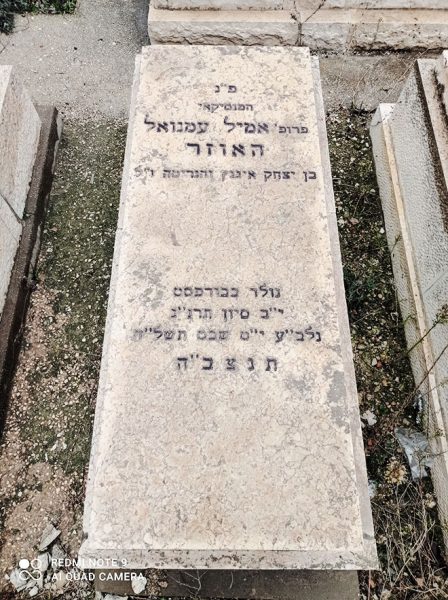
This is, in fact, the only monument that bears his name. It took the British authorities only four years to officially recognize his unique contribution to the musical life of the Jewish community in Mandate-era Palestine, awarding him the title Officer of the Order of the British Empire (O.B.E.) in 1937.
In the State of Israel, however, forty-seven years after his death, there is still not a single street or square that bears his name. To this day, the archive preserved in the Music Collection of the National Library of Israel remains his only memorial.


