
“Wow, Ayelet, what a nice and unique name. Where is it from?”
“It’s Hebrew,” I would reply.
I entered Columbia University’s Barnard College as a bright, optimistic student. It had never occurred to me to hide my identity, my ethnicity. When peers asked about my name, I didn’t hesitate to mention Judaism and Israel. My father’s family is from Israel, my mother’s from the far-off land of Canada. Yet, growing up, Israel always felt closer to me than the neighboring country of Canada. Israel was our pride – the land that protected us, and in return, the land we felt bound to protect. When you have relatives living through war after war, some even fighting in them, the connection runs deeper than “my ancestors are from there.” Sometimes when explaining my background, I was met with awkwardness, and I’d been raised to tread carefully when bringing up Israel or Judaism with strangers. Still, most people didn’t seem to care, and I was eager to exchange ideas, debate freely, and learn from opposing views.
That all changed in my senior year, on October 7. It was Simchat Torah. I was celebrating with Jewish friends when news broke of something horrific in Israel. Nearly everyone there had family or friends in Israel. I remember the sudden unity: some clustered around the TV upstairs, others who were observant listening for updates from peers. For a moment, we were one community, grieving and clinging to each other. That unity didn’t last.
The very next day, October 8, Jewish students organized a vigil. At that point, there were no rallies, no posters, no chants, no all-out war yet – just grief. We lit candles, stood in a circle, and sang a sad song. Then, faintly but unmistakably, we heard voices in the distance: “Free Palestine.” My friends and I exchanged looks but brushed it off. We had no idea what was coming.

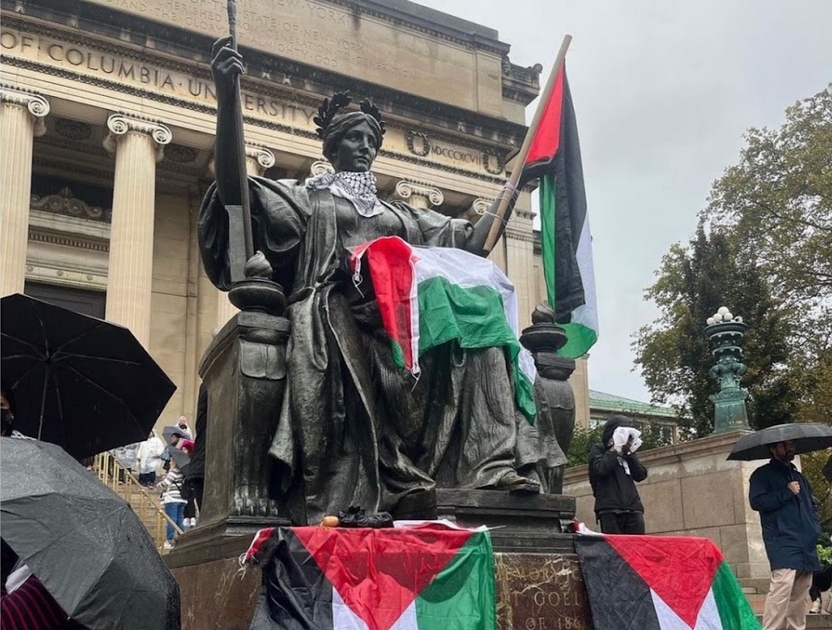
In the following months, tensions on campus escalated. There was a protest for Palestine every day. Jews felt unsafe on campus. Israeli students were harassed by protestors. In solidarity, many students hung posters of hostages, only to see them torn down or graffitied. There was a point where I would avoid certain streets just to avoid seeing a picture of an Israeli child with the word “satan” graffitied on top.


The protests grew dangerous. Protesters occupied Hamilton Hall, renaming it “Hind’s Hall” after a Palestinian child. Students and janitors in the building at the time were injured. It became unacceptable – racist, even – to say anything positive about Israel. Some non-observant Jews with no connection to Israel joined in denouncing it. They mocked our traditions, setting up a “Sha-f***ing-bat Shalom” tent on the lawn. By Passover, campus was unsafe. Our rabbi advised us to stay home. Finals were canceled or shortened.

What shook me most wasn’t just the hostility from strangers. It was the silence, or rejection, from peers I’d once trusted. One day, walking with a friend, a student in a keffiyeh shouted “F*** you” at the tiny Magen David around my neck, a piece of jewelry I hadn’t thought twice about before. But I could dismiss that as childish hostility. It was harder to dismiss what happened in class.

A week after October 7, in my ironically titled “Peace Building” course, the professor asked if anyone had connections to Israel. Knowing my name, she looked directly at me. I admitted quietly, “I do.” She offered condolences. But the students around me shifted uncomfortably, avoided my eyes, and didn’t speak to me again that day.

In another class, after pushing through a wall of protesters to arrive on time, I sat beside a friendly classmate. She sighed, “I’m so exhausted.” When I asked why, she replied, “I’ve been boycotting my daily Starbucks—since they support Israel.” I nearly laughed at the absurdity. Here were some of the most privileged students in the world, at an Ivy League university, lamenting the burden of buying a different latte – while Israeli children hid in bomb shelters and fathers were being called back to reserves. They cosplayed as refugees, skipping classes to have a ‘fun’ day of protests with friends; we lived with real grief.

Columbia prided itself on free exchange of ideas, but there was no dialogue left. Students with near-god complexes dismissed any opposing views as racist or Islamophobic. On Sidechat, an anonymous forum, they circulated Osama Bin Laden’s “Letter to America,” urging others to “hear him out,” insisting Al-Qaeda had “valid points.”
By semester’s end, I felt quarantined in my apartment, the atmosphere eerily reminiscent of COVID lockdowns. My Jewish friends and I avoided campus, not only out of fear of violence, but because it was unbearable to be there. At graduation, shouts of “Free Palestine” rang out. Red handprints were smeared across caps, a symbol that became a token for Palestinian freedom but originated in an image of blood smeared on the hands of a Palestinian man after the lynching of two Israelis.

I looked around at my peers, the supposed future leaders of America, and knew I wanted no part in it. If these were my future leaders, if this is what my peers thought of me, I wanted out. I had always felt a connection to Israel and knew I might end up there eventually, but I decided at that moment to officially make Aliyah.

It has now been nearly a year since I made Aliyah. Moving to Israel in the middle of a war has not been easy. I’ve grown used to sirens jolting me awake in the early hours of the morning, and life here comes with its own fears and challenges. Still, I do not regret my decision. In America, I had begun to feel a sense of loss; alienated from my peers, silenced in classrooms, and unwelcome on the very campus that had once promised open dialogue.
Israel has not been an escape from conflict or politics; in fact, many here voice deep frustration with the government. Yet despite disagreements, there is an underlying unity, a shared understanding that binds us together in a way I never experienced in the U.S. We may argue fiercely about what the future should look like, but we are united in believing there will be one – bright, resilient, and ours. Here, among my people, I have found not just refuge, but home. It’s imperfect, but it’s ours.
As part of the groundbreaking Bearing Witness archive, NLI is leading a special initiative to document post-October 7 experiences at North American college campuses. This project is collecting documentation about specific events and incidents, including encounters with antisemitism, as well as the broader experiences of Jewish students, faculty, and staff during this pivotal time. Collected materials also capture communal and organizational responses and the wider shifts taking place in campus life and academia.
Materials of all forms, and from any perspective, are welcome. To date, more than 6,000 items have been gathered from over 50 campuses and organizations across the U.S. and Canada. If you have any relevant items you would like to share, please visit the Bearing Witness website or contact Project Coordinator Abby Horowitz.


