
From Indonesia to Israel’s Southern Desert Capital
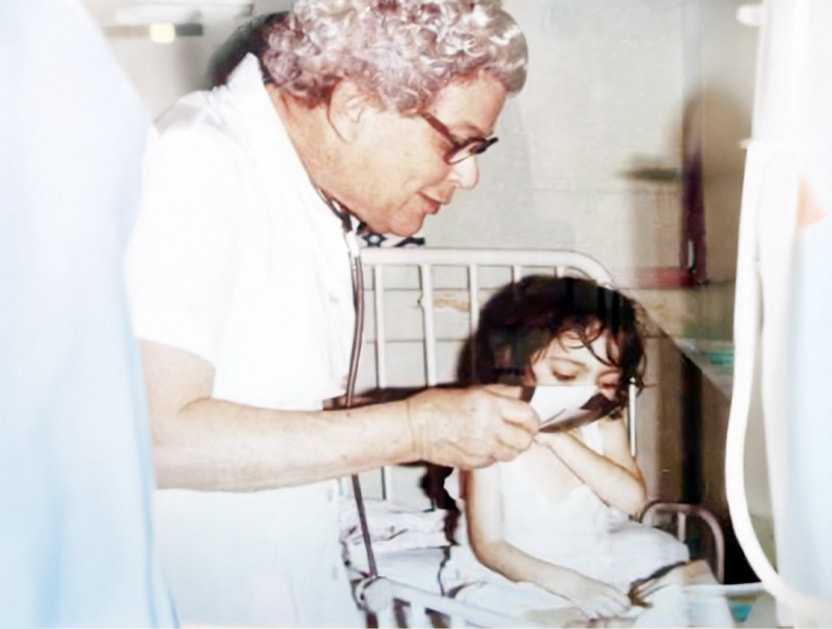
For five years, day and night, 24 hours a day, 365 days a year, there was just one doctor responsible for the health of children across Israel’s southern Negev desert region: Dr. Wilhelmina Cohen. From the moment she arrived at the pediatric department of Soroka Medical Center, she became deeply committed to both the ward and the children it served. She wasn’t just the department’s founding physician – she was its only doctor. She worked 30 night shifts each month. With no neonatal or premature infant unit in place, she also took care of newborns. On top of that, she sometimes performed autopsies on children who had died in the ward, because there were no pediatric pathologists available. It wasn’t until 1957, five years after she first arrived in Be’er Sheva, that another physician joined the department. Only then was Dr. Cohen no longer the sole pediatrician.
Cohen was born in October 1916 to a Dutch-Jewish family in one of the furthest places imaginable from Be’er Sheva: Indonesia, then a Dutch colony. At the time, about 2,500 Jews lived in Indonesia. Most, like Wilhelmina’s parents, had come from the Netherlands and held various administrative positions under colonial rule, while a smaller group were Jewish merchants from Iraq.
In 1935, at the age of 19, Wilhelmina left the small community in Indonesia and traveled to the Netherlands to study medicine at the University of Amsterdam. Her studies were interrupted by World War II. She survived the Holocaust and, after the war ended, resumed her education. She completed her pediatric specialization in 1948.
Four years later, Dr. Cohen immigrated to Israel. Just one week after arriving, she was sent to Be’er Sheva to establish the pediatric ward at what would become Soroka Hospital (then called “The Medical Center for the Negev”). At that time, following Israel’s War of Independence and the liberation of the Negev, and especially with the rise of the “development towns” in the region, the young state urgently needed a hospital in the south. The development towns were new communities established to provide homes for the large waves of immigrants who arrived in Israel following its establishment, mainly from Arab countries but also Holocaust survivors from Europe. Dr. Cohen, newly arrived from Amsterdam and only four years past her medical training, found herself tasked with setting up pediatric care for the children of the desert. She spoke no Hebrew and had just stepped off the boat, yet she was sent to Be’er Sheva with an enormous responsibility.

In 1952, when Dr. Cohen began building the pediatric ward, Be’er Sheva had 14,500 residents, along with about 12,000 Bedouins living in nearby scattered communities. These were soon joined by immigrants arriving in the newly established development towns.
For this entire population, the new hospital had just 50 beds, about 20 of which were designated for the pediatric ward. Demand quickly outpaced supply, and the ward often held 40 to 60 children at the same time. How did they manage with so few beds? They simply put multiple children in each one. Reports from the period describe how children were “placed two or three to a bed, with infants suffering from diarrhea lying next to tuberculosis patients and others with contagious diseases.” [From a publication marking 50 years of Soroka Hospital]

In addition to her overwhelming responsibilities in the children’s ward, Dr. Cohen also managed the maternity and neonatal units. In fact, she wasn’t just the only pediatrician at the hospital – she was the only pediatrician in all of Be’er Sheva. Instead of being crushed by the pressure, Dr. Cohen took the shortage of pediatric care in the Negev with utmost seriousness. She became widely known across the region for her extraordinary dedication. When she wasn’t on duty at the hospital, she traveled to remote communities for home visits, first by Vespa and later with her car – an Israeli-made “Susita“.
Dr. Cohen’s commitment, along with the founding of the hospital itself, sparked a profound transformation in the region, particularly among the Bedouin population. Studies have shown that in the years following the hospital’s establishment, and especially after the opening of the children’s ward, life expectancy among Bedouin children increased, while the number of sick days among Jewish children began to drop.
A Desert Hospital Without Air Conditioning
Despite the clear need for a medical center in the Negev, Soroka Hospital struggled in its early years with chronic budget shortages and had to operate under extremely challenging conditions. In October 1959, for example, the newspaper Davar reported that due to budgetary constraints, the hospital still lacked an air-conditioning system. In 1956, LaMerhav reported that despite the crushing workload on doctors in the south, their salaries remained the same as those of physicians in major cities.
In 1959, a new hospital building was inaugurated. Though it too lacked air conditioning, the press declared it the beginning of a new era in the Negev: a bed for every hospitalized child. The children’s ward in the new building was expanded to 70 beds.
1957: The Children’s Ward Expands and a Second Doctor Arrives
Just two years earlier, in 1957, five years after Dr. Cohen’s arrival, the hospital succeeded in hiring another pediatrician: Dr. Amiram Yosef. At long last, Dr. Cohen had someone with whom to share the load of shifts and duties.
Unlike Dr. Cohen, Dr. Yosef came from a well-established family in Israel. His father, Dov Yosef, was a prominent lawyer and a cabinet minister in the country’s early governments. He is best remembered as the man who oversaw Israel’s austerity policies in the early 1950s, and also served briefly as Minister of Health in 1955 for 128 days.
Raised in Jerusalem and the son of a senior politician, Dr. Yosef could have taken a job as a doctor anywhere in the country. His decision to work at the small hospital in the Negev was a matter of principle. His father had been a close associate of David Ben-Gurion and a strong advocate for the development of the Negev, but Dr. Yosef’s reasons were also deeply personal – connected to his sister, Lila-Naomi. During Israel’s War of Independence, she served in the Palmach and was killed at age 19 during an Egyptian bombing raid as the Yiftach Brigade fought to liberate the Negev. After her death, Dr. Yosef felt it only natural to continue her path and contribute to the development of the region she died fighting for.
Even so, the transition to the Negev wasn’t easy for Dr. Yosef, who was used to city life. In a 2018 interview with Calcalist, his wife Tzafira recalled:
“The Negev was a shock. At first, I struggled. We moved into a tiny Amidar [a state-owned company providing subsidized housing] apartment. There were constant sandstorms. I’d clean the house, and an hour later it would be like no one had cleaned it at all. Fortunately, someone asked me to give a trial lesson at the local ulpan [Hebrew school]. I wasn’t sure, but after the class, the inspector said, ‘You’re staying.’ That set things in motion. I went on to earn two degrees, and eventually, we all adjusted – to the city, and to the Negev.”

Dr. Cohen’s story epitomizes the immense challenges Soroka Medical Center faced in its early years.
How Do You Run a Hospital With Too Few Doctors?
Numerous news reports from the first decades of Soroka focused on the dire shortage of physicians in the Negev and at the hospital itself. In the mid-1960s, Clalit Health Services, which operated the hospital, described the situation in the northern and southern districts as “horrific.” In February 1966, Al HaMishmar highlighted the doctor shortage in the south – especially in the communities near Gaza. The paper wrote with some irony: “The residents of Kibbutz Kissufim are guarded by the archangel Raphael.” The previous doctor, it noted, had “gone abroad a few years ago and never returned,” leaving the residents of Kibbutzim Ein Hashlosha, Nirim, Kissufim, Be’eri, Magen, Nir Oz, and Moshav Patish without a permanent doctor.
That same year, HaTzofeh reported that 30% of the medical staff required in the Negev was missing. The article also described some of the creative measures taken to address the shortage – including asking residents to avoid unnecessary clinic visits. Other approaches included recruiting kibbutz members from communities without a doctor to work part-time at Soroka while continuing their kibbutz jobs, and deploying more nurses in clinics across the region.

A Hospital That Welcomes Immigrants
To address its chronic staffing issues, Soroka’s leadership came up with a bold idea: to bring in doctors from abroad. In 1957, the hospital sent its first overseas recruitment mission to encourage Jewish doctors to immigrate to Israel and join the effort to build a hospital in the Negev capital. A special ulpan was created at the hospital, combining Hebrew lessons with medical training for new immigrant physicians.
Over the following decade, the hospital managed to bring 13 groups of doctors to Israel – 300 in total, all of whom came specifically to work at Soroka. Many were recruited from Argentina – Jewish medical school graduates eager to escape the country’s military regime. Others came from Eastern Europe, seeking to leave the Soviet bloc. Soroka became a new home for them all.
But the fast-track training program also placed new burdens on Soroka’s already overworked physicians, who now had to train and mentor the newcomers. A June 13, 1965 article in Al HaMishmar noted:
“In the midst of a doctor shortage, expert physicians are being pulled away from their regular duties to train and absorb their newly arrived colleagues. So far, the Negev district has trained 70 immigrant doctors, including 15 women. Today, the region – from Kiryat Gat to Eilat – is served by 86 doctors, only three of whom are graduates of the Jerusalem medical school!”
In this way, a small hospital in the heart of the Negev became one of the most culturally diverse places in the country. If anything defined Soroka in its early years, it was this: The hospital had become a true ingathering of the exiles. Like Dr. Cohen, most of the medical staff were new immigrants. In 1964, HaMakor reported that of the 15 new doctors who came to the Negev that year, only one had studied medicine in Israel (at Hebrew University), and the rest were immigrants – mostly from Europe, and some from South America. That year, 25% of the medical positions in the Negev still remained unfilled.
Prof. Stern, Soroka’s first director, reflected on those early years:
“Most of the staff were new immigrants, unfamiliar with medical practices in Israel, and with the language and local customs. In the early days, the hospital had 35 doctors who spoke 18 different languages, treating a population that spoke just as many – though not necessarily the same ones.”

In Her Spare Time, Dr. Cohen Founded an Orchestra
It’s hard to say how she found the time, but outside her work at the hospital, Dr. Cohen also volunteered as chair of Be’er Sheva’s orchestra and choir committee. She had played violin and viola since childhood in Indonesia, and despite her intense schedule, she continued to play – and even helped found a local orchestra and choir.
The following was written about Dr. Cohen in a 1965 newspaper article:
“In her early days in the city, she would walk among the houses, trying to catch the sound of someone playing piano, hoping to find a musician in the great wilderness.”
Among the members of the choir was composer Mirjam Shatal, a fellow Dutch Holocaust survivor and University of Amsterdam graduate. Her husband, Dr. Shatal, also worked at Soroka. Her personal archive is now held at the National Library of Israel.
Honored by the City of Be’er Sheva
When Ben-Gurion University’s medical school was founded in the early 1970s, Dr. Cohen was appointed associate professor. She retired from Soroka in 1977. Over the 25 years she worked there, the hospital expanded significantly. It now included multiple pediatric departments with various specializations. One of them, a pediatric nephrology clinic, was established by Dr. Cohen herself.
Even after her retirement, she remained active in caring for children across the Negev. She worked as a pediatrician in a clinic in the town of Ofakim and continued to serve as a specialist in the very nephrology clinic she had helped create at Soroka.
In 1991, Dr. Cohen was awarded the title “Honored Citizen of the Negev” for her contributions to the region. She passed away in January 2000, at the age of 84.
Today, visitors to the pediatric wings of Soroka Medical Center pass by the hospital’s main children’s auditorium – named in her honor. In this way, Dr. Wilhelmina Cohen continues to be part of the hospital she helped build and the community she served so tirelessly.


