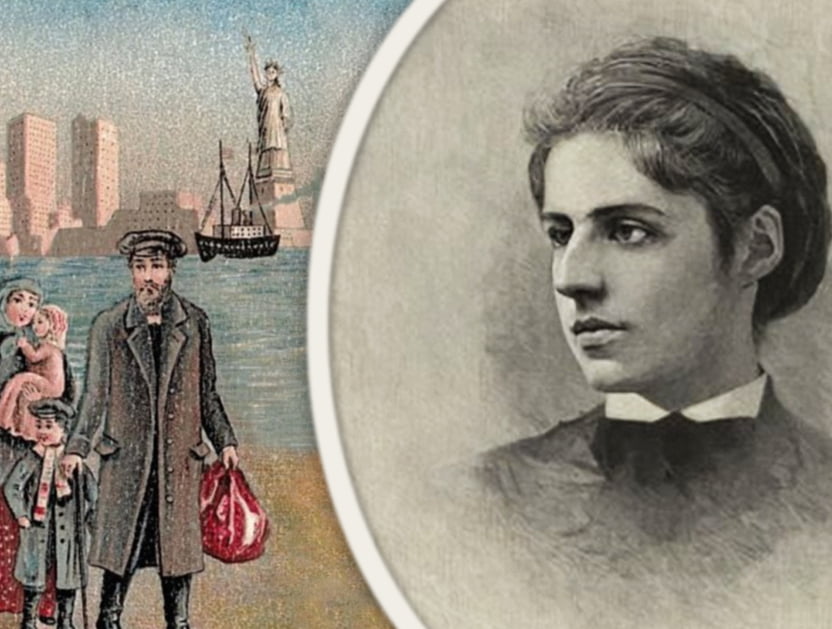
At a museum a few hundred yards from the Statue of Liberty on a June afternoon, visitor after visitor approached the portion of a glass case displaying two large plaques. On one plaque was engraved “The New Colossus,” a poem by Emma Lazarus (1849-1887) that is indelibly associated with the iconic statue long a symbol of immigration to the United States. The other plaque featured a bas relief of Lazarus, a Manhattan native and a Jew.

Almost no visitors snapping pictures at the spot noticed, let alone read, the two plaques of subdued bronze, instead honing in on a colorful item perched between them: a papier-mache mask depicting the statue’s face in red, white and blue and covered with scores of flags representing some of the countries from whence came millions of people filling ships entering New York Harbor during a great wave of immigration running from the 1880s to the 1950s.
The objects reflected a stark irony: Lazarus and her iconic poetry, which inspired countless newcomers to the United States long after her death, were being upstaged by the 21st century creation of an artist, George Dukov, himself an immigrant from Bulgaria.
“An ardent patriot and poet, she wrote the immortal sonnet, ‘The New Colossus,’ which is inscribed on the plaque in the Statue of Liberty,” states the text beside the bas relief dedicated in 1977 by the Emma Lazarus Commemorative Committee.
“Give me your tired, your poor, your huddled masses yearning to breathe free, the wretched refuse of your teeming shore,” reads the poem’s best-known line.

Raj Konaseema, who was visiting New York this day, stopped to examine the plaques. A native of India, Konaseema moved in 2017 to Mississauga, Ontario, Canada.
Konaseema “saw the lady’s face and wanted to know if there’s any relationship between the statue and [her],” he said of the plaque.
Outside, on a walkway facing the front of the statue, Richard Hinsliff was reading an explanatory poster about Lazarus on the sweltering afternoon.
Hinsliff, who immigrated from Leeds, England, in 2003 and lives just north of Manhattan, knew about the poem but not of its representing freedom for millions of immigrants.
“I think the symbolism of the statue is more important than the statue itself: of America being the symbol of freedom,” said Hinsliff, who’d come to the site with his U.S.-born wife and daughters and his mother, visiting from England. “It’s fantastic symbolism.”

Plenty of Americans and foreigners know that the Statue of Liberty was a gift to the people of the United States from the people of France. It was sculpted from copper by French artist Frédéric Auguste Bartholdi and shipped to the U.S., where it was dedicated in 1886 on Bedloe’s Island (now Liberty Island), located between the states of New York and New Jersey. It had remained in storage until funds were raised for constructing a granite pedestal on which the massive statue would be mounted.
That’s where Lazarus came in. She’d written plays, poems and a novel, was a translator of literary works and advocated for East European Jews who then were resettling en masse in the United States. She penned “The New Colossus” for auctions in 1883-84 of items, mostly art, held in Brooklyn and Manhattan to benefit the pedestal fund. Lazarus died of an illness in 1887 at age 38. Her worsening condition likely prevented her from attending the statue’s dedication ceremony. In 1903, following the lobbying of Lazarus’s friend, Georgina Schuyler, a plaque of “The New Colossus” was made and affixed to an inner wall of the pedestal’s entrance. It remains on display today inside the pedestal close to its original placement. (The plaque in the aforementioned glass case is an exact replica.)

Approximately 4.5 million people visit the Statue of Liberty annually. If the tourists on this June day are representative, Lazarus is all but ignored. Standing later that day outside the brownstone on Manhattan’s West 10th Street where Lazarus lived with her family and likely penned most of her works, I saw no passersby reading the blue historical marker that acknowledges Lazarus’s residency there. When Matt Housch, who works for the Statue of Liberty historical site as a U.S. National Parks Service archivist, gave tours as a park ranger, people rarely asked about the poem and who wrote it, he said.
“There was not very much interest from the general public,” he said. Housch admitted that he knew little about either Lazarus or the poem prior to taking the job — only the famous line about the hopeful, hapless immigrants.
Melanie Meyers memorized “The New Colossus” in school. “I feel that everyone knows the poem,” said Meyers, the deputy director of the American Jewish Historical Society, whose holdings include several Lazarus items. “I’m not sure everyone knows who wrote it. I certainly don’t think she’s forgotten, but perhaps she’s not as widely known as she should be.”

Housch explained that the plaque in the 1960s was relocated a few feet within the pedestal to become part of a museum of immigration. In recent decades, it’s dwelt nearly alone after the other items were moved to nearby Ellis Island.
That’s where a ferry took me after Liberty Island. I entered the main building into the room where arrivals’ baggage was stored while people underwent inspection and processing. Those steps occurred upstairs in the registry room, better known as The Great Hall. My late Grandma Rozzie had written me a letter in which she speculated on what her father Morris Eisen, then single and still named Moshe, felt upon landing in the United States in the early years of the 20th century. He’d surreptitiously left Lodz, unwilling to be conscripted, perhaps for a lifetime, into the Polish army. Morris, she wrote, had experienced an uncomfortable journey in steerage, but surely, upon reaching Ellis Island, all was subsumed by his excitement at starting a new life in a free land.

Strolling in the massive, near-empty hall, I imagined the thousands of fellow immigrants jostling with him on line awaiting questioning by U.S. authorities. I thought of the din of conversation and interrogation in scores of languages, the newcomers’ fatigue and confusion mingled with hope and excitement. I wondered whether he could have foreseen then his decades of hard labor in the silk mills of Paterson, New Jersey, his meeting and marrying fellow immigrant Fannie Frishman, raising their daughter, losing two infant sons to disease and living in an apartment on Summer Street to which their granddaughter, my mother, would go after school for cookies and hugs — and, at the end of Morris’s earthly stay, whether he felt the struggle had been worth it. Just two weeks before my encounter with the Great Hall’s ghosts, I’d driven with my cousin Effy Unterman to our great-grandparents’ graves near Paterson and pondered some of the same questions. We snapped pictures of Morris’s and Fannie’s tombstones.
Morris had landed at Ellis Island not tired, but certainly poor. He and the others on the ship constituted Lazarus’s huddled masses yearning to breathe free. He may have later learned of the poet, or not. Moments before reaching Ellis Island, he must have gazed wondrously toward the eminent statue, the “mighty woman with a torch,” in Lazarus’s words, who beckoned to newcomers to set down their bags and imbibe liberty beyond the new country’s “golden door.”

The statue often goes by the nickname “Lady Liberty,” but I’m entranced by the moniker Lazarus bestowed on it: “Mother of Exiles.” It broadcasts an almost-godlike gravitas and authority, a welcome to America’s newcomers. More than a welcome — an official pat on the back to encourage the exiles-turned-arrivals, no matter the frayed state of their clothing or boldly accented English, and get them on their way in the new land.

Views vociferously differed then, and diverge still, in Americans’ debate over immigration and the securing of borders, but I’ll always be grateful that “The New Colossus,” standing amidst a wide harbor where two rivers and an ocean converge, extended Lazarus’s, and the country’s, “world-wide welcome” to Morris and my other ancestors, who saw the statue’s outline against the sky as they left exile.
Writer-editor Hillel Kuttler can be reached at hk@HillelTheScribeCommunications.com.