
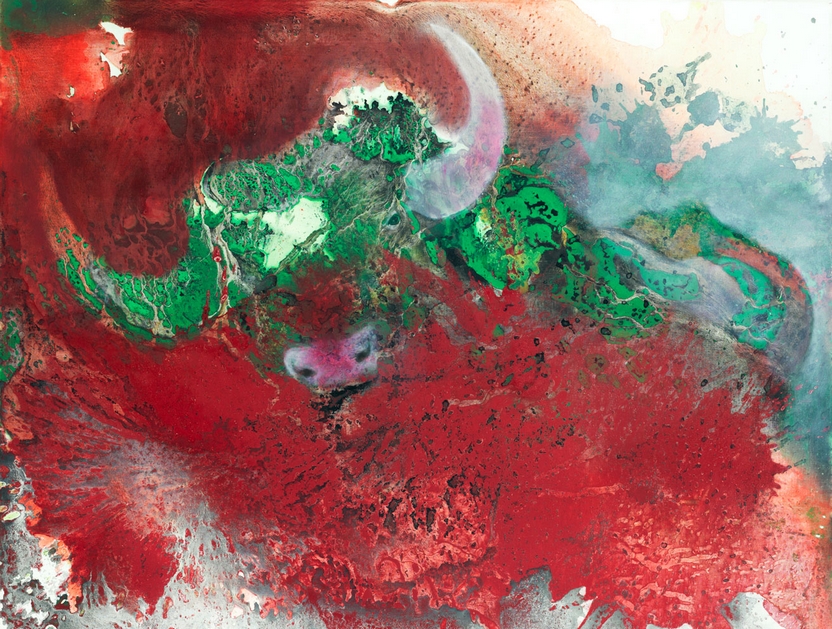
Edwin Salomon was a Jewish Israeli painter who was not afraid to embrace his own expressionistic, Surrealism-evoking style on the margins of the Israeli art world, while the Israeli conceptual and abstract art movements were at their height. His fringe immigrant voice sheds light on why Jewish Israeli art can never embrace the full measure of true Surrealism due to its hints of memory and hope intertwined on the canvas of the subconscious. In his youth, Salomon managed to escape both the Nazis and the Communist regime, eventually settling in Holon, Israel where he was finally able to find his powerful voice through painting animals in a quasi-Surrealistic and existential style, at times even Kafkaesque.

There was no true Surrealism in Israeli art in the twentieth century. Surrealism was emancipation from stress and persecution, while in the young Israeli state allegories were gleaned from anxiety and the intense mental energy of the individual and the national psyche. Salomon could not fully break from his abnormal reality in the wake of the Holocaust and while facing frequent wars and existential crises. His art’s sharp comments using animal imagery give textured and colored expression to both good and evil.
Salomon was born on February 3, 1935 in Ocna Mureș, a small town in Transylvania, to Jewish parents. On January 24, 1941, the very night he was slated and dressed to be deported to Auschwitz, an uprising against the Nazis in Cluj, Romania saved him from execution. He then grew up under the Communist regime, studying at the Institute for Fine Arts in Cluj-Napoca (today the University of Art and Design in Cluj-Napoca) from 1951 to 1957. In his fourth year of studies, the National Museum of Art of Romania bought three of his paintings. Salomon graduated in June of 1957 with honors. He became nationally renowned in Romania, to the point that on his birthday, his name ran across the screen of the national television station.
In 1961 Salomon, with his parents, managed to leave Communist Romania and immigrate to Israel, arriving at a Jewish immigrant absorption center in the southern city of Ashkelon. When Edwin was asked what his profession was, he insisted that he could only ever be a painter. The intake agents had trouble accepting this, asking him over and over again about his primary occupation before finally taking him at his word. At first, he had trouble finding his footing, or indeed any work as a painter in Israel. Salomon had come from a very traditional European background, in which he had trained as an artist, and now experienced difficulty while trying to adjust to the sparse and rough reality of 1960s Israeli culture.
Edwin’s relocation to Israel freed his artistic expression though. He was able as a young man to begin to embrace his true artistic voice through painting animals in an existential, subjective style. Edwin explored the wake of Cubism, German Realism, and Surrealism. No longer bound to the dogma of the required (or tolerated) Naturalism of the Communist Romania he trained in, Salomon flourished in his painting of abstract figures, and then quasi-Surrealist animals, using various techniques during different periods of his career. In 1965, he won the Nordau Prize for Art in Israel; he then continued his art training abroad at the Sorbonne in Paris for a year. After his return to Israel, Edwin continued to teach art and still painted, living out his days with his wife and only son in Holon.
Over the decades, Salomon’s use of animals continued to make strong statements about the nature of man and beast. Salomon was attempting to comprehend mankind by means of animals – everything from the examination of human as beast, violence and sex, the destiny of the individual versus the group/herd/nation, motherhood, society losing sight of the dignity that can be found in nature, as well as the drive and struggle for survival. Salomon liked to use his artwork to explore these facets of human nature, and his art demands the viewer to think through his colors, textures and thrilling techniques. Salomon’s technique on canvas involved texture, through scraping of layered oil and acrylic paints. Salomon’s paper works were done with oil colors, utilizing chemicals to create burst effects.
While he painted in many styles throughout his lifetime, from realistic portraits to quasi-Surrealist scenes, he had a passion for using animals to give expression to fundamental human traits. He often drew predators hunting their prey, evoking their hunting instincts and depicting the gore of their feasting – expressing his contemplations on man. Salomon stated, “I am not looking for human traits in animals. I regret that man has lost his animal dignity.” Salomon’s surrealistic animals, in a moment of abstraction in Israeli art, were counter-cultural.
Salomon also used symbols and strategic titles for his works; for example, Last Journey portrays the defeated individual (a bull) being dragged away by the many (several horses), a wrenching acknowledgement that, after the world forces conflict and war upon its peoples, at the end of the journey even the vitality of a ferocious bull is extinguished.
Salomon shifted his style frequently throughout his early years in Israel, experimenting with a variety of media and styles. By 1958 a new generation of artists further”infused abstraction with symbolic, semi-figurative, at times surrealistic content expressing pessimistic and even tragic views of the human condition”. This set the stage for figures to re-enter Israeli art expressing Holocaust traumas and existential content, a trend that was similar to the Likrat/”Towards” movement of Israeli poetry spearheaded by Natan Zach. Zach and Salomon were colleagues. Salomon embraced Zach’s zeitgeist in his artwork upon his 1961 arrival to Israel, particularly in the march of distorted, ghostly figures in his black and white Holocaust.

Natan Zach’s Likrat focused on the anti-hero and social reject. Zach wrote a tremendous piece, “The Animal Language of Edwin Salomon,” that views Salomon’s animals as comprising a metaphoric, mythological language in and of themselves. The art of this generation was poetic and symbolically expressive of suffering and anxiety: the bitterness of human existence and its pained shared psyche full of troubled manifestations. This moment of Holocaust anxieties explored themes of alienation, existential anxiety, and the absurd in surreal situations. Salomon’s paintings, for example Wild Beasts and Cockfight, depict through animals the individual feeling powerless to control what is happening around and to them. However, it is not fully Surrealist art. Ofrat eloquently describes:
“Wherever you look in Jewish and Israeli quasi-Surrealism, it is not eros, the Id, or the body that dominates existence, but a consciousness frozen in the trauma of time, locked in the prison of memory.”

Sadly, Jewish existential trauma leads to torturous memories, which Salomon confronts on his canvases in his animal jungle. His alienated roosters of Cockfight and fish of Wild Beasts are forced to fight and survive in the hands of cruel, wild gorilla and cat masters.
Inspired by Ardon, Bezem and Bak, upon his move to Israel in 1961, Salomon boldly worked to find his own language of signs and symbols, and also dealt with the taboo subject of the Holocaust. For example, Holocaust reflected directly on Nazi dehumanization tactics against Jews, a theme that would reverberate in Salomon’s artworks for decades. Through his unique animal imagery Salomon shows the rejected few in existential crisis brought on by the onlooking cruel masses and harsh officials of the regimes gawking at Jewish “otherness.” Salomon’s Bighorn, painted in 1980,shows an authority figure shepherding the masses up a treacherous mountain, with a smoky doom-filled sky of ashes alongside. Salomon’s use of marabou storks, rats, and fish schools reoccurs, shedding light on Salomon’s psychological distress around the stereotyping of exiled, frail, and/or submissive Jews, who in his memory were doomed to be persecuted and annihilated.

Salomon comes out of a specific moment, though he was not a part of its zeitgeist. His internal struggles, of being at times a misunderstood immigrant, are also dealt with in his art. He was a solitary island of sorts, a respected marginality, and his career can help us understand why quasi-Surrealism was never embraced in the Jewish Israeli art scene. Salomon infuses much symbolism and many messages of memory in his art. His art’s sharp commentary helps us to contemplate at a deeper level what it is to be human – both the evil in humanity and the hope for good in humanity.
Salomon believed in the power of art to educate the public, existing as it does beyond the bounds of self and language. He regarded painting as an influential vehicle for social change, having the power to turn pictorial horrors into comments on reality. Surrealism finds as its ultimate goal the dream, the escape from reality. Salomon cannot escape from reality, not even in his fantastical animal world. In that alternate universe, he looks critically at the world, at humans, at human psychology and interpersonal behavior. He turns fantasy into reality, or at least a critique and questioning of reality. He brings the spectator into a dialogue with the subject matter, his ultimate goal being to ask the viewer to think about the state of the world and his/her place therein through his ‘Like Animals’ Existential Art world.
Salomon’s paintings have found themselves in the margins of Israeli art history. Perhaps this destiny was determined by his alienation as a radicant, immigrant artist in the throes of redefining his self-identity and grappling with taboo questions of his day, whether the Jewish existential crisis of the Shoah or the pain of the Yom Kippur War. His perception of Jewish history, the State of Israel, nationality, and a sense of belonging before and after immigration created a special nuance of style and quasi-Surrealism which was enhanced by the tension between homeland and diaspora, personal traumas, and the negotiation of cultural memory through multiple narratives and transitory realities.

Salomon’s multiple cultural identities were forged between history and culture, in a studio space where the constant play on canvas of memory, fantasy, narrative, and mythology further brought quasi-Surrealism to Israel through his animal jungle. His dream was that his paintings would speak to everyone, but intimately. Salomon asserted, “The simple man should not stay apathetic (לא להישאר אדיש).” He wanted his art to engage with the average man, to question him.
Viewing Salomon’s artworks in person is a wonderful adventure of texture and color springing from the canvases and papers, bringing to life the human experience through animal motifs in a swirl of movement and expressiveness. Each work is a revelry of layers, exciting surfaces that the eye engages with in delight. The first moments of viewing the pieces are retinally, physically stimulating – which in turn evokes an emotional and then intellectual engagement with the many components of the subject matter and its presentation. Salomon proclaimed, “The animal and the texture in my works are one. In their ‘struggle,’ the power balance alternates and each time another party will raise its head and have the upper hand.” Salomon’s physical and spiritual accessing of the greater cosmos faces reality, and is yet surreal.
Edwin Salomon passed away in 2014. His ‘Like Animals’ art has left his questions to the world and strong comments on humanity, helping us to contemplate at a deeper level what it is to be a human being. Salomon’s paintings appear in numerous private collections in Israel, the USA, Canada, Uruguay, Brazil, Romania, Sweden, and Hungary, as well as in public collections such as the National Museum of Bucharest, the Cluj Museum, the Herzliya Museum, the President’s Residence in Jerusalem, and the Great Synagogue of Washington DC.
Salomon’s work and representations help us explore humans through animals – and when humans act as animals – across aesthetics, periods, and styles spanning his career of some 50 years. Salomon believed that animal fauna is the best tool to express true human nature, especially in the Middle East’s environment. His subject matter on human beings through the wild animal will help generations to come ponder the existential human experience.
This year a new thesis on Edwin Salomon, written by Jackie Frankel Yaakov, was added to the Library’s digital collection. You can read the full thesis here.


