During Hermann Burchardt's travels to Yemen in 1901, he came upon one of the most isolated and forgotten communities of the Jewish people. The photographs he sent home caused a sensation throughout the whole of European Jewry.
At the age of 30, Hermann Burchardt decided to leave home and travel around the world to document the most remote communities in existence. During his travels to Yemen in 1901, he came upon one of the most isolated and forgotten communities of the Jewish people. The photographs he sent home caused a sensation throughout the whole of European Jewry.
The search for the “authentic Jew” was a common pursuit among Jewish communities in the 19th century. Many asked themselves the question in one form or another: “Am I really living according to the ways of my ancestors?”
And so, this young German-Jew who had just turned thirty, decided to leave the family business and set off on a journey around the world that would incorporate two of his great passions: photography and the study of ancient and exotic peoples. Hermann Burchadt decided to use his substantial inheritance to rent an apartment in Damascus that would serve as the base for his research expeditions and adventures. He had already studied Arabic and Turkish which he hoped to use to his advantage.
Even before he set off, Burchardt, whose archives are preserved at the National Library of Israel, saw himself as a citizen of the world, a man without limits, able to reach places no European had ever set foot before. On one of his journeys, in 1901, he encountered just such a place. In the middle of the harsh and barren desert he reached the city of Sana’a. On his wanderings around the hilly capital city he was stunned by a group of people he encountered—members of the Sana’a Jewish community, whose ties to other Jewish communities in the world had been almost completely severed for generations.
Together with his large entourage, Burchardt spent almost a year with the community. He got to know them personally, to study and document their customs, listen to their unique life stories, transcribing almost every word in his diary, and for the first time in history, he photographed them.
The article he published in the journal Ost und West included the spectacularly beautiful first-ever photographs of the Yemenite Jewish community. The images were nothing short of a revelation for European Jewry. After a break of thousands of years there was at last a tangible sign of the existence of the Yemenite Jewish community. To some, it seemed as if the world’s most authentic Jews, who had lived completely isolated from any foreign influence, had finally been found. The article so excited the journal’s readership that the photographs were turned into postcards which were sold and circulated by the thousands.
Was this how Jews looked before the Exile? Were these the Jews of the Second Temple? For those who had been overwhelmed by encounters with the Jews living in Ottoman Palestine, the West’s encounter with the isolated and remote community of Sana’a was even more astonishing. They wanted to examine authentic Yemenite siddurs, to analyze the differences between the biblical traditions, and essentially, every tiny scrap of information about their unique customs.
In 1909, while Burchardt was escorting the Italian consul on his way from Sana’a, the adventurous and learned ethnographer convinced the consul to take a route that had never before been traveled by a European. The grand convoy was ambushed and the robbery ended with tragic consequnces: Hermann Burchardt and the Italian consul were killed.
At his funeral, Burchardt was eulogized by an Italian merchant who had befriended him on his last visit to Sana’a. He told of how the Jews of Sana’a now mourned the passing of the famous adventurer, who had placed them in his heart.
During the Great War in the early 20th-century young Jewish men all across Europe joined their peers in enlisting in the military to serve their countries, with over 100,000 Jews joining the German army alone. Included in the ranks of these brave men was the Bavarian soldier Abraham Adolf Fraenkel, a doctor of mathematics, who later recounted his experiences as a Jew in World War I in his memoir, “Recollections of a Jewish Mathematician in Germany.”
In his memoirs, Fraenkel describes the difficulties he faced as a traditional Jew in the military “especially regarding food but also concerning prayer, phylacteries, not shaving and many other things.” Though he was able to maintain his kosher diet, he found himself rarely able to maintain the traditions of Shabbat.
“Recollections of a Jewish Mathematician in Germany,” by Abraham A. Fraenkel. Edited by Jiska Cohen-Mansfield and translated by Allison Brown. Springer International Publishing Switzerland 2016.
In 1915, Abraham found himself serving as a medical orderly for the army, which included such responsibilities as transcribing autopsy reports from dictation and assisting in minor surgeries. During his two years of service in the field hospitals, Fraenkel was also authorized by the Bavarian Ministry of Culture Affairs to serve as the Jewish chaplain to his peers in the military. While this position did not reduce the responsibilities he had in his day to day service, it did offer him a chance to stay connected to his religion and to assist others in maintaining their traditions as well.
In 1915, Fraenkel was stationed at the military hospital in the French city of Cambrai. Fraenkel explains in his book that he was responsible for the religious affairs of the Jewish soldiers. He filled the gap between their religious needs, and the availability of the army chaplain rabbis, who were not able to always be where they were needed. Fraenkel took his position seriously, arranging for prayer services in the field and ensuring the religious soldiers could celebrate their holidays as in line with the tradition as possible.
Abraham A. Fraenkel, from the National Library of Israel Collections.
At the end of March 1915, Fraenkel prepared to celebrate the Jewish holiday of Passover and prepared a list of the local soldiers who were interested in joining the Seder, the traditional meal where the exodus of the Jews from slavery in Egypt is recounted, which was set to take place on the 29th and 30th of March.
“Participants are asked to specify if they plan to attend both evening meals or just the first,” read the registration sheet. Participants were advised to request leave for religious reasons so they would be granted a permit to attend the festivities. Registrants were advised that they would only receive their leave on the day of the holiday and it was suggested that if they planned to attend the holiday prayer services, they bring their own prayer books – if they had them of course.
List of Seder participants. From the National Library of Israel collections.
A total of nine soldiers registered for both of the Passover Seder including men serving as medics, logistics officers, combat engineers and one who was serving in the newly formed German air force who did not specify which Seder he planned to attend, perhaps because he knew there was a chance he would be called away at the last minute.
During the second half of World War I, Fraenkel transferred to a weather-forecasting unit, a job that better suited his outstanding talents as a mathematician. At the end of the war, Abraham Frankel returned to Marburg University, and later, went on to serve as a professor of mathematics in the city of Kiel, in northern Germany. In 1926, the mathematician visited the Land of Israel together with his family, and three years later, he moved to the country and was appointed as a professor of mathematics at The Hebrew University. In 1938, he was even chosen to be rector of the university. In Israel, he published mathematical works and devised many mathematical terms for concepts that until that time did not exist in the Hebrew language.
Abraham Adolf Fraenkel, from the Abraham Schwadron Portrait Collection at the National Library of Israel.
Fraenkel kept the list of Seder participants in 1915 with his personal belongings and preserved it for many decades. The list of Seder participant arrived at the National Library of Israel together with the rest of his personal archive.
Special thanks to Dr. Stefan Litt for his assistance in writing this article.
This post was written as part of Gesher L’Europa, the NLI’s initiative to connect with Europe and make our collections available to diverse audiences in Europe and beyond.
Almost all of the large countries involved in the war appealed to their citizens to help achieve victory by donating their private money through the purchase of the bonds.
First page of a booklet for the purchase of war bonds (ARC. 4* 1776 03 9)
Every war requires tremendous resources. Vast funds are needed to finance the weapons and military equipment, soldiers’ salaries and food, and the various other costs that arise in wartime. Armed conflicts alter the economies of all the nations involved: in order to prepare the national economy for this exceptional situation, the state needs money from loans and bonds, including funds for the purpose of changing the profile of the national economy for the benefit of the war objectives.
In the history of the 20th century, governments were always full of hope that they would be victorious, and thereby be able to return the debts at the end of the war. Defeated countries were expected to pay reparations to the victors, and the money would be allocated to covering the latter’s debts. However, there are losers in every war, and in the case of defeat, it was impossible to repay the banks and individuals who had purchased war bonds. To the contrary, in such a situation, it was necessary to borrow additional funds, i.e. to incur new debts in order to satisfy the demands of the winning side.
During periods of war, propaganda has always played a central role, both in maintaining unity on the home front, but also for garnering civilian support from soldiers on the battlefield. Needless to say, the eventuality of defeat did not come up in the public declarations, and naturally, not in the various materials printed in wartime: placards, pamphlets, etc. Public discussion of such a possibility posed the risk of interfering with civilians’ willingness to harness themselves to the war effort, for example, leading in turn to a drastic reduction in the purchase of war bonds. Therefore, advertisements for the purchase of war bonds usually played on the sentiments of the civilians and their fears of the cruel enemy. Fear is a known sales pitch during war.
World War I was the heyday of war bonds and associated advertisements. Almost all of the large countries involved in the war appealed to their citizens to help achieve victory by donating their private money through the purchase of the bonds.
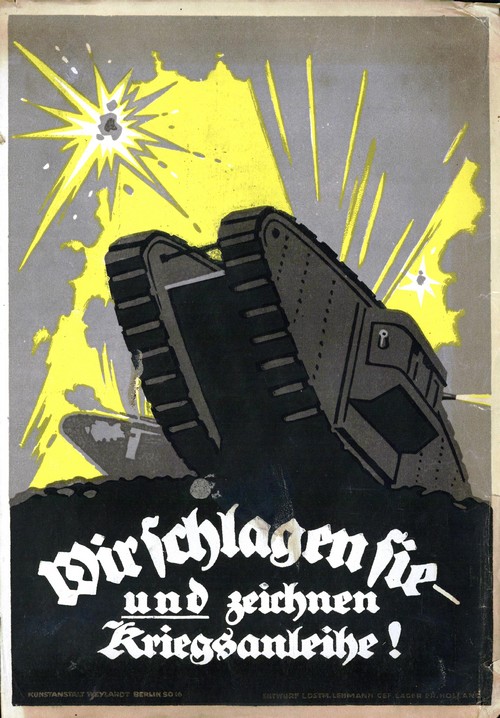
The German Empire issued war bonds nine different times, in order to fund the tremendous war expenses. Selling these bonds yielded almost 100 billion marks for the war treasury of the German army – some 85 percent of the overall cost.
Approximately every half year during the war, the German government launched a new campaign to raise money from the public. The last was in September 1918, just two months prior to the end of the fighting. The interest rate was set at 5% (more than in ordinary savings plans). It was possible to trade in war bonds, which in principle had a chance of high yield in the event of a German military victory.
However, history took its own course, and Germany was vanquished in 1918. This is how the terrible economic catastrophe occurred: the state was incapable of paying its debts. Moreover, it was forced to commit to paying enormous reparations to the Allied Powers through the Treaty of Versailles agreements. In addition, following the explosive hyperinflation from 1922 to the end of 1923, all of the bonds lost their value. The result was that the state was released of its obligation to its citizens, while the latter irreversibly lost their private capital, which they had invested to finance the German army. This development caused despair among the citizens of Germany, who had been educated to place their belief in the authorities. The authorities, however, had collapsed, leading to defeat in war, and ultimately, an unfathomably large-scale dissolution of private capital.
The placard displayed here was published apparently in 1918, but to date, we do not know with certainty if it was released together with the eighth or ninth (and last) issue. The central motif was the threat to Germany and its forces posed by a new type of weaponry: the British tank. The Mark I tank model entered into intensive use during the last year of the war, and confounded both the German High Command and the soldiers in the trenches. The placard presented here belongs to the collection of Arthur Czellitzer, a Berlin ophthalmologist who collected placards and political and propaganda fliers in Berlin for a period of ten years. Dr. Czellitzer deposited the collection in the Jerusalem library in 1936. Czellitzer met a bitter end: he was murdered in the Holocaust in 1943.